The Water and Carbon Cycles

Aligned to the AQA 8461 specification
- Topic
- Ecology
- Level
- Intermediate
- Reading time
- 9 min
- Published
- 16 June 2026
- Updated
- 16 August 2026
On this page
Key takeaways
- Materials are recycled, moving through the abiotic (non-living) and biotic (living) parts of an ecosystem to provide the building blocks for future organisms.
- Photosynthesis is the only process that takes carbon dioxide out of the atmosphere; respiration, combustion and decomposition all return it to the air.
- Decomposers are microorganisms, chiefly bacteria and fungi, that return carbon to the air as carbon dioxide and return mineral ions to the soil.
- In the water cycle the Sun's heat evaporates water (and plants transpire), the vapour condenses into clouds, and it falls as precipitation, supplying fresh water to land.
- Sea water is salty, so it only becomes fresh water once it has evaporated, leaving the salt behind, and fallen again as precipitation.
A Diagram of the Carbon Cycle
A clear way to picture the whole cycle is to put the atmosphere at the top, plants and animals in the middle, and the return arrows pointing back up to the air.
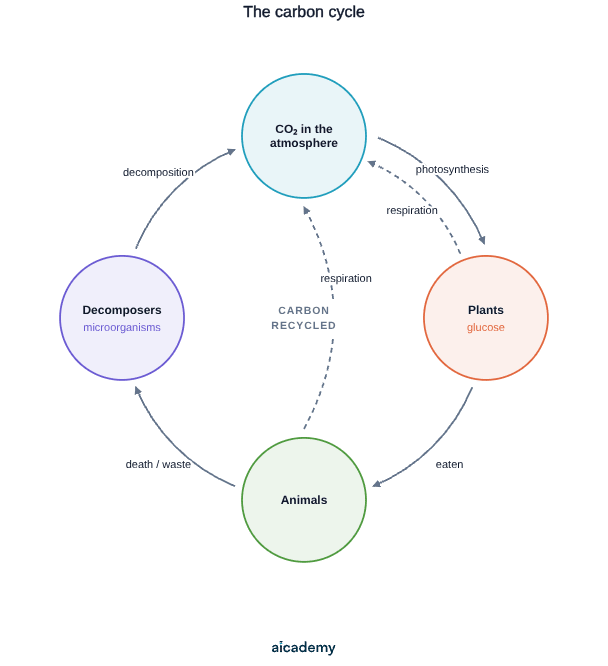
Reading the diagram: one arrow points down out of the atmosphere (photosynthesis), and every other arrow points up into it (respiration, combustion, decomposition). If you can label the four arrows correctly, you can answer almost any carbon-cycle question.
Studying this for an exam?
Generate a personalised learning path for this subject. Free to get started.
The Water Cycle
The water cycle supplies fresh water to plants and animals living on land, before that water drains back into the seas. Like carbon, water is not used up — the same water molecules move round and round between the sea, the air, the land and living things.
There are three key processes to name:
- Evaporation. Heat energy from the Sun turns liquid water — mainly from the surface of the seas — into water vapour, a gas. Plants also add water vapour to the air through transpiration (evaporation of water from leaves).
- Condensation. As the water vapour rises and cools, it condenses into tiny droplets, forming clouds.
- Precipitation. The droplets join, grow heavy, and fall as rain, snow or sleet — this is the fresh water that plants and animals on land depend on.
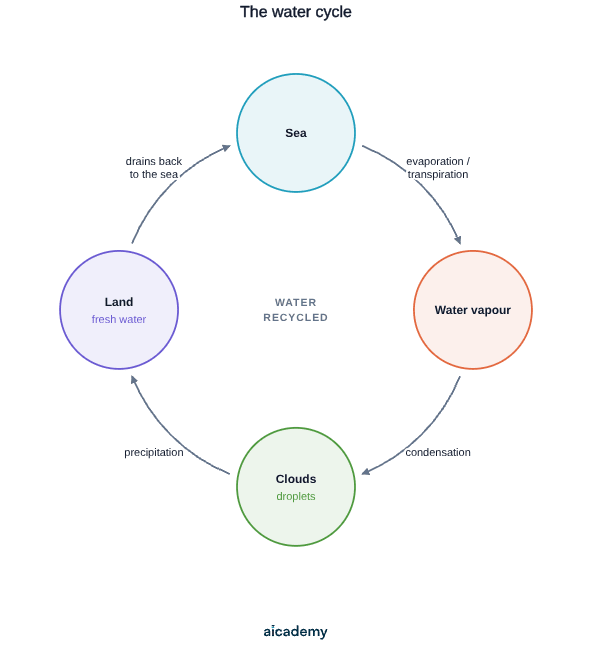
How the cycle provides fresh water — a walk-through. Sea water is salty, so it cannot be drunk or used by most land plants. When the Sun evaporates sea water, only the water turns to vapour — the salt is left behind in the sea. That vapour condenses into clouds and falls as precipitation over the land. Because the salt was left behind, the rain that falls is fresh (salt-free) water. Plants absorb it through their roots and animals drink it; the rest flows through rivers and drains back into the seas, where the whole cycle begins again.
Key terms
- Abiotic components
- The non-living parts of an ecosystem: the air, water, soil and minerals.
- Biotic components
- The living parts of an ecosystem: plants, animals, fungi and microorganisms.
- Photosynthesis
- The process in plants and algae that removes carbon dioxide from the air, locking the carbon into glucose.
- Decomposer
- A microorganism, chiefly bacteria and fungi, that feeds on dead organisms and waste, returning carbon to the air and mineral ions to the soil.
- Evaporation
- The process by which heat from the Sun turns liquid water into water vapour, a gas.
- Transpiration
- The evaporation of water from the leaves of plants, adding water vapour to the air.
- Condensation
- The process by which rising water vapour cools and turns into tiny droplets, forming clouds.
- Precipitation
- Water droplets joining, growing heavy and falling as rain, snow or sleet.
Frequently asked questions
Photosynthesis is the only process that takes carbon dioxide out of the atmosphere, carried out by plants and algae. Respiration, combustion and decomposition all return carbon dioxide to the air.
Decomposers are microorganisms, chiefly bacteria and fungi, that feed on dead organisms and waste. As they respire they return carbon to the air as carbon dioxide, and they also return mineral ions to the soil for plants to reuse.
When the Sun evaporates salty sea water, only the water turns to vapour and the salt is left behind. That vapour condenses into clouds and falls as precipitation over land, so the rain that falls is fresh, salt-free water.
Generate revision on any topic you study
Type any topic you're studying and Aicademy generates a complete lesson, quiz, and flashcard set, personalised to your level.
Lessons on anything
Structured, level-matched lessons on any topic you study
Practice quizzes
Find out what you actually know before the exam does
Flashcard sets
Lock in key concepts with instant revision cards
Ask Aica
Stuck on something? Get a clear explanation, any time
Sampling Techniques: Quadrats and Transects
Decomposition and the Rate of Decay
Related lessons
9 min
9 min
9 min