Biodiversity and Human Impact on Ecosystems

Aligned to the AQA 8461 specification
- Topic
- Ecology
- Level
- Intermediate
- Reading time
- 12 min
- Published
- 16 June 2026
- Updated
- 16 August 2026
On this page
- 1.What Biodiversity Means
- 2.Why High Biodiversity Stabilises Ecosystems
- 3.How Humans Reduce Biodiversity: Waste and Pollution
- 4.Worked Example: How Fertiliser Pollution Reduces Biodiversity
- 5.How Humans Reduce Biodiversity: Land Use
- 6.Peat Bogs: Land Use Meets Carbon Dioxide
- 7.Impact of Environmental Change on Species Distribution
- 8.Maintaining Biodiversity: Conservation Measures
- 9.Common Exam Mistakes
Key takeaways
- Biodiversity is the variety of all the different species of organisms on Earth or within an ecosystem; it measures variety, not the total number of individual organisms.
- High biodiversity ensures the stability of an ecosystem by reducing the dependence of one species on another for food, shelter and the maintenance of the physical environment.
- More people and a higher standard of living produce more waste; if poorly handled this causes water, air and land pollution, which kills plants and animals and reduces biodiversity.
- Destroying peat bogs both reduces biodiversity by destroying a habitat and releases carbon dioxide that adds to global warming; these are two separate points.
- Conservation measures include breeding programmes for endangered species, protecting and regenerating rare habitats, reintroducing field margins and hedgerows, reducing deforestation and CO2 emissions, and recycling instead of using landfill.
Worked Example: How Fertiliser Pollution Reduces Biodiversity
A common exam task is to explain, step by step, how a named pollutant reduces biodiversity. Fertiliser washing into a river is the classic case.
Walk-through — fertiliser → fewer species in a river:
- Farmers spread fertiliser on fields to supply nitrates and other nutrients to crops.
- Rain washes excess fertiliser off the land and into a nearby river (runoff).
- The extra nutrients cause algae and water plants to grow rapidly, forming a dense layer over the surface.
- This layer blocks light, so plants beneath it cannot photosynthesise and they die.
- Microorganisms (decomposers) feed on the dead plants and multiply. Their aerobic respiration uses up the dissolved oxygen in the water.
- With little dissolved oxygen left, fish and other aquatic animals cannot respire and they die.
- The river ends up with far fewer species than before — biodiversity has fallen.
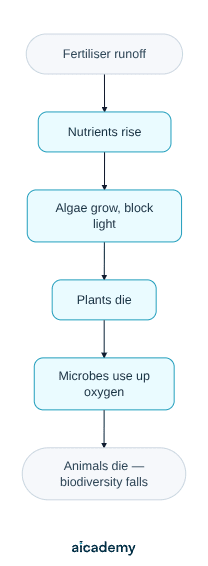
The same step-by-step logic applies to sewage in water: it feeds microorganisms, oxygen is used up, and aquatic life dies.
This process is often called eutrophication.
(Extra context — the term "eutrophication" is not required vocabulary by AQA 8461, but the oxygen-depletion sequence above is exactly what the spec expects you to explain.)
Studying this for an exam?
Generate a personalised learning path for this subject. Free to get started.
Key terms
- Biodiversity
- The variety of all the different species of organisms on Earth, or within an ecosystem.
- Species
- A group of organisms that can breed together to produce fertile offspring.
- Ecosystem
- The interaction of a community of living organisms with the non-living (abiotic) parts of their environment.
- Stability
- A state where the populations and physical environment of an ecosystem stay in balance over time.
- Pollution
- Harmful waste and chemicals in water, air or land that kill plants and animals and reduce biodiversity.
- Peat
- Partly decayed plant material that builds up over thousands of years in waterlogged, low-oxygen peat bogs and is sold as compost.
- Monoculture
- A single crop grown on farmland, which supports far fewer species than the varied habitat it replaced.
- Deforestation
- Clearing forests for timber, farmland or grazing, which destroys habitats and contributes to global warming.
Frequently asked questions
Biodiversity is the variety of all the different species of organisms on Earth, or within a single ecosystem. It is a measure of how many different species are present, not the total number of individual organisms, so a field of one crop has many organisms but low biodiversity.
High biodiversity reduces the dependence of one species on another for food, shelter and the maintenance of the physical environment. When many species are present, no single species is relied on completely, so if one food source declines, consumers have alternatives and populations do not crash.
Destroying peat bogs causes two problems. It reduces biodiversity by destroying the habitat of the plants, animals and microorganisms that live there, and it releases carbon dioxide into the atmosphere as the peat decays or is burned, contributing to global warming.
Generate revision on any topic you study
Type any topic you're studying and Aicademy generates a complete lesson, quiz, and flashcard set, personalised to your level.
Lessons on anything
Structured, level-matched lessons on any topic you study
Practice quizzes
Find out what you actually know before the exam does
Flashcard sets
Lock in key concepts with instant revision cards
Ask Aica
Stuck on something? Get a clear explanation, any time
The Water and Carbon Cycles
Deforestation and Global Warming
Related lessons
11 min
12 min
10 min