Track progress, take quizzes and save notes on this lesson.

Free forever · no card needed

Start free
Intermediate

Biodiversity and Human Impact on Ecosystems

4.7.2.4 Impact of environmental change (HT)·4.7.3.1 Biodiversity·4.7.3.2 Waste management·4.7.3.3 Land use·4.7.3.6 Maintaining biodiversity

Aligned to the AQA 8461 specification

Topic
Ecology
Level
Intermediate
Reading time
12 min
Published
16 June 2026
Updated
1 July 2026
On this page
  1. 1.What Biodiversity Means
  2. 2.Why High Biodiversity Stabilises Ecosystems
  3. 3.How Humans Reduce Biodiversity: Waste and Pollution
  4. 4.Worked Example: How Fertiliser Pollution Reduces Biodiversity
  5. 5.How Humans Reduce Biodiversity: Land Use
  6. 6.Peat Bogs: Land Use Meets Carbon Dioxide
  7. 7.Impact of Environmental Change on Species Distribution
  8. 8.Maintaining Biodiversity: Conservation Measures
  9. 9.Common Exam Mistakes

Key takeaways

  • Biodiversity is the variety of all the different species of organisms on Earth or within an ecosystem; it measures variety, not the total number of individual organisms.
  • High biodiversity ensures the stability of an ecosystem by reducing the dependence of one species on another for food, shelter and the maintenance of the physical environment.
  • More people and a higher standard of living produce more waste; if poorly handled this causes water, air and land pollution, which kills plants and animals and reduces biodiversity.
  • Destroying peat bogs both reduces biodiversity by destroying a habitat and releases carbon dioxide that adds to global warming; these are two separate points.
  • Conservation measures include breeding programmes for endangered species, protecting and regenerating rare habitats, reintroducing field margins and hedgerows, reducing deforestation and CO2 emissions, and recycling instead of using landfill.

What Biodiversity Means

Biodiversity is the variety of all the different species of organisms on Earth, or within a single ecosystem.

It is a measure of variety — how many different species are present — not just the total number of organisms. A field with 30 different plant, insect, bird and mammal species has higher biodiversity than a field of the same size carrying a single crop, even if the crop field holds more individual organisms overall.

Definition: Biodiversity is the variety of all the different species of organisms on Earth, or within an ecosystem.

A species is a group of organisms that can breed together to produce fertile offspring. An ecosystem is the interaction of a community of living organisms with the non-living (abiotic) parts of their environment.

High biodiversity matters because it ensures the stability of ecosystems. A stable ecosystem is one where the populations and physical environment stay in balance over time. The future of the human species relies on us maintaining a good level of biodiversity, yet many human activities are reducing it — and only recently have measures been taken to try to slow this reduction.

Why High Biodiversity Stabilises Ecosystems

A great biodiversity ensures the stability of an ecosystem by reducing the dependence of one species on another for food, shelter and the maintenance of the physical environment.

When many species are present, no single species is relied on completely. If one food source declines, consumers have alternatives, so populations do not crash. This makes the whole web of life more resistant to disturbance.

Walk-through — why a varied ecosystem is more stable:

  1. Imagine a meadow where a caterpillar species eats many different plants and is itself eaten by several predators (birds, beetles, shrews).
  2. A disease wipes out one of the plant species the caterpillar feeds on.
  3. Because the caterpillar can switch to other plants, its population does not collapse.
  4. Because predators eat several prey types, they are not left without food either.
  5. The result: the loss of one species causes only a small ripple, and the ecosystem stays in balance.

Now contrast a low-biodiversity system: a field of one crop fed on by one specialist pest, eaten by one predator. Remove any link and the whole chain fails. Low biodiversity makes an ecosystem fragile; high biodiversity makes it stable.

Exam phrasing: stability comes from reducing the dependence of one species on another for food, shelter and maintaining the physical environment. Use that wording.

How Humans Reduce Biodiversity: Waste and Pollution

Rapid growth in the human population and an increase in the standard of living mean that more resources are used and more waste is produced. Unless waste and chemical materials are properly handled, more pollution is caused. Pollution kills plants and animals, which reduces biodiversity.

Pollution acts in three places — water, air and land — each with its own causes:

Pollution typeCaused byEffect on biodiversity
WaterSewage, fertiliser, toxic chemicalsKills aquatic plants and animals; reduces species in rivers, lakes and seas
AirSmoke and acidic gasesDamages and kills plants and animals on land
LandLandfill and toxic chemicalsDestroys habitats and poisons soil organisms

Key chain to memorise: more people + higher standard of living → more waste → if poorly handled → pollution → pollution kills plants and animals → biodiversity falls.

The acidic gases and smoke that cause air pollution link to GCSE Chemistry (4.9.3.1, atmospheric pollutants from fuels). You do not need the chemistry detail here — only that burning fuels releases gases that pollute the air and harm living things.

Worked Example: How Fertiliser Pollution Reduces Biodiversity

A common exam task is to explain, step by step, how a named pollutant reduces biodiversity. Fertiliser washing into a river is the classic case.

Walk-through — fertiliser → fewer species in a river:

  1. Farmers spread fertiliser on fields to supply nitrates and other nutrients to crops.
  2. Rain washes excess fertiliser off the land and into a nearby river (runoff).
  3. The extra nutrients cause algae and water plants to grow rapidly, forming a dense layer over the surface.
  4. This layer blocks light, so plants beneath it cannot photosynthesise and they die.
  5. Microorganisms (decomposers) feed on the dead plants and multiply. Their aerobic respiration uses up the dissolved oxygen in the water.
  6. With little dissolved oxygen left, fish and other aquatic animals cannot respire and they die.
  7. The river ends up with far fewer species than before — biodiversity has fallen.
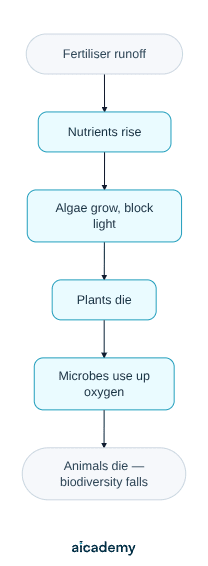
The same step-by-step logic applies to sewage in water: it feeds microorganisms, oxygen is used up, and aquatic life dies.

This process is often called eutrophication.

(Extra context — the term "eutrophication" is not required vocabulary by AQA 8461, but the oxygen-depletion sequence above is exactly what the spec expects you to explain.)

Studying this for an exam?

Generate a personalised learning path for this subject. Free to get started.

Create a learning path

How Humans Reduce Biodiversity: Land Use

Humans reduce the amount of land available for other animals and plants by building, quarrying, farming and dumping waste. Each of these takes over habitat that wild species once used.

Land useWhat it does to habitats
BuildingHouses, roads and factories cover land, removing habitats
QuarryingDigging out rock and minerals destroys the surface and the species living on it
FarmingClearing land for crops or livestock replaces varied habitats with one or two species
Dumping wasteLandfill sites bury and pollute large areas of land

Less habitat means fewer places for species to live, so biodiversity falls. Farming in particular tends to replace a varied natural community with a single crop (a monoculture), which supports far fewer species than the habitat it replaced.

Deforestation — clearing forests for timber, farmland or grazing — is a major form of land-use change. It destroys habitats directly and, by removing trees that absorb carbon dioxide, also contributes to global warming. Both effects reduce biodiversity.

Peat Bogs: Land Use Meets Carbon Dioxide

Peat is partly decayed plant material that builds up over thousands of years in waterlogged, low-oxygen ground called a peat bog or peatland. Peat is dug up and sold as garden compost.

Destroying peat bogs causes two distinct problems, and the exam expects both:

  1. Habitat loss. Draining and digging out peat reduces the area of this habitat, and so reduces the variety of plant, animal and microorganism species that live there — that is, it reduces biodiversity.
  2. Carbon dioxide release. Peat is a store of carbon locked away in the dead plant material. When peat is removed it decays or is burned, and this releases carbon dioxide into the atmosphere, contributing to global warming.

Two-mark trap: peat bog destruction (a) reduces biodiversity by destroying a habitat and (b) releases CO₂ that adds to global warming. State both — they score separately.

The conflict to evaluate: cheap, available compost helps growers produce more food, but conserving peat bogs protects biodiversity and keeps carbon locked away. There is genuine tension between the need for cheap compost to increase food production and the need to conserve peatlands as habitats and carbon stores.

One resolution gardeners are encouraged towards is peat-free compost made from other materials, which avoids destroying the bogs. Weighing the cheap-compost benefit against the biodiversity and CO₂ costs is exactly the kind of evaluate answer the spec asks for.

Impact of Environmental Change on Species Distribution

(Higher Tier only — section 4.7.2.4 is assessed only on the Higher Tier paper.)

Environmental changes affect the distribution of species — that is, where a species is found — within an ecosystem. The spec names three factors:

  • Temperature
  • Availability of water
  • Composition of atmospheric gases

These changes may be:

  • Seasonal — e.g. some birds migrate to warmer regions in winter as temperatures fall and food becomes scarce.
  • Geographic — e.g. a species' range shifts as conditions vary from place to place, such as moving to higher ground as lowland temperatures rise.
  • Caused by human interaction — e.g. burning fossil fuels changes atmospheric gas composition (more CO₂), and pollution or water extraction changes water availability.

Walk-through — interpreting a distribution question:

Suppose data show a bird species' breeding range has moved northwards over several decades while average regional temperature has risen.

  1. Identify the environmental change: rising temperature.
  2. Link it to the factor: temperature affects where the species can survive and find food.
  3. Explain the distribution change: as the south becomes too warm, suitable conditions are now found further north, so the range shifts north.
  4. Note possible causes: this could be a long-term, human-influenced warming trend rather than a single season.

HT skill: you are asked to evaluate the impact of environmental changes on the distribution of species given appropriate information — so read the data, link a named factor (temperature, water, atmospheric gases) to the change, and explain the shift. Do not just describe the graph.

Maintaining Biodiversity: Conservation Measures

Scientists and concerned citizens have put programmes in place to reduce the negative effects of humans on ecosystems and biodiversity. The spec lists five measures you must know, each with a clear effect:

MeasureHow it helps biodiversity
Breeding programmes for endangered speciesIncreases numbers of rare species so they are less likely to become extinct
Protection and regeneration of rare habitatsPreserves and restores places where many species live, keeping their communities intact
Reintroducing field margins and hedgerowsProvides habitats and food on farmland where only one crop is grown, supporting more species
Reducing deforestation and CO₂ emissions (by some governments)Protects forest habitats and slows global warming, both of which protect species
Recycling resources rather than dumping waste in landfillReduces land pollution and the area of habitat lost to landfill

Walk-through — evaluating a conservation measure (reintroducing hedgerows):

  1. The problem: intensive farms grow a single crop over large fields, removing the varied habitats wild species need — biodiversity is low.
  2. The measure: farmers replant hedgerows and leave uncultivated strips (field margins) at field edges.
  3. The benefit: hedgerows give nesting sites, shelter and food for birds, insects and small mammals, so more species can live on the farmland — biodiversity rises.
  4. The cost / conflict: the land used for hedges and margins is no longer growing crops, slightly reducing the area available for food production.
  5. The evaluation: the biodiversity gain is usually judged worthwhile, and margins can also bring benefits such as supporting pollinators and pest-eating predators; but there is a real trade-off with maximising crop yield.

Evaluate means weigh both sides and reach a justified judgement — not just list the benefits. The spec specifically asks you to explain and evaluate the conflicting pressures on maintaining biodiversity.

Common Exam Mistakes

1. Defining biodiversity as "the number of organisms"

Biodiversity is the variety of different species, not the total count of individuals. A huge field of one crop has many organisms but low biodiversity.

2. Forgetting why high biodiversity gives stability

The mark is for stating that variety reduces the dependence of one species on another for food, shelter and the maintenance of the physical environment. "It's just better" scores nothing.

3. Giving only one effect of peat bog destruction

Peat destruction both reduces biodiversity (habitat loss) and releases carbon dioxide (the peat decays or is burned). Two separate points — state both.

4. Saying fertiliser "poisons" the fish directly

In the fertiliser/sewage sequence, fish die because microorganisms use up the dissolved oxygen as they decompose the extra plant growth — the fish suffocate. The fertiliser itself is not a direct poison here. Follow the oxygen-depletion chain.

5. Treating 4.7.2.4 as Foundation content

The impact of environmental change on species distribution (temperature, water, atmospheric gases) is Higher Tier only. Foundation students are not assessed on it.

6. Describing data instead of evaluating it

When asked to evaluate a conservation measure or a distribution change, link a named factor to the change and weigh the pros and cons to reach a judgement — do not simply read numbers off the graph.

Key terms

Biodiversity
The variety of all the different species of organisms on Earth, or within an ecosystem.
Species
A group of organisms that can breed together to produce fertile offspring.
Ecosystem
The interaction of a community of living organisms with the non-living (abiotic) parts of their environment.
Stability
A state where the populations and physical environment of an ecosystem stay in balance over time.
Pollution
Harmful waste and chemicals in water, air or land that kill plants and animals and reduce biodiversity.
Peat
Partly decayed plant material that builds up over thousands of years in waterlogged, low-oxygen peat bogs and is sold as compost.
Monoculture
A single crop grown on farmland, which supports far fewer species than the varied habitat it replaced.
Deforestation
Clearing forests for timber, farmland or grazing, which destroys habitats and contributes to global warming.

Frequently asked questions

Biodiversity is the variety of all the different species of organisms on Earth, or within a single ecosystem. It is a measure of how many different species are present, not the total number of individual organisms, so a field of one crop has many organisms but low biodiversity.

High biodiversity reduces the dependence of one species on another for food, shelter and the maintenance of the physical environment. When many species are present, no single species is relied on completely, so if one food source declines, consumers have alternatives and populations do not crash.

Destroying peat bogs causes two problems. It reduces biodiversity by destroying the habitat of the plants, animals and microorganisms that live there, and it releases carbon dioxide into the atmosphere as the peat decays or is burned, contributing to global warming.

Generate revision on any topic you study

Type any topic you're studying and Aicademy generates a complete lesson, quiz, and flashcard set, personalised to your level.

Lessons on anything

Structured, level-matched lessons on any topic you study

Practice quizzes

Find out what you actually know before the exam does

Flashcard sets

Lock in key concepts with instant revision cards

Ask Aica

Stuck on something? Get a clear explanation, any time

Prev

Decomposition and the Rate of Decay

Next

Deforestation and Global Warming

Related lessons

Top students don’t revise more. They revise what counts.

Start revising free

Free to start. No card needed.