Track progress, take quizzes and save notes on this lesson.

Free forever · no card needed

Start free
Intermediate

Deforestation and Global Warming

4.7.3.4 Deforestation·4.7.3.5 Global warming

Aligned to the AQA 8461 specification

Topic
Ecology
Level
Intermediate
Reading time
10 min
Published
16 June 2026
Updated
1 July 2026
On this page
  1. 1.Why Tropical Forests Are Being Cleared
  2. 2.How Deforestation Raises Atmospheric Carbon Dioxide
  3. 3.Worked Walk-Through: Explaining a CO₂ Rise
  4. 4.Deforestation and Biodiversity
  5. 5.Greenhouse Gases and Global Warming
  6. 6.Biological Consequences of Global Warming
  7. 7.Evaluating the Evidence for Human-Caused Warming
  8. 8.Common Exam Mistakes

Key takeaways

  • Deforestation is the large-scale removal of trees, happening on a huge scale in tropical areas to provide land for agriculture (cattle and rice) and to grow crops for biofuels.
  • Deforestation raises atmospheric carbon dioxide in two ways at once: it increases release (burning trees and decomposers respiring) and reduces removal (fewer trees photosynthesising).
  • Deforestation destroys habitats so species lose food and shelter, reducing biodiversity, which is the variety of species rather than just the number of organisms.
  • The greenhouse gases named by the spec, carbon dioxide and methane, are increasing; they absorb and trap heat radiated from Earth, raising the average global temperature, which is global warming.
  • Biological consequences of global warming include loss of habitat from rising sea levels, changes in species distribution, and changes in migration patterns.

Why Tropical Forests Are Being Cleared

Deforestation is the large-scale removal of trees, usually to use the land for something else. It has happened on a huge scale in tropical areas — the warm, wet regions near the equator, such as the Amazon and parts of Southeast Asia.

Humans clear tropical forest for several reasons. AQA 8461 names clearing land for agriculture (cattle and rice fields) and for biofuel crops; selling timber is a further common driver:

Reason for deforestationWhat the land is used for
To provide land for agricultureGrazing cattle and growing rice in fields
To grow crops for biofuelsCrops such as oil palm, burned or processed for fuel
To harvest timber (extra context — not named in AQA 8461)Selling wood for building and paper

The land underneath tropical rainforest is valuable for farming and fuel crops, and the trees themselves can be sold. These economic pressures drive the clearing.

Key term — biofuel: a fuel made from recently grown plant or animal material, rather than from fossil fuels. Crops grown for biofuels still take up land that was once forest.

The two big environmental problems this causes are more carbon dioxide in the atmosphere and reduced biodiversity — the next slides work through each.

How Deforestation Raises Atmospheric Carbon Dioxide

This is the most commonly examined idea, and it has two separate mechanisms. To get full marks you must describe both — many students only give one.

Mechanism 1 — deforestation releases more CO₂ into the air.

  • When forest is cleared, the trees are often burned. Combustion of the wood releases the carbon stored in it as carbon dioxide.
  • Trees and other plant material that are not burned are broken down by decomposers (microorganisms). As these decomposers respire, they also release carbon dioxide.

Mechanism 2 — deforestation removes less CO₂ from the air.

  • Living trees carry out photosynthesis, which absorbs carbon dioxide from the atmosphere.
  • With fewer trees, less photosynthesis happens, so less carbon dioxide is taken out of the air.

The net effect is a rise in atmospheric CO₂ from both ends at once:

Before deforestationAfter deforestation
CO₂ releasedNormal (respiration)High (burning + decomposers)
CO₂ removedHigh (many trees photosynthesising)Low (few trees photosynthesising)
Net atmosphereRoughly balancedCO₂ rises

Exam rule: a top answer states that deforestation increases the release of CO₂ and reduces its removal. Giving only one mechanism is the single most common reason answers lose marks here.

Worked Walk-Through: Explaining a CO₂ Rise

Exam questions often give a scenario and ask you to explain the effect on carbon dioxide. Here is how to build a full-mark answer step by step.

Question: "A large area of rainforest is cut down and burned to make a cattle farm. Explain how this affects the level of carbon dioxide in the atmosphere."

Step 1 — name the released-CO₂ mechanism. Burning the felled trees is combustion, which releases the carbon stored in the wood as carbon dioxide.

Step 2 — add the decomposer point. Any remaining dead plant material is broken down by decomposing microorganisms; their respiration releases more carbon dioxide.

Step 3 — name the reduced-removal mechanism. The trees that have been removed can no longer photosynthesise, so less carbon dioxide is absorbed from the atmosphere.

Step 4 — state the net result. Both effects push the same way, so the level of carbon dioxide in the atmosphere increases.

A model answer reads: "Burning the trees releases carbon dioxide, and decomposers respiring on dead material release more. At the same time, fewer trees means less photosynthesis, so less carbon dioxide is removed. Overall, atmospheric carbon dioxide increases."

Notice the structure: two release routes + one reduced-removal route + a net conclusion. Reuse this skeleton for any deforestation CO₂ question.

Deforestation and Biodiversity

Biodiversity is the variety of all the different species of organisms in an ecosystem. Tropical rainforests hold an enormous share of the planet's species, so clearing them does serious damage.

When forest is removed:

  • Habitats are destroyed. Species that can only live in the forest lose the conditions, food and shelter they depend on.
  • Populations shrink, and some species may become extinct locally or entirely.
  • The number of different species in the area falls, so biodiversity is reduced.
CauseDirect effectConsequence
Trees burned / felledCarbon released; carbon store lostAtmospheric CO₂ rises
Fewer trees remainLess photosynthesisLess CO₂ removed from air
Forest habitat removedSpecies lose food and shelterBiodiversity reduced

Lower biodiversity matters because it makes ecosystems less stable: a community with many interdependent species copes better with change than one with only a few.

Watch the word "biodiversity": it means the range of species, not just the number of organisms. Cutting forest reduces the variety of species, not simply the total count of living things.

Studying this for an exam?

Generate a personalised learning path for this subject. Free to get started.

Create a learning path

Greenhouse Gases and Global Warming

Carbon dioxide is one of several greenhouse gases. For AQA Biology the two you must name are carbon dioxide (CO₂) and methane (CH₄), and the specification states that their levels in the atmosphere are increasing.

Methane is added to the atmosphere by, for example, cattle (livestock farming) and decay in waterlogged conditions such as rice fields — the same agricultural changes that drive deforestation also raise methane.

How the greenhouse effect works:

  • The Sun's energy reaches the Earth and warms the surface.
  • The warmed Earth radiates energy back out as heat.
  • Greenhouse gases in the atmosphere absorb and trap some of this heat instead of letting it escape into space.
  • More greenhouse gas means more heat trapped, so the average global temperature rises. This rise is global warming.
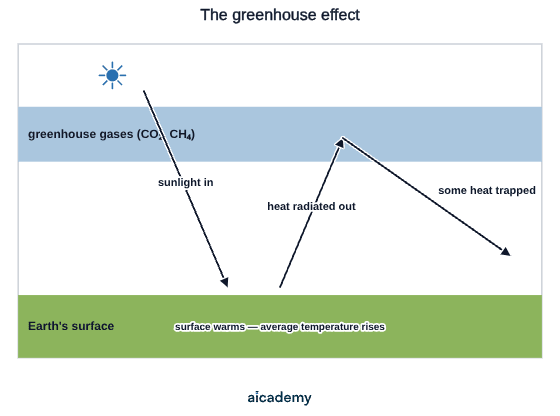
Don't confuse two things: the greenhouse effect is the natural trapping of heat that keeps Earth warm enough for life. Global warming is the extra warming caused by rising levels of greenhouse gases.

(Extra context — not required by AQA 8461.) Atmospheric CO₂ passed about 420 parts per million by the mid-2020s, up from roughly 280 ppm before industrialisation. You do not need figures for the exam; the spec only requires that you know the levels are increasing.

Biological Consequences of Global Warming

The specification asks you to describe biological consequences of global warming. Each consequence has a mechanism — knowing why it happens earns the marks.

ConsequenceMechanism (why it happens)
Loss of habitatRising temperatures melt ice, so sea levels rise and flood low-lying land, destroying the habitats there
Changes in species distributionAs temperature or rainfall changes in a region, species move to areas that now suit them and disappear from areas that no longer do
Changes in migration patternsSome animals migrate in response to temperature or seasonal cues; as these shift, the timing or route of migration changes

Worked walk-through — explaining one consequence:

Question: "Explain how global warming can cause a loss of habitat."

  • Step 1: Global warming raises average global temperatures.
  • Step 2: Higher temperatures melt ice and cause sea water to expand, so sea levels rise.
  • Step 3: Rising seas flood low-lying coastal areas.
  • Step 4: The organisms living there lose their habitat — a biological consequence of global warming.

A "consequence" answer is only complete when it links warming → physical change → biological effect. Stating "habitats are lost" with no mechanism rarely gets full marks.

Evaluating the Evidence for Human-Caused Warming

The specification asks you to evaluate the evidence linking human activity to rising greenhouse gases, and to understand why scientists handle this evidence carefully.

Why the data is treated as strong:

  • The scientific consensus is based on systematic reviews of thousands of peer-reviewed publications, not on one study.
  • Peer review means other independent scientists check a study's methods and conclusions before it is published, which filters out flawed work.
  • Evidence that is valid (it measures what it claims to) and reproducible (other scientists get the same result when they repeat it) is trusted far more than a one-off finding.

Why some uncertainty remains:

  • Climate is a complex system with many interacting factors, so it is hard to be certain about the size of every future effect.
  • Early or unrepeated data, and data reported in the media without peer review, may be unreliable.

Evaluate means weigh both sides. State that the overwhelming peer-reviewed evidence links human activity to rising CO₂ and methane, then note where uncertainty remains — rather than treating the question as a simple yes/no.

This is why you should be cautious about a single dramatic statistic or a claim that has not been peer reviewed: good science depends on evidence that other researchers can check and reproduce.

Common Exam Mistakes

1. Giving only one CO₂ mechanism

Deforestation raises atmospheric CO₂ in two ways: it increases release (burning and decomposers) and reduces removal (less photosynthesis). An answer with only one of these is incomplete.

2. Saying trees "make oxygen" instead of removing CO₂

The carbon point that scores marks is that trees absorb carbon dioxide during photosynthesis. Fewer trees means less CO₂ removed. Oxygen production is not the focus of this topic.

3. Forgetting methane

The greenhouse gases named by the spec are carbon dioxide and methane. Many students name only CO₂. Methane levels are rising too and also contribute to global warming.

4. Confusing the greenhouse effect with global warming

The greenhouse effect is the natural trapping of heat. Global warming is the extra warming from rising greenhouse gas levels. They are not synonyms.

5. Describing a consequence with no mechanism

"Habitats are lost" or "animals migrate differently" alone is weak. Link it: warming → sea-level rise / changed temperature or rainfall → the biological effect.

6. Treating biodiversity as the number of organisms

Biodiversity is the variety of species. Deforestation reduces the range of species present, not just the headcount of living things.

Key terms

Deforestation
The large-scale removal of trees, usually to use the land for agriculture or biofuel crops.
Biofuel
A fuel made from recently grown plant or animal material, rather than from fossil fuels.
Biodiversity
The variety of all the different species of organisms in an ecosystem, not just the number of organisms.
Greenhouse gas
A gas, such as carbon dioxide or methane, that absorbs and traps heat radiated from Earth's surface.
Greenhouse effect
The natural trapping of heat by greenhouse gases that keeps Earth warm enough for life.
Global warming
The extra warming of Earth's average temperature caused by rising levels of greenhouse gases.
Peer review
The process by which other independent scientists check a study's methods and conclusions before it is published, filtering out flawed work.

Frequently asked questions

It works in two ways. Burning felled trees releases carbon dioxide, and decomposers respiring on dead plant material release more. At the same time, fewer trees means less photosynthesis, so less carbon dioxide is removed from the air. Overall, atmospheric carbon dioxide rises.

The greenhouse effect is the natural trapping of heat by greenhouse gases that keeps Earth warm enough for life. Global warming is the extra warming caused by rising levels of greenhouse gases such as carbon dioxide and methane.

They include loss of habitat, for example when melting ice raises sea levels and floods low-lying land, changes in the distribution of species as temperature or rainfall changes, and changes in the timing or routes of animal migration patterns.

Generate revision on any topic you study

Type any topic you're studying and Aicademy generates a complete lesson, quiz, and flashcard set, personalised to your level.

Lessons on anything

Structured, level-matched lessons on any topic you study

Practice quizzes

Find out what you actually know before the exam does

Flashcard sets

Lock in key concepts with instant revision cards

Ask Aica

Stuck on something? Get a clear explanation, any time

Prev

Biodiversity and Human Impact on Ecosystems

Next

Trophic Levels and Biomass Transfer

Related lessons

9 min

Lesson

The Water and Carbon Cycles

AQA GCSE Biology · AQA 8461

1 month ago

Top students don’t revise more. They revise what counts.

Start revising free

Free to start. No card needed.