Track progress, take quizzes and save notes on this lesson.

Free forever · no card needed

Start free
Intermediate

The Digestive System and Food Tests

4.2.2.1 The human digestive system (Required practical 4)

Aligned to the AQA 8461 specification

Level
Intermediate
Reading time
9 min
Published
16 June 2026
Updated
1 July 2026
On this page
  1. 1.The Digestive System as an Organ System
  2. 2.How Each Organ Handles Food
  3. 3.Digestive Enzymes: Where They Are Made and What They Do
  4. 4.The Role of Bile
  5. 5.Required Practical 4: Testing Foods for Nutrients
  6. 6.Worked Walk-Throughs: Predicting Results and Tracing Digestion
  7. 7.Common Exam Mistakes

Key takeaways

  • The digestive system is an organ system in which organs work together to break large insoluble food molecules into small soluble ones that can be absorbed into the blood.
  • Amylase breaks starch into sugars, protease breaks protein into amino acids, and lipase breaks lipids into fatty acids and glycerol; each is made in specific organs such as the pancreas and small intestine.
  • Bile is not an enzyme; made in the liver and stored in the gall bladder, it neutralises stomach acid to give the optimum pH and emulsifies fats to increase the surface area for lipase.
  • Food tests: iodine turns blue-black with starch, Benedict's turns brick-red with reducing sugar on heating, Biuret turns purple with protein, and the ethanol emulsion test turns cloudy white with lipid.
  • Products of digestion are absorbed in the small intestine, while the large intestine absorbs water from the remaining material.

The Digestive System as an Organ System

The digestive system is an organ system: a group of organs working together to break food down and absorb the useful molecules into the blood.

The food you eat is made of large insoluble molecules — starch, proteins and lipids — that are too big to pass through the wall of the gut into your bloodstream. Digestion breaks these into small soluble molecules that can be absorbed.

Food travels along the alimentary canal (the gut) in a fixed order. Each part has a job:
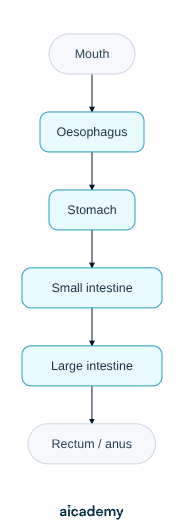
Three organs sit alongside the canal and release substances into it rather than passing food through:

  • Salivary glands — release amylase into the mouth.
  • Pancreas — releases amylase, protease and lipase into the small intestine.
  • Liver — makes bile (stored in the gall bladder), which flows into the small intestine.

The digestive system is the spec's named example of an organ system: several organs cooperating to carry out one function — digesting and absorbing food.

How Each Organ Handles Food

Trace what happens to a meal as it moves along the gut. Each region adds something or absorbs something.

OrganWhat happens there
MouthTeeth chew food (mechanical breakdown); salivary glands release amylase to start digesting starch
OesophagusMuscular tube; squeezes the food ball down to the stomach
StomachMuscular bag; churns food and releases protease (pepsin) and hydrochloric acid (acidic conditions, about pH 2)
Small intestineReceives enzymes from the pancreas and its own wall, plus bile from the liver; digestion is completed and products are absorbed into the blood
Large intestineWater is absorbed from the remaining material, forming faeces
Rectum/anusStores and removes faeces (egestion)

The hydrochloric acid in the stomach gives the optimum pH for stomach protease and helps kill bacteria in food.

Enzymes are biological catalysts that break large molecules into small soluble ones; their detailed action (active site, pH and temperature effects) is covered in the separate enzymes lesson.

Digestive Enzymes: Where They Are Made and What They Do

Three groups of digestive enzymes break down the three food groups. Each is made in specific organs and produces specific small molecules.

EnzymeWhere producedSubstrate (breaks down)Products
Amylase (a carbohydrase)Salivary glands, pancreasStarchSimple sugars (e.g. maltose, glucose)
ProteaseStomach, pancreas, small intestineProteinsAmino acids
LipasePancreas, small intestineLipids (fats and oils)Fatty acids and glycerol

As word equations (no symbol equations are needed for this spec):

  • starch → simple sugars (glucose)
  • protein → amino acids
  • lipid → fatty acids + glycerol

Learn enzyme, site of production and products together as a set. A common exam question gives you one and asks for the other two.

The body reuses the products: amino acids build new proteins, fatty acids and glycerol build new lipids, and glucose is used in respiration to release energy or stored as glycogen.

The Role of Bile

Bile is not an enzyme — it does not break chemical bonds. It is a greenish alkaline fluid that supports lipid digestion in two ways.

  • Made in the liver, stored in the gall bladder, released into the small intestine.
  • Neutralises stomach acid: food leaving the stomach is acidic. Bile is alkaline, so it raises the pH to give the optimum pH for the enzymes in the small intestine (which work best in slightly alkaline conditions, unlike stomach protease).
  • Emulsifies lipids: it breaks large fat droplets into many tiny droplets. This increases the surface area of the fat exposed to lipase.

Together, the alkaline pH and the larger surface area increase the rate of fat breakdown by lipase.

Bile emulsifies fat — it does not digest it. Lipase does the chemical digestion; bile just speeds it up by increasing surface area and providing the right pH.

A bigger surface area means more lipid is in contact with lipase at any moment, so more fatty acids and glycerol are produced per second.

Worth saving these ideas?

Turn what you've read into instant revision cards. Free to get started.

Make flashcards

Required Practical 4: Testing Foods for Nutrients

Required practical 4 uses qualitative reagents to test a food sample for sugars, starch, protein and lipids. "Qualitative" means the result is a colour change (present or not), not a measured amount.

Prepare the food first: grind the sample, mix with distilled water, and filter to get a clear solution to test.

NutrientReagentMethodPositive result (colour change)
Reducing sugarBenedict's solutionAdd to sample, heat in a water bath (~75 °C) for a few minutesBlue → green → yellow → orange → brick-red
StarchIodine solutionAdd a few drops at room temperatureOrange-brown → blue-black
ProteinBiuret reagentAdd to sample, no heating neededBlue → purple/lilac
LipidEthanol (emulsion test)Mix sample with ethanol, then add to waterClear → cloudy white emulsion

Safety and method points to remember:

  • Benedict's test needs heat — use a water bath, not a naked flame, because ethanol and some samples are flammable. Wear eye protection.
  • A negative Benedict's result stays blue; a negative iodine result stays orange-brown; a negative Biuret result stays blue.
  • The deeper the Benedict's colour (yellow → orange → brick-red), the more reducing sugar is present, so it gives a rough indication of concentration.

The lipid emulsion test in AQA 8461 uses ethanol then water, giving a cloudy white emulsion if lipid is present. There is no Sudan III test required for this spec.

Worked Walk-Throughs: Predicting Results and Tracing Digestion

Walk-through 1 — predict the colour for a slice of white bread.

White bread is rich in starch and contains some protein (gluten), with little free sugar and little fat. Predict and justify each test:

  • Iodine: turns blue-black — bread is high in starch (positive).
  • Benedict's: stays blue, or only turns slightly green — little free reducing sugar (negative or weakly positive).
  • Biuret: turns purple/lilac — bread contains protein (positive).
  • Emulsion test: stays mostly clear — little lipid (negative).

If you first chew the bread and leave it before testing, salivary amylase begins breaking starch into sugars — so iodine goes weaker and Benedict's gets stronger. That single observation demonstrates enzyme action.

Walk-through 2 — trace a starch molecule from plate to bloodstream.

  1. Mouth: salivary amylase starts breaking starch into smaller sugars.
  2. Stomach: little starch digestion here — the acidic pH stops amylase working; food is churned and proteins start being digested.
  3. Small intestine: pancreatic amylase completes the breakdown of starch into glucose; bile has neutralised the acid to give the optimum pH.
  4. Small intestine wall: glucose is small and soluble, so it is absorbed into the blood and carried to cells.
  5. Cells: glucose is used in respiration to release energy, or stored as glycogen.

Absorption of the products of digestion happens in the small intestine; the large intestine absorbs water, not nutrients. Mixing these up is a frequent error.

Common Exam Mistakes

1. Saying bile digests or breaks down fat

Bile emulsifies fat into small droplets and neutralises acid. Lipase carries out the chemical digestion. State both roles of bile (emulsification and neutralising acid) and link them to increasing the rate of lipase action.

2. Confusing where products versus water are absorbed

The small intestine absorbs the small soluble products of digestion (glucose, amino acids, fatty acids, glycerol). The large intestine absorbs water. Name the correct organ for each.

3. Getting the food-test colour changes the wrong way round

Iodine starts orange-brown and goes blue-black with starch. Biuret goes purple/lilac with protein. Benedict's goes blue to brick-red with reducing sugar on heating. State the starting colour and the positive colour, and remember Benedict's needs heating.

4. Forgetting that lipase produces two products

Lipids break down into fatty acids and glycerol — name both. Proteins give amino acids; starch gives simple sugars (glucose).

5. Calling bile an enzyme

Bile contains no enzyme and breaks no chemical bonds. Describe it as an alkaline fluid that emulsifies lipids and neutralises stomach acid.

6. Naming the wrong enzyme source

Amylase is made in the salivary glands and pancreas; protease in the stomach, pancreas and small intestine; lipase in the pancreas and small intestine. Match each enzyme to its production sites rather than guessing a single organ.

Key terms

Organ system
A group of organs working together to carry out one function, such as the digestive system breaking down and absorbing food.
Digestion
The breakdown of large insoluble food molecules into small soluble molecules that can be absorbed into the blood.
Amylase
A carbohydrase enzyme, made in the salivary glands and pancreas, that breaks down starch into simple sugars.
Protease
An enzyme, made in the stomach, pancreas and small intestine, that breaks down proteins into amino acids.
Lipase
An enzyme, made in the pancreas and small intestine, that breaks down lipids into fatty acids and glycerol.
Bile
An alkaline fluid made in the liver and stored in the gall bladder that neutralises stomach acid and emulsifies fats.
Emulsify
To break large fat droplets into many tiny droplets, increasing the surface area exposed to lipase.
Qualitative test
A food test whose result is a colour change showing whether a nutrient is present, not a measured amount.

Frequently asked questions

Bile is an alkaline fluid made in the liver and stored in the gall bladder. It neutralises stomach acid to give the optimum pH for small-intestine enzymes, and it emulsifies fats into tiny droplets to increase the surface area for lipase. Bile is not an enzyme and does not digest fat itself.

Iodine goes orange-brown to blue-black with starch. Benedict's goes blue to brick-red with reducing sugar when heated. Biuret goes blue to purple/lilac with protein. The ethanol emulsion test goes clear to cloudy white with lipid.

The small soluble products of digestion, such as glucose, amino acids, fatty acids and glycerol, are absorbed into the blood in the small intestine. The large intestine absorbs water from the remaining material, forming faeces.

Generate revision on any topic you study

Type any topic you're studying and Aicademy generates a complete lesson, quiz, and flashcard set, personalised to your level.

Lessons on anything

Structured, level-matched lessons on any topic you study

Practice quizzes

Find out what you actually know before the exam does

Flashcard sets

Lock in key concepts with instant revision cards

Ask Aica

Stuck on something? Get a clear explanation, any time

Prev

Enzymes and the Lock-and-Key Model

Next

The Heart and Blood Vessels

Related lessons

Top students don’t revise more. They revise what counts.

Start revising free

Free to start. No card needed.