Track progress, take quizzes and save notes on this lesson.

Free forever · no card needed

Start free
Intermediate

Cell Structure: Eukaryotes and Prokaryotes

4.1.1.1 Eukaryotes and prokaryotes·4.1.1.2 Animal and plant cells·4.1.1.3 Cell specialisation·4.1.1.4 Cell differentiation

Aligned to the AQA 8461 specification

Level
Intermediate
Reading time
8 min
Published
16 June 2026
Updated
1 July 2026
On this page
  1. 1.Eukaryotic and Prokaryotic Cells
  2. 2.Inside an Animal Cell
  3. 3.What Plant Cells Add
  4. 4.The Bacterial Cell
  5. 5.Identifying a Cell From Its Features
  6. 6.Specialised Cells: Structure Fits Function
  7. 7.Common Exam Mistakes

Key takeaways

  • A eukaryotic cell keeps its genetic material (DNA) inside a nucleus, while a prokaryotic cell has no nucleus and its DNA floats freely in the cytoplasm; plant and animal cells are eukaryotic and bacteria are prokaryotic.
  • Animal cells contain a nucleus, cytoplasm, cell membrane, mitochondria and ribosomes; plant cells have all of these plus chloroplasts, a permanent vacuole and a cellulose cell wall.
  • A bacterial cell has cytoplasm, a cell membrane and a cell wall, but its DNA is a single loop in the cytoplasm and it may also carry plasmids, small extra rings of DNA.
  • Chloroplasts appear only in plant cells that receive light, so root cells, which are underground, have none.
  • As an organism develops, its cells differentiate to become specialised, gaining the structures and shape needed for one job, such as a sperm cell with a tail and many mitochondria.

Eukaryotic and Prokaryotic Cells

Every living thing is built from cells, and those cells fall into two groups defined by one feature: where the genetic material sits.

A eukaryotic cell keeps its genetic material (DNA) inside a nucleus — a membrane-bound compartment. Plant cells and animal cells are eukaryotic. A prokaryotic cell has no nucleus; its DNA floats freely in the cytoplasm. Bacteria are prokaryotic.

Eukaryote = genetic material enclosed in a nucleus. Prokaryote = genetic material not enclosed in a nucleus.

Size separates them too. Prokaryotic cells are much smaller than eukaryotic cells.

Cell typeExampleNucleus?Typical size
EukaryoticPlant, animalYes (DNA enclosed)About 10–100 µm
ProkaryoticBacteriumNo (DNA free)About 1–10 µm

The unit µm is a micrometre: one millionth of a metre (). A bacterium is roughly a tenth the length of an animal cell, so it can be hundreds of times smaller by volume. Remembering "pro = no [nucleus]" fixes the core distinction the exam tests first.

Inside an Animal Cell

An animal cell is the baseline eukaryotic cell — learn its parts first, then add to them for plant and bacterial cells.

Each structure does a specific job. The nucleus controls the cell's activities and stores the DNA. The cytoplasm is the jelly-like fluid where most chemical reactions happen. The cell membrane is the thin outer boundary that controls what enters and leaves. Mitochondria (singular: mitochondrion) release energy through aerobic respiration — the oxygen-using reaction that powers the cell. Ribosomes are the tiny sites where proteins are made.

StructureFunction
NucleusControls the cell and holds the genetic material (DNA)
CytoplasmSite of most chemical reactions; jelly-like fluid
Cell membraneControls movement of substances in and out of the cell
MitochondriaRelease energy by aerobic respiration
RibosomesSite of protein synthesis (making proteins)

A cell that uses a lot of energy — like a muscle cell — has many mitochondria. Structure follows demand.

These five parts are present in most animal cells. Plant cells have all of them too, plus extras covered next.

What Plant Cells Add

A plant cell contains everything an animal cell has, then adds three structures linked to making food and providing support.

Chloroplasts are where photosynthesis happens — the reaction that uses light energy to make glucose. They contain the green pigment chlorophyll, which absorbs the light. A permanent vacuole is a large fluid-filled sac containing cell sap; when full it pushes outward and keeps the cell firm. The cell wall, made of cellulose (a tough carbohydrate), surrounds the membrane and strengthens the cell so it holds its shape.

Structure (plant only)Function
ChloroplastsSite of photosynthesis; contain chlorophyll to absorb light
Permanent vacuoleHolds cell sap; keeps the cell firm and supported
Cell wall (cellulose)Strengthens the cell and maintains its shape

Only cells exposed to light contain chloroplasts. Root cells are underground and dark, so they have none — a point examiners use to catch students who assume every plant cell is green.

So the cell wall and vacuole appear in all plant cells, but chloroplasts appear only where photosynthesis can occur.

The Bacterial Cell

A bacterium is prokaryotic, so its layout differs in ways the exam asks you to state precisely.

It has cytoplasm and a cell membrane, like other cells, and a cell wall surrounding the membrane. But its genetic material is not in a nucleus. Instead the DNA is a single loop floating in the cytoplasm. Many bacteria also carry plasmids — small extra rings of DNA, one or more per cell, separate from the main loop. Bacterial cells have no chloroplasts and no permanent vacuole.
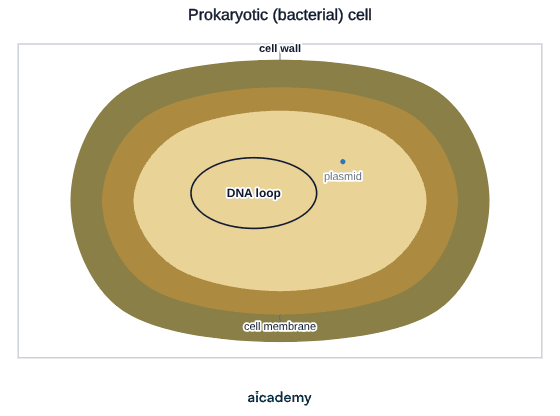
The bacterial cell wall is not made of cellulose — that is a plant feature. Stating "cellulose cell wall" for a bacterium loses the mark.

The single DNA loop and the plasmids are the two features that most reliably identify a cell as prokaryotic.

Studying this for an exam?

Generate a personalised learning path for this subject. Free to get started.

Create a learning path

Identifying a Cell From Its Features

When an exam gives you a list of structures, you decide whether the cell is animal, plant or bacterial by working through the distinguishing features in order.

Ask three questions:

  1. Is the DNA in a nucleus? No → it is a bacterium (prokaryotic). Stop.
  2. If yes, does it have a cellulose cell wall, vacuole or chloroplasts? Yes → plant.
  3. If it has a nucleus but none of those plant extras → animal.

Walk-through 1. A cell has: cytoplasm, a cell membrane, a cell wall, a single loop of DNA and two plasmids. No nucleus is listed. Question 1 answers no nucleus, so this is prokaryotic — a bacterium. The cell wall alone does not make it a plant; the missing nucleus and the plasmids settle it.

Walk-through 2. A cell has: a nucleus, cytoplasm, cell membrane, mitochondria, ribosomes, a cellulose cell wall and a permanent vacuole, but no chloroplasts. The nucleus rules out a bacterium. The cellulose wall and vacuole are plant features, so it is a plant cell — most likely one from a part of the plant that gets no light, such as a root, which is why no chloroplasts are present.

Specialised Cells: Structure Fits Function

As an organism develops, its cells differentiate — they change to become a particular type, gaining the sub-cellular structures and shape needed for one job. The result is a specialised cell whose structure fits its function.

Specialised cellAdaptationWhy it helps
Sperm cellTail (flagellum) and many mitochondriaSwims to the egg; mitochondria supply the energy
Nerve cellLong, thin shape with branched endsCarries electrical signals over long distances
Muscle cellPacked with protein fibres and many mitochondriaContracts and has energy to do so
Root hair cellLong projection increasing surface area; no chloroplastsAbsorbs more water and mineral ions from soil
Xylem cellHollow dead tubes, no end walls, strengthened wallsTransports water up the plant; walls give support
Phloem cellLiving tubes with sieve-like end platesTransports dissolved sugars around the plant

Walk-through — the sperm cell. Its job is to reach and fuse with an egg. The tail lets it swim; swimming costs energy, so it carries many mitochondria to release that energy by respiration. Every adaptation maps to the function: name the feature, then state what it lets the cell do.

Differentiation matters because it lets one organism build many cell types from the same DNA, each efficient at one task.

Common Exam Mistakes

1. Saying prokaryotes have "no DNA"

Bacteria do have DNA — it simply is not enclosed in a nucleus. State it as a single loop in the cytoplasm, plus plasmids. The error is confusing no nucleus with no genetic material.

2. Giving a bacterium a cellulose cell wall

Bacterial cells have a cell wall, but it is not made of cellulose. Cellulose walls are a plant and algal feature. Write "cell wall" for a bacterium without claiming it is cellulose.

3. Assuming every plant cell has chloroplasts

Chloroplasts appear only in cells that receive light. Root cells and many internal cells have none. Describe a root hair cell as having no chloroplasts.

4. Listing a feature without linking it to a function

A 2-mark "explain" question wants the adaptation and its purpose. "It has many mitochondria" is half an answer; "many mitochondria release the energy needed to swim" is the full one.

5. Confusing differentiation timing in animals and plants

Most animal cells differentiate at an early stage, and in mature animals cell division is mainly for repair and replacement. Many plant cells keep the ability to differentiate throughout life. Do not state that all cells stay able to differentiate.

6. Mixing up units of size

A micrometre (µm) is m and a nanometre (nm) is m. Animal cells are measured in µm, not mm, so check the prefix before any size comparison.

Key terms

Eukaryotic cell
A cell that keeps its genetic material enclosed in a nucleus; plant and animal cells are eukaryotic.
Prokaryotic cell
A cell with no nucleus, whose DNA floats freely in the cytoplasm; bacteria are prokaryotic and are much smaller.
Nucleus
The structure that controls the cell's activities and holds its genetic material (DNA).
Mitochondria
Structures that release energy by aerobic respiration; cells that use a lot of energy have many of them.
Ribosomes
The tiny sites in a cell where proteins are made.
Chloroplasts
Plant-cell structures where photosynthesis happens; they contain the green pigment chlorophyll to absorb light.
Permanent vacuole
A large fluid-filled sac in a plant cell containing cell sap that keeps the cell firm and supported.
Plasmids
Small extra rings of DNA found in many bacteria, separate from the main single loop of DNA.
Differentiation
The process by which a cell changes to become a specialised type with the structures and shape needed for one job.

Frequently asked questions

A eukaryotic cell keeps its genetic material enclosed in a nucleus, and plant and animal cells are eukaryotic. A prokaryotic cell, such as a bacterium, has no nucleus, so its DNA floats freely in the cytoplasm as a single loop, and prokaryotic cells are much smaller than eukaryotic ones.

A plant cell has everything an animal cell has plus three extra structures: chloroplasts, where photosynthesis happens and which contain chlorophyll; a permanent vacuole holding cell sap that keeps the cell firm; and a cell wall made of cellulose that strengthens the cell.

No. A bacterial cell does have a cell wall, but it is not made of cellulose. A cellulose cell wall is a plant feature, so writing 'cellulose cell wall' for a bacterium loses the mark.

Generate revision on any topic you study

Type any topic you're studying and Aicademy generates a complete lesson, quiz, and flashcard set, personalised to your level.

Lessons on anything

Structured, level-matched lessons on any topic you study

Practice quizzes

Find out what you actually know before the exam does

Flashcard sets

Lock in key concepts with instant revision cards

Ask Aica

Stuck on something? Get a clear explanation, any time

Next

Microscopy and Magnification

Related lessons

9 min

8 min

Lesson

Mitosis and the Cell Cycle

AQA GCSE Biology · AQA 8461

1 month ago

Top students don’t revise more. They revise what counts.

Start revising free

Free to start. No card needed.