Microscopy and Magnification

Aligned to the AQA 8461 specification
- Topic
- Cell biology
- Level
- Intermediate
- Reading time
- 9 min
- Published
- 16 June 2026
- Updated
- 16 August 2026
On this page
Key takeaways
- Magnification is how many times bigger the image is than the real object, while resolution is the smallest distance at which two points can still be seen as separate.
- Magnification = image size ÷ actual size; it has no units and the image and actual sizes must be in the same unit before dividing.
- The key unit chain is 1 mm = 1000 µm = 1,000,000 nm; going to a smaller unit you multiply and to a larger unit you divide.
- In standard form a number is written between 1 and 10 times a power of ten, and small lengths take a negative power, for example 0.0007 mm is 7 x 10⁻⁴ mm.
- An electron microscope has higher magnification and higher resolution than a light microscope, which is why it reveals sub-cellular structures a light microscope cannot.
Rearranging to Find Actual or Image Size
The same equation rearranges two ways. A formula triangle makes the rearrangement reliable: cover the quantity you want, and what is left tells you whether to multiply or divide.
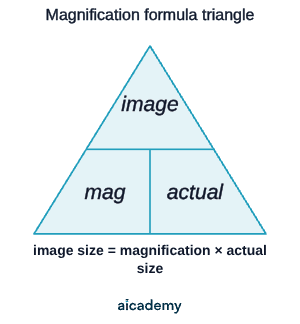
Worked example — find the actual size
A cell is viewed at a magnification of 400×. Its image measures 24 mm across. Find the real size of the cell.
| Step | Working |
|---|---|
| Rearrange | actual size = image size ÷ magnification |
| Substitute | actual size = 24 mm ÷ 400 |
| Calculate | actual size = 0.06 mm |
| Convert to µm | 0.06 mm × 1000 = 60 µm |
Check: 60 µm = 0.06 mm, and 0.06 mm × 400 = 24 mm, which matches the image. The answer is correct.
Decide what the question is asking for before you start: the magnification (a number), or a real length (which needs a sensible unit such as µm or nm).
Studying this for an exam?
Generate a personalised learning path for this subject. Free to get started.
Key terms
- Magnification
- How many times bigger the image is than the real object, calculated as image size divided by actual size.
- Resolution
- The smallest distance between two points that can still be seen as two separate points rather than blurring into one.
- Light microscope
- A microscope that focuses visible light through glass lenses and can show living or dead specimens.
- Electron microscope
- A microscope that fires a beam of electrons, giving much higher magnification and resolution but only able to view dead specimens in a vacuum.
- Standard form
- A way of writing numbers as a value between 1 and 10 multiplied by a power of ten.
- Order of magnitude
- A comparison of sizes by powers of ten, where an object ten times longer than another is one order of magnitude bigger.
- Micrometre (µm)
- A unit of length equal to one thousandth of a millimetre, where 1 mm = 1000 µm.
- Nanometre (nm)
- A unit of length where 1 µm = 1000 nm, so 1 mm = 1,000,000 nm.
Frequently asked questions
Magnification is how many times bigger the image is than the real object, whereas resolution is the smallest distance between two points that can still be seen as separate. Electron microscopes beat light microscopes on both, and it is the higher resolution that reveals more sub-cellular detail.
Use magnification = image size ÷ actual size. Magnification has no units and is written as a number with a ×, such as 400×. The image size and actual size must be converted to the same unit before you divide.
An electron microscope fires a beam of electrons, which have a far shorter wavelength than light, so it has much higher resolving power as well as higher magnification. That higher resolution lets it reveal sub-cellular structures a light microscope cannot show.
Generate revision on any topic you study
Type any topic you're studying and Aicademy generates a complete lesson, quiz, and flashcard set, personalised to your level.
Lessons on anything
Structured, level-matched lessons on any topic you study
Practice quizzes
Find out what you actually know before the exam does
Flashcard sets
Lock in key concepts with instant revision cards
Ask Aica
Stuck on something? Get a clear explanation, any time
Cell Structure: Eukaryotes and Prokaryotes
Culturing Microorganisms
Related lessons
10 min
8 min