Blood: Components and Functions

Aligned to the AQA 8461 specification
- Topic
- Organisation
- Level
- Foundational
- Reading time
- 11 min
- Published
- 16 June 2026
- Updated
- 25 August 2026
On this page
Key takeaways
- Blood is a tissue consisting of plasma, in which red blood cells, white blood cells and platelets are suspended.
- Plasma is the liquid part of blood and transports carbon dioxide, soluble products of digestion (glucose and amino acids), urea, hormones and heat; oxygen is carried by red blood cells, not plasma.
- Red blood cells are adapted to carry oxygen by their biconcave disc shape, having no nucleus to make room for more haemoglobin, and being packed with haemoglobin, the iron-containing protein that binds oxygen.
- Haemoglobin binds oxygen to form oxyhaemoglobin in the lungs (high oxygen) and releases it again in the respiring tissues (low oxygen).
- White blood cells defend against pathogens by phagocytosis and producing antibodies and antitoxins, while platelets are cell fragments that help the blood clot to seal wounds.
Red Blood Cells: Structure Built for Oxygen
Red blood cells (also called erythrocytes) have one job: carry oxygen from the lungs to every respiring cell in the body. Almost every structural feature is an adaptation that increases how much oxygen they can carry and how fast they can load and unload it.
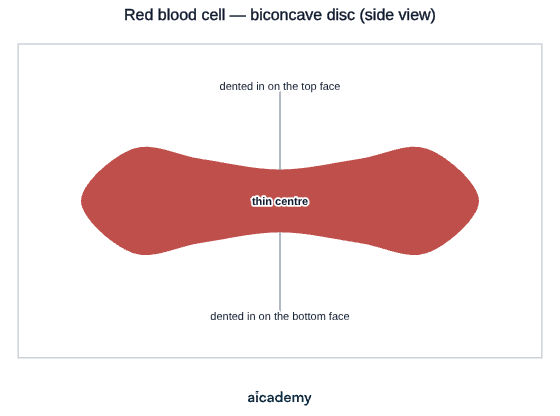
A simplified side-on view of the biconcave shape, dented on both flat faces:
Three key adaptations, and the reasoning behind each:
| Adaptation | What it means | Why it helps carry oxygen |
|---|---|---|
| Biconcave disc shape | Flattened disc, dented on both flat faces | Larger surface area to volume ratio, so oxygen diffuses in and out faster |
| No nucleus | The nucleus is lost as the cell matures | More internal room for haemoglobin, so each cell carries more oxygen |
| Packed with haemoglobin | A red, iron-containing protein fills the cell | Haemoglobin is the molecule that actually binds and releases oxygen |
Remember: mature red blood cells have no nucleus. This is unusual for an animal cell, and it exists to make room for more haemoglobin — not for any other reason.
The biconcave shape also makes the cells flexible, so they can squeeze single-file through narrow capillaries where gas exchange happens.
Worth saving these ideas?
Turn what you've read into instant revision cards. Free to get started.
Key terms
- Plasma
- The straw-coloured liquid part of blood, about 55% of its volume, that transports dissolved substances and heat.
- Red blood cell
- A biconcave cell with no nucleus, packed with haemoglobin, whose job is to carry oxygen.
- Haemoglobin
- The red, iron-containing protein inside red blood cells that binds and releases oxygen.
- Oxyhaemoglobin
- The substance formed when haemoglobin binds oxygen in the lungs; it breaks down again in the respiring tissues.
- White blood cell
- A larger cell with a nucleus that defends the body against pathogens.
- Platelet
- A tiny fragment of a cell, with no nucleus, that helps the blood clot to seal wounds.
- Pathogen
- A microorganism that causes disease, such as a bacterium or virus.
- Urea
- A waste product made in the liver from the breakdown of excess amino acids, carried in plasma to the kidneys.
Frequently asked questions
Blood has four components: plasma, the straw-coloured liquid that transports dissolved substances and heat; red blood cells, which carry oxygen; white blood cells, which defend against pathogens; and platelets, which help the blood clot to seal wounds.
Mature red blood cells lose their nucleus to make more internal room for haemoglobin, so each cell can carry more oxygen. This is unusual for an animal cell and exists for that one reason. Their biconcave disc shape also gives a large surface area to load and unload oxygen quickly.
No. Plasma transports carbon dioxide, the soluble products of digestion such as glucose and amino acids, urea, hormones and heat. Oxygen is carried by red blood cells, bound to haemoglobin, not by the plasma.
Generate revision on any topic you study
Type any topic you're studying and Aicademy generates a complete lesson, quiz, and flashcard set, personalised to your level.
Lessons on anything
Structured, level-matched lessons on any topic you study
Practice quizzes
Find out what you actually know before the exam does
Flashcard sets
Lock in key concepts with instant revision cards
Ask Aica
Stuck on something? Get a clear explanation, any time
The Heart and Blood Vessels
Coronary Heart Disease
Related lessons
10 min
12 min
16 min