Coronary Heart Disease

Aligned to the AQA 8461 specification
- Topic
- Organisation
- Level
- Intermediate
- Reading time
- 16 min
- Published
- 16 June 2026
- Updated
- 25 August 2026
On this page
- 1.What Goes Wrong in Coronary Heart Disease
- 2.Stents: Holding the Artery Open
- 3.Statins: Lowering Blood Cholesterol
- 4.Worked Evaluation: Stent or Statin?
- 5.Faulty Heart Valves and Their Replacement
- 6.Worked Evaluation: Mechanical or Biological Valve?
- 7.Heart Failure: Transplants and Artificial Hearts
- 8.Common Exam Mistakes
Key takeaways
- Coronary heart disease is the narrowing of the coronary arteries by fatty deposits, reducing the supply of oxygenated blood to the heart muscle; it is a non-communicable disease.
- A stent is a mechanical mesh tube that widens a narrowed artery to restore blood flow, but it does not treat the underlying cause, so fatty deposits can still build up elsewhere.
- Statins are drugs that reduce blood cholesterol, slowing the build-up of fatty deposits across all the arteries, but must be taken long term and can cause side effects.
- A faulty valve that does not open fully restricts blood flow, while a leaky valve lets blood flow backwards; it can be replaced with a biological or a mechanical valve.
- In heart failure a transplant replaces the failing heart with a donor organ, while an artificial heart is a mechanical pump used only as a temporary measure.
What Goes Wrong in Coronary Heart Disease
Coronary heart disease (CHD) is a non-communicable disease — it is not caused by a pathogen and cannot be passed from person to person.
The coronary arteries are the blood vessels that supply the heart muscle itself with oxygenated blood. In CHD, layers of fatty material build up inside the coronary arteries, narrowing them. This narrowing reduces the flow of blood through the arteries, so the heart muscle receives less oxygen.
Heart muscle needs a constant oxygen supply to respire and keep contracting. Starve it of oxygen and the consequences follow in a chain:
- Narrowed artery → reduced blood flow → less oxygen reaching the heart muscle
- Less oxygen → less aerobic respiration → the muscle cannot release enough energy to contract properly
- A fully blocked coronary artery → that region of heart muscle dies → a heart attack (myocardial infarction)
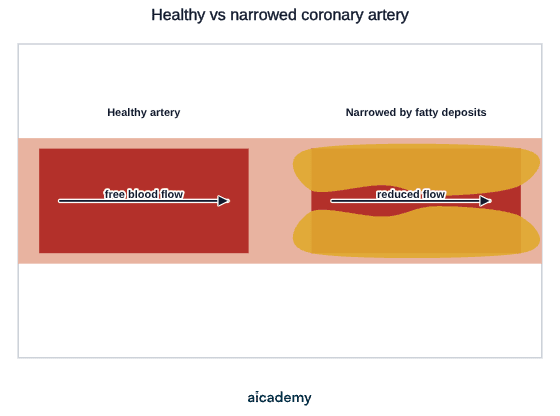
Key definition: Coronary heart disease is the narrowing of the coronary arteries by fatty deposits, reducing the supply of oxygenated blood to the heart muscle.
The rest of this lesson covers the treatments AQA asks you to know — stents, statins, replacement valves, transplants and artificial hearts — and how to evaluate each one.
Stents: Holding the Artery Open
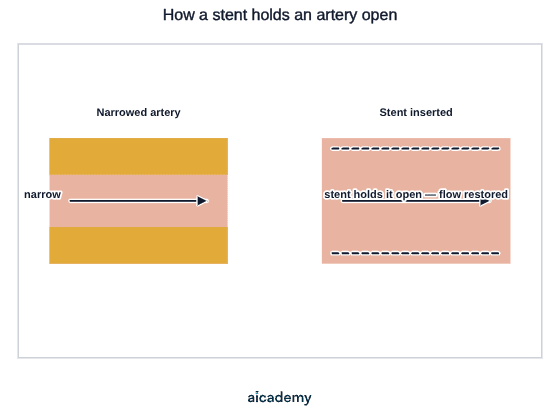
A stent is a small mesh tube that is inserted into a narrowed coronary artery and expanded to push the artery wall open. It is a mechanical, surgical solution: it physically widens the vessel so blood can flow normally again.
| Feature | Detail |
|---|---|
| How it works | Mesh tube widens the artery and keeps it open, restoring blood flow to the heart muscle |
| Advantages | Effective for a long time; the recovery time from surgery is relatively quick |
| Disadvantages | Surgery carries risks (bleeding, infection); blood clots can form near the stent (thrombosis); does not treat the underlying cause, so more fatty deposits can still build up elsewhere |
The most important evaluation point: a stent widens one narrowed section. It does nothing to stop fatty material building up in the rest of the arteries, because it does not lower the patient's cholesterol.
Exam tip: Classify each treatment as a drug, a mechanical device, or a transplant — AQA frames the evaluation question (WS 1.3, 1.4) around those three categories. A stent is a mechanical device.
Studying this for an exam?
Generate a personalised learning path for this subject. Free to get started.
Key terms
- Coronary heart disease
- The narrowing of the coronary arteries by fatty deposits, reducing the supply of oxygenated blood to the heart muscle.
- Coronary arteries
- The blood vessels that supply the heart muscle itself with oxygenated blood.
- Non-communicable disease
- A disease that is not caused by a pathogen and cannot be passed from person to person.
- Stent
- A small mesh tube inserted into a narrowed coronary artery and expanded to hold the artery open and restore blood flow.
- Statin
- A drug that reduces blood cholesterol levels, slowing the rate at which fatty material is deposited inside the arteries.
- Anticoagulant drug
- A drug that reduces the blood's ability to clot, taken for life by patients with a mechanical heart valve.
- Artificial heart
- A mechanical pump used temporarily to keep blood circulating while a patient waits for a transplant or lets their own heart rest and recover.
- Heart failure
- A condition in which the heart can no longer pump blood effectively around the body.
Frequently asked questions
A stent is a mechanical mesh tube fitted by surgery to widen one narrowed coronary artery and restore blood flow. A statin is a drug taken long term that reduces blood cholesterol, slowing fatty build-up across all the arteries.
Layers of fatty material build up inside the coronary arteries, narrowing them and reducing blood flow, so the heart muscle receives less oxygen. A fully blocked coronary artery can cause that region of heart muscle to die, a heart attack.
Blood tends to clot on the mechanical surface of the valve, and a clot could break off and block a vessel. Anticoagulant drugs reduce the blood's ability to clot, so they are essential for mechanical-valve patients for life.
Generate revision on any topic you study
Type any topic you're studying and Aicademy generates a complete lesson, quiz, and flashcard set, personalised to your level.
Lessons on anything
Structured, level-matched lessons on any topic you study
Practice quizzes
Find out what you actually know before the exam does
Flashcard sets
Lock in key concepts with instant revision cards
Ask Aica
Stuck on something? Get a clear explanation, any time
Blood: Components and Functions
Non-Communicable Diseases and Risk Factors
Related lessons
10 min
8 min
11 min