Track progress, take quizzes and save notes on this lesson.

Free forever · no card needed

Start free
Intermediate

Food Security and Sustainable Food Production

4.7.5.1 Food security·4.7.5.2 Farming techniques·4.7.5.3 Sustainable fisheries·4.7.5.4 Role of biotechnology (Biology only)

Aligned to the AQA 8461 specification

Topic
Ecology
Level
Intermediate
Reading time
9 min
Published
16 June 2026
Updated
1 July 2026
On this page
  1. 1.What Food Security Means
  2. 2.Biological Factors Threatening Food Security
  3. 3.Making Farming More Efficient
  4. 4.Intensive Farming: Advantages and Ethics
  5. 5.Sustainable Fisheries
  6. 6.Biotechnology: Mycoprotein and Genetic Modification
  7. 7.Common Exam Mistakes

Key takeaways

  • Food security is having enough food to feed a population, and it is threatened by factors such as rising birth rate, changing diets, new pests and pathogens, environmental change, the cost of agricultural inputs and conflict.
  • Farming is made more efficient by restricting the energy transfer from food animals to the environment, for example by limiting movement and controlling temperature so more energy goes into body mass.
  • Intensive (factory) farming makes food cheaper and faster but raises ethical objections, such as animals being unable to behave naturally and the overuse of antibiotics.
  • Fish stocks are kept sustainable by controlling net mesh size, so young fish escape to breed, and by fishing quotas that limit how much of a species is caught.
  • Mycoprotein is a protein-rich food for vegetarians made from the fungus Fusarium grown on glucose syrup in aerobic conditions, then harvested and purified.

What Food Security Means

Food security is having enough food to feed a population. A country is food-secure when its people can reliably get enough safe, nutritious food. When that supply is unreliable, the population faces shortages, hunger and famine.

The challenge is scale. The human population keeps growing, and every extra person needs feeding from a planet whose farmland, oceans and fresh water are limited. The job of biology here is to identify the biological factors that threaten food security and to find sustainable ways to feed everyone — methods that meet today's needs without using resources up so fast that future generations go short.

Food security: having enough food to feed a population.

This lesson works through four linked questions the AQA specification expects you to answer:

  • What biological factors threaten food security? (4.7.5.1)
  • How can farming be made more efficient — and why do some object? (4.7.5.2)
  • How are fish stocks kept at a sustainable level? (4.7.5.3)
  • How does biotechnology help feed a growing population? (4.7.5.4)

Biological Factors Threatening Food Security

Several biological and human factors push food supply below the level a population needs. You should be able to describe each one and explain why it reduces the food available.

FactorWhy it threatens food security
Increasing birth rateA rising population means more mouths to feed from the same land, so supply per person falls in some countries.
Changing diets in developed countriesAs richer countries demand a wider variety of foods, scarce food resources are transported around the world rather than eaten where they are grown.
New pests and pathogensPests and diseases that affect farming can destroy crops and livestock, cutting yields.
Environmental changeChanges such as failed rains cause widespread famine in some countries when crops cannot grow.
Cost of agricultural inputsSeeds, fertiliser, fuel and machinery cost money; when inputs become too expensive, farmers grow less.
ConflictWars in some parts of the world disrupt the availability of water and food, and block farming and supply routes.

Exam tip: the command word is usually "describe" or "explain". Naming a factor earns little on its own — say why it reduces the amount of food available.

Because all these pressures act at once, sustainable methods must be found to feed everyone on Earth: farming smarter, fishing within limits, and using biotechnology.

Making Farming More Efficient

The efficiency of food production can be improved by restricting the transfer of energy from food animals to the environment. To see why this works, recall how energy moves through a food chain.

Only about 10% of the energy (biomass) at one trophic level is passed on to the next. The other ~90% is lost — as heat from respiration, in movement, and in waste. If a farmer can stop an animal losing energy to its surroundings, more of the energy in its food is stored as body mass instead, so the animal grows faster on less food.

Worked example — why limiting movement helps. A pig kept in a small pen cannot run around. Movement requires muscle contraction, which requires respiration, which releases energy as heat to the environment. By limiting movement:

  • less energy is used in muscle activity,
  • less is lost as heat,
  • so more of the energy from its food is transferred into new body tissue (biomass).

Controlling the temperature of the surroundings works the same way. A warm barn means the animal does not have to respire extra glucose just to keep its body temperature up, so again more energy goes into growth. Some animals are also fed high-protein foods to speed up growth, because protein supplies the amino acids needed to build new tissue.

These methods — keeping animals indoors, warm, still and well-fed — are known as intensive or factory farming.

Intensive Farming: Advantages and Ethics

Intensive methods make food production cheaper and faster, but many people have ethical objections to them. You should be able to evaluate both sides.

AdvantagesDisadvantages and objections
More food produced from the same resourcesAnimals kept in small spaces cannot behave naturally
Faster animal growth, so cheaper meatCrowding can spread disease, so antibiotics may be overused
Less land needed per kilogram of foodMany consider restricting movement cruel
Easier to control conditions and feedingHigh-protein feed may use crops that could feed people directly

Evaluate means weigh up both sides and reach a judgement — do not just list points. A strong answer might conclude: intensive farming raises efficiency and lowers cost, but the welfare cost to the animals leads many people to reject it on ethical grounds.

The specification asks you to understand that some people have ethical objections — it does not require you to hold a particular view. Marks come from explaining the objections clearly and balancing them against the efficiency gains.

Want more lessons like this one?

Generate lessons on anything you study. Free account, no card needed.

Start generating

Sustainable Fisheries

Fish are a major source of protein, but fish stocks in the oceans are declining because we have caught them faster than they can reproduce. It is important to keep fish stocks at a level where breeding can continue; otherwise some species may disappear altogether in certain areas.

Two conservation measures help stocks recover to a sustainable level:

MeasureHow it conserves stocks
Controlling net (mesh) sizeA larger mesh lets young, small fish slip through and escape. They survive to breed, while only mature fish are caught.
Fishing quotasA quota is a legal limit on how much of a species may be caught. It prevents over-fishing and gives the population time to recover.

Worked example — evaluating bigger mesh sizes. Suppose a fishery switches to a wider mesh. Benefit: juvenile fish are not removed, so they grow up and reproduce, and the breeding population recovers. Drawback: fishers catch fewer fish in the short term, reducing their income now. The judgement: a short-term loss in catch protects the long-term survival of the stock, so the measure is sustainable even though it is unpopular at first.

Sustainable fishing: taking fish at a rate that still allows the population to breed and replace itself, so the stock does not collapse.

Biotechnology: Mycoprotein and Genetic Modification

Modern biotechnology lets us culture (grow) very large quantities of microorganisms for food, and lets us modify organisms to make useful products. These approaches help meet the food demands of a growing population.

Mycoprotein is a protein-rich food suitable for vegetarians. It is made from the fungus Fusarium:
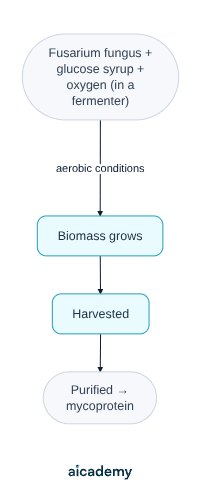
The fungus is grown on glucose syrup, in aerobic conditions; the resulting biomass is harvested and purified to make the food.

Other biotechnology examples use genetic modification (GM) — transferring a gene from one organism into another so the second organism makes a useful product:

ExampleWhat is doneWhy it helps
GM bacterium making insulinA human insulin gene is inserted into a bacterium, which then produces human insulin; this is harvested and purifiedTreats people with diabetes
GM cropsCrops are modified to give higher yields or better nutritionCould provide more food, or food with improved nutritional value
Golden riceRice modified to make a precursor of vitamin AHelps prevent vitamin A deficiency where rice is the staple food

(Extra context — not required by AQA 8461.) GM insulin is sometimes called "human insulin" because the bacterium reads a human gene, so the protein is identical to the insulin a human body makes.

Common Exam Mistakes

1. Defining food security vaguely

Food security is specifically having enough food to feed a population — not "having good food" or "having a healthy diet". Use the exact definition.

2. Naming factors without explaining them

Listing "war" or "pests" earns little. Say why each one cuts the amount of food available — e.g. conflict disrupts access to water and food and blocks supply.

3. Getting the energy logic backwards

Restricting movement and warming the surroundings reduce energy loss from the animal, so more biomass is built. Students often write that it gives the animal more energy — the energy comes from food; the technique simply stops it being wasted.

4. Confusing the two fisheries measures

Net (mesh) size controls which fish are caught (lets young ones escape to breed); quotas control how many are caught. They are different tools — name the right one.

5. Muddling the biotechnology examples

Fusarium is a fungus grown for mycoprotein on glucose syrup in aerobic conditions. Insulin is made by a GM bacterium. Do not swap the organisms or the products.

6. Saying mycoprotein is grown anaerobically

The fungus needs oxygen — it is cultured in aerobic conditions. Anaerobic conditions would be the wrong answer.

Key terms

Food security
Having enough food to feed a population.
Intensive farming
Farming that keeps animals indoors, warm, still and well-fed to reduce energy loss and speed up growth; also called factory farming.
Sustainable fishing
Taking fish at a rate that still allows the population to breed and replace itself, so the stock does not collapse.
Fishing quota
A legal limit on how much of a species may be caught, which prevents over-fishing and gives the population time to recover.
Biotechnology
The use of cultured microorganisms and modified organisms to make useful products and help feed a growing population.
Mycoprotein
A protein-rich food suitable for vegetarians, made from the fungus Fusarium grown on glucose syrup in aerobic conditions.
Fusarium
The fungus grown to produce mycoprotein, cultured on glucose syrup in aerobic conditions in a fermenter.
Genetic modification (GM)
Transferring a gene from one organism into another so the second organism makes a useful product.
Golden rice
Rice modified to make a precursor of vitamin A, helping prevent vitamin A deficiency where rice is the staple food.

Frequently asked questions

Food security is having enough food to feed a population, so that people can reliably get enough safe, nutritious food. When the supply is unreliable, a population faces shortages, hunger and famine. The exact definition is needed, not just having good food or a healthy diet.

Movement requires muscle contraction and respiration, which releases energy as heat to the environment. Limiting movement and keeping the surroundings warm reduce this energy loss, so more of the energy from the animal's food is transferred into new body tissue and it grows faster on less food.

Two measures help: controlling net mesh size, where a larger mesh lets young fish escape to survive and breed, and fishing quotas, which are legal limits on how much of a species may be caught. Mesh size controls which fish are caught; quotas control how many.

Generate revision on any topic you study

Type any topic you're studying and Aicademy generates a complete lesson, quiz, and flashcard set, personalised to your level.

Lessons on anything

Structured, level-matched lessons on any topic you study

Practice quizzes

Find out what you actually know before the exam does

Flashcard sets

Lock in key concepts with instant revision cards

Ask Aica

Stuck on something? Get a clear explanation, any time

Prev

Trophic Levels and Biomass Transfer

Related lessons

9 min

11 min

Lesson

Genetic Engineering

AQA GCSE Biology · AQA 8461

1 month ago

Top students don’t revise more. They revise what counts.

Start revising free

Free to start. No card needed.