The Working Memory Model

Aligned to the AQA 7182 specification
- Topic
- Memory
- Level
- Intermediate
- Reading time
- 9 min
- Published
- 1 July 2026
- Updated
- 16 August 2026
On this page
Key takeaways
- The working memory model (Baddeley & Hitch, 1974) explains short-term memory only, describing it as an active system of separate components rather than a single unitary store.
- The central executive is the attentional control system that directs resources to the slave systems; it is modality-free and has a very limited capacity with no storage of its own.
- The phonological loop handles auditory and verbal information and preserves word order, splitting into the phonological store (inner ear) and the articulatory process (inner voice).
- The visuo-spatial sketchpad stores visual and spatial information and was subdivided by Logie into the visual cache and the inner scribe.
- The episodic buffer, added by Baddeley in 2000, integrates information from the other components and from long-term memory into a single, time-sequenced record.
The Structure of Working Memory
Working memory has a controlling component, the central executive, which supervises three subordinate "slave systems": the phonological loop, the visuo-spatial sketchpad, and the episodic buffer. The episodic buffer, and the system as a whole, links to long-term memory (LTM) so that stored knowledge can be pulled into current processing.
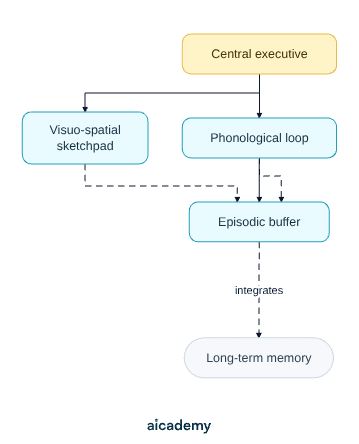
The solid arrows show the central executive directing each slave system. The dashed arrows show information being integrated by the episodic buffer, which draws on the other components and on long-term memory. Keep this shape in your head: one controller, three subsystems, one link out to LTM.
Want more lessons like this one?
Generate lessons on anything you study. Free account, no card needed.
Key terms
- Central executive
- The attentional control system of working memory that directs attention and allocates resources to the slave systems; it is modality-free and has no storage capacity of its own.
- Phonological loop
- The component of working memory that processes auditory and verbal information and preserves the order of words, made up of the phonological store and the articulatory process.
- Visuo-spatial sketchpad
- The component of working memory that stores visual and spatial information, subdivided by Logie into the visual cache and the inner scribe.
- Episodic buffer
- A limited-capacity component added by Baddeley in 2000 that integrates information from the other subsystems and from long-term memory into a single, time-sequenced record.
- Dual-task performance
- Doing two tasks at the same time; performance stays high when the tasks use different working memory components but drops when they compete for the same component.
Frequently asked questions
The working memory model is Baddeley and Hitch's (1974) explanation of short-term memory. It replaces the idea of a single STM store with an active system made of a central executive that controls three subsystems: the phonological loop, the visuo-spatial sketchpad and the episodic buffer.
Baddeley and Hitch found people cannot do two visual tasks at once (both compete for the sketchpad) but can do one visual and one verbal task together, because these use different components. This shows the phonological loop and visuo-spatial sketchpad are separate stores.
The central executive is the attentional control system. It directs attention, allocates resources to the slave systems and is modality-free, but it has a very limited capacity and no storage capacity of its own.
Generate revision on any topic you study
Type any topic you're studying and Aicademy generates a complete lesson, quiz, and flashcard set, personalised to your level.
Lessons on anything
Structured, level-matched lessons on any topic you study
Practice quizzes
Find out what you actually know before the exam does
Flashcard sets
Lock in key concepts with instant revision cards
Ask Aica
Stuck on something? Get a clear explanation, any time
The Multi-Store Model of Memory
Explanations for Forgetting: Interference and Retrieval Failure
Related lessons
9 min
9 min
Explanations for Forgetting: Interference and Retrieval Failure
A-Level Psychology · AQA 7182
4 months ago
10 min
Eyewitness Testimony: Misleading Information and Anxiety
A-Level Psychology · AQA 7182
4 months ago
9 min
Improving Eyewitness Testimony: The Cognitive Interview
A-Level Psychology · AQA 7182
4 months ago