Track progress, take quizzes and save notes on this lesson.

Free forever · no card needed

Start free
Intermediate

Eyewitness Testimony: Misleading Information and Anxiety

4.1.2 Memory

Aligned to the AQA 7182 specification

Topic
Memory
Level
Intermediate
Reading time
9 min
Published
1 July 2026
On this page
  1. 1.Why Eyewitness Testimony Can Be Unreliable
  2. 2.Leading Questions: Loftus and Palmer (1974)
  3. 3.Response-Bias or a Changed Memory?
  4. 4.Post-Event Discussion: Gabbert et al. (2003)
  5. 5.Anxiety: The Negative Effect and Weapon Focus
  6. 6.Anxiety: The Positive Effect and the Inverted-U
  7. 7.Evaluation
  8. 8.Common Exam Mistakes

Key takeaways

  • Leading questions can distort a memory: in Loftus and Palmer (1974) the verb 'smashed' produced a mean speed estimate of 40.8 mph versus 31.8 mph for 'contacted'.
  • Post-event discussion causes memory conformity: Gabbert et al. (2003) found 71% of witnesses recalled details they had not seen but had picked up while discussing the event.
  • Anxiety can reduce accuracy through weapon focus (Johnson and Scott, 1976) but real-world evidence (Yuille and Cutshall, 1986) shows it can also improve recall.
  • The Yerkes-Dodson inverted-U explains the contradiction: recall is most accurate at a moderate level of anxiety and is impaired when anxiety is very low or very high.
  • Weapon focus may be caused by surprise or unusualness rather than fear, as Pickel (1998) showed with unusual but non-threatening objects.

Why Eyewitness Testimony Can Be Unreliable

Eyewitness testimony (EWT) is the evidence a witness gives about an event they saw, such as a crime or accident. Courts once treated it as strong evidence, but psychological research shows that memory is reconstructive: we do not replay a recording, we rebuild the event, and that rebuild can be distorted.

AQA asks you to explain three factors that affect the accuracy of EWT:

FactorWhat distorts the memory
Leading questionsThe wording of a question biases the answer or the memory
Post-event discussionTalking to other witnesses contaminates individual recall
AnxietyHigh arousal can impair recall, but may sometimes sharpen it

The first two are forms of misleading information — inaccurate information supplied to a witness after the event. Anxiety is a separate factor about the emotional state of the witness at the time.

This lesson covers the three factors only. The cognitive interview, the technique designed to improve EWT accuracy, is a separate topic on the AQA spec and is covered in its own lesson.

Leading Questions: Loftus and Palmer (1974)

A leading question is one whose wording suggests a particular answer. Elizabeth Loftus and John Palmer ran the classic study demonstrating their effect on memory.

Procedure (Experiment 1): 45 student participants watched film clips of car accidents. Each was then asked to estimate speed with the same question except for one changed verb:

"About how fast were the cars going when they ___ each other?"

The five verbs used were hit, smashed, collided, bumped, and contacted.

Findings: the verb changed the mean speed estimate, even though everyone saw the same clips:

Verb in the questionMean speed estimate (mph)
Smashed40.8
Collided39.3
Bumped38.1
Hit34.0
Contacted31.8

A single word shifted estimates by roughly 9 mph between "smashed" and "contacted". The leading question influenced what participants reported about the same physical event.

Response-Bias or a Changed Memory?

Experiment 1 raised a question: did the verb change the actual memory, or just the answer given? Loftus and Palmer ran a second experiment to find out.

Procedure (Experiment 2): new participants watched a clip of a car crash. One group was asked the "smashed" question, one the "hit" question, and a control group was asked no speed question. One week later all were asked, "Did you see any broken glass?" There was no broken glass in the film.

Findings: the "smashed" group were more than twice as likely to falsely report seeing broken glass than the "hit" group. The wording appeared to have altered the stored memory, not just the immediate answer.

This gives two competing explanations for how leading questions work:

ExplanationWhat it claims
Response-biasThe wording biases the answer chosen at that moment; the memory is unchanged
Substitution (memory)The wording alters the actual memory that is stored, so recall is genuinely changed

The delayed broken-glass result supports the substitution explanation, because the distortion persisted a week later when the leading word was no longer present.

Post-Event Discussion: Gabbert et al. (2003)

Misleading information does not only come from an interviewer. It can come from other witnesses. Post-event discussion is when co-witnesses talk about an event before giving their accounts, and it can contaminate individual memory.

Procedure: Gabbert and colleagues had participants work in pairs. Each pair watched the same crime filmed from two different angles, so each person could see details the other could not. The pairs then discussed the event before completing an individual recall test.

Findings: 71% of the participants who had discussed the event went on to recall details they had not actually seen but had only picked up from their partner. A control group who did not discuss the event showed no such contamination.

This effect is called memory conformity: witnesses adjust their account to match a co-witness, either because they believe the other person is right (informational influence) or because they want social approval (normative influence).

The practical implication is direct: witnesses to the same crime should be kept apart and interviewed separately, before they can reshape one another's memories.

How much of this have you taken in?

Quiz yourself on this section, free, no card needed.

Test myself

Anxiety: The Negative Effect and Weapon Focus

Anxiety is a state of physical and emotional arousal. Crimes are often frightening, so a key question is whether that fear helps or harms accurate recall. One influential idea is weapon focus: a weapon draws attention, narrowing what else the witness takes in.

Johnson and Scott (1976): participants sat in a waiting room believing they were waiting for a study. In the low-anxiety condition they overheard a casual conversation, then saw a man leave carrying a pen covered in grease. In the high-anxiety condition they heard an angry, aggressive exchange and breaking glass, then saw a man leave holding a knife covered in blood.

Findings: participants were later asked to identify the man from photographs:

ConditionCorrect identification of the man
Low anxiety (greasy pen)about 49%
High anxiety (bloodied knife)about 33%

Identification was worse when a weapon was present. The interpretation is that anxiety and the weapon narrowed attention onto the threat, so fewer resources were available to encode the culprit's face.

Anxiety: The Positive Effect and the Inverted-U

The weapon-focus finding is not the whole story. Studies of real crimes suggest anxiety can sometimes improve recall.

Yuille and Cutshall (1986): the researchers interviewed 13 witnesses to a real shooting in Vancouver, in which a shop owner shot a thief who had fired at him. The witnesses were re-interviewed months later. Recall stayed accurate over time, witnesses resisted misleading questions the researchers deliberately inserted, and those who had reported the most stress at the time were the most accurate of all. This directly challenges the idea that anxiety always damages memory.

How can anxiety both harm and help? The Yerkes-Dodson law, applied to EWT by Deffenbacher, resolves the contradiction. Accuracy follows an inverted-U: it is low when anxiety is very low, rises to a peak at a moderate level of anxiety, and then falls again when anxiety is very high.
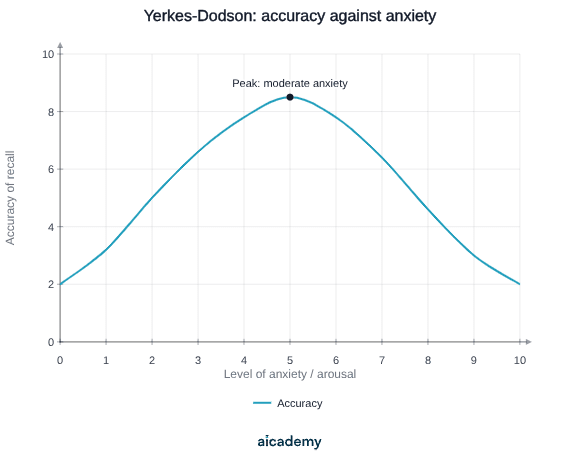
At the peak, arousal has focused attention usefully; beyond it, arousal becomes overwhelming and accuracy drops.

Evaluation

You need to evaluate this research (AO3), not just describe it. Develop each point: state the criticism, then explain why it matters.

Lab studies may lack ecological validity. Loftus and Palmer's participants watched short clips of accidents. Watching a clip is not the emotional, high-stakes experience of witnessing a real crash, so participants may treat the task less seriously. This means the studies may overstate the misleading-information effect and tell us less about real EWT than they appear to.

Real-world studies challenge the lab findings. Yuille and Cutshall's real witnesses were accurate and resisted misleading questions, the opposite of what the lab work predicts. This suggests laboratory demonstrations of distortion do not fully generalise to genuine crimes, where the memory is emotionally significant.

Weapon focus may be about surprise, not anxiety. Pickel (1998) had participants watch a scene in a hairdressing salon where a man held either scissors (usual and low-threat), a handgun (unusual and high-threat), a wallet (usual, low-threat) or a raw chicken (unusual, low-threat). Identification was worst for the unusual items — the chicken and the handgun — not simply the threatening ones. This suggests weapon focus is driven by an object being unexpected, so studies like Johnson and Scott may not show an effect of anxiety at all.

The inverted-U is an oversimplification. The Yerkes-Dodson model reduces anxiety to a single level of physical arousal. Real anxiety is multi-dimensional (cognitive worry as well as physical arousal), so a one-dimensional curve cannot capture how these components separately affect memory. It is a useful framework but an incomplete explanation.

Common Exam Mistakes

1. Saying anxiety always reduces accuracy

The evidence is mixed, not one-directional. Johnson and Scott found anxiety reduced accuracy; Yuille and Cutshall found high-stress witnesses were the most accurate. The inverted-U reconciles both: accuracy peaks at moderate anxiety. Claiming anxiety only ever harms memory ignores half the research.

2. Confusing leading questions with post-event discussion

Both are misleading information, but the source differs. A leading question is misleading wording from an interviewer (Loftus and Palmer). Post-event discussion is misleading information from other witnesses, causing memory conformity (Gabbert et al.). Attach the correct study to the correct factor.

3. Misquoting the speed-estimate figures

The mean estimate was 40.8 mph for "smashed" and 31.8 mph for "contacted". These exact figures earn credit; vague statements like "a bit higher" do not. Learn the two anchor values.

4. Treating weapon focus as proven to be caused by anxiety

Do not state as fact that anxiety causes weapon focus. Pickel (1998) showed unusualness / surprise is a strong alternative explanation, because identification was worst for an unusual but harmless raw chicken. Present it as a debated cause, not a settled one.

5. Describing studies without evaluating them

Longer-mark questions require AO3. A pure description of Loftus and Palmer will cap at the AO1 marks. Pair each factor with an evaluation point: ecological validity, real-world evidence, or an alternative explanation.

Key terms

Eyewitness testimony
The evidence given by a witness who saw an event such as a crime or accident, based on their memory of what happened.
Leading question
A question phrased so that its wording suggests or biases a particular answer.
Post-event discussion
A conversation between co-witnesses, or between a witness and others, after an event that can alter what each person recalls.
Weapon focus
The tendency for a witness's attention to be drawn to a weapon, reducing their ability to accurately recall other details such as the culprit's face.
Yerkes-Dodson law
The principle that performance, including memory accuracy, is best at a moderate level of arousal or anxiety and worse when arousal is very low or very high, producing an inverted-U relationship.

Frequently asked questions

A leading question suggests a desired answer through its wording. In Loftus and Palmer (1974), changing one verb shifted mean speed estimates from 31.8 mph ('contacted') to 40.8 mph ('smashed'), and later made witnesses more likely to falsely recall broken glass.

It can do either. Johnson and Scott (1976) found anxiety and weapon focus reduced identification, but Yuille and Cutshall (1986) found the most stressed real witnesses were the most accurate. The Yerkes-Dodson inverted-U resolves this: accuracy peaks at moderate anxiety.

A leading question is misleading information from an interviewer's wording. Post-event discussion is misleading information from other witnesses: talking to co-witnesses causes memory conformity, as in Gabbert et al. (2003), where 71% reported details they only heard from someone else.

Generate revision on any topic you study

Type any topic you're studying and Aicademy generates a complete lesson, quiz, and flashcard set, personalised to your level.

Lessons on anything

Structured, level-matched lessons on any topic you study

Practice quizzes

Find out what you actually know before the exam does

Flashcard sets

Lock in key concepts with instant revision cards

Ask Aica

Stuck on something? Get a clear explanation, any time

Prev

Explanations for Forgetting: Interference and Retrieval Failure

Next

Improving Eyewitness Testimony: The Cognitive Interview

Related lessons

8 min

Lesson

The Working Memory Model

A-Level Psychology · AQA 7182

20 days ago

8 min

Top students don’t revise more. They revise what counts.

Start revising free

Free to start. No card needed.