Social Learning Theory

Aligned to the AQA 7182 specification
- Level
- Intermediate
- Reading time
- 11 min
- Published
- 1 July 2026
- Updated
- 16 August 2026
On this page
Key takeaways
- Social learning theory says behaviour is learned by observing and imitating role models in a social context, bridging behaviourism and the cognitive approach by adding mental processes.
- Identification is how strongly an observer relates to a role model; people identify most with models who are similar, high status or attractive.
- Vicarious reinforcement is indirect learning: seeing a model rewarded for a behaviour makes the observer more likely to imitate it, and seeing them punished makes it less likely.
- Bandura's four mediational processes are attention, retention, motor reproduction and motivation; attention and retention govern learning, reproduction and motivation govern performance.
- The Bobo doll studies showed children imitate specific aggression from an observed adult model, and imitate more when the model is rewarded rather than punished.
Mediational Processes
Bandura argued that four cognitive stages sit between observing a behaviour and reproducing it. These are the mediational processes, and they are what make SLT more than simple behaviourism. They explain why observation does not automatically lead to imitation.
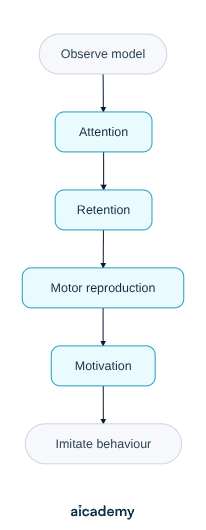
| Process | What it involves | Relates to |
|---|---|---|
| Attention | Noticing and paying attention to the model's behaviour | Learning |
| Retention | Remembering the behaviour so it can be recalled later | Learning |
| Motor reproduction | Being physically able to reproduce the behaviour | Performance |
| Motivation | The will to perform it, often driven by observed reinforcement | Performance |
The first two, attention and retention, decide whether the behaviour is learned. The last two, motor reproduction and motivation, decide whether it is actually performed. A person can learn a behaviour without ever performing it if they lack the ability or the motivation.
Attention and retention govern learning; motor reproduction and motivation govern performance. This split explains why we do not imitate everything we observe.
How much of this have you taken in?
Quiz yourself on this section, free, no card needed.
Key terms
- Imitation
- Copying the behaviour of another person.
- Identification
- The extent to which an observer relates to a role model and wants to be like them, which is stronger when the model is similar, high status or attractive.
- Modelling
- From the observer's side, imitating the behaviour of a role model; from the model's side, demonstrating a behaviour that can be imitated.
- Vicarious reinforcement
- Indirect learning that occurs when an observer sees a model rewarded or punished for a behaviour, which changes how likely the observer is to imitate it.
- Mediational processes
- The cognitive stages that come between observing a behaviour and imitating it: attention, retention, motor reproduction and motivation.
- Role model
- A person an observer identifies with and whose behaviour they are likely to imitate, typically someone similar, high status or attractive.
Frequently asked questions
Both say behaviour is learned from the environment, but social learning theory adds mediational (cognitive) processes between observing a behaviour and imitating it. Behaviourism ignores these mental processes; SLT uses them to explain why we do not imitate everything we see.
Attention, retention, motor reproduction and motivation. Attention and retention determine whether a behaviour is learned; motor reproduction and motivation determine whether it is actually performed.
Vicarious reinforcement is learning indirectly by watching the consequences a model receives. If a model is rewarded for a behaviour, the observer is more likely to imitate it; if the model is punished, the observer is less likely to.
Generate revision on any topic you study
Type any topic you're studying and Aicademy generates a complete lesson, quiz, and flashcard set, personalised to your level.
Lessons on anything
Structured, level-matched lessons on any topic you study
Practice quizzes
Find out what you actually know before the exam does
Flashcard sets
Lock in key concepts with instant revision cards
Ask Aica
Stuck on something? Get a clear explanation, any time
The Behaviourist Approach
The Cognitive Approach
Related lessons
9 min
9 min
11 min
9 min