Abstraction and Automation

Aligned to the AQA 7517 specification
- Level
- Intermediate
- Reading time
- 8 min
- Published
- 13 June 2026
- Updated
- 16 August 2026
On this page
Key takeaways
- Abstraction is the process of removing unnecessary detail to focus on what is essential for the task at hand.
- AQA's problem-solving process has four stages: define the problem, abstract, design an algorithm, and automate.
- AQA identifies seven types of abstraction: representational, generalisation/classification, information hiding, procedural, functional, data, and problem reduction.
- Information hiding makes internal details inaccessible to external code, not destroyed; the implementation still exists inside the module but is not exposed.
- Automation implements an abstract model as a program a computer can execute; the program is a running instance of the model, not the model itself.
Decomposition and Composition
Decomposition means breaking a large problem into smaller, more manageable sub-problems that can each be solved independently.
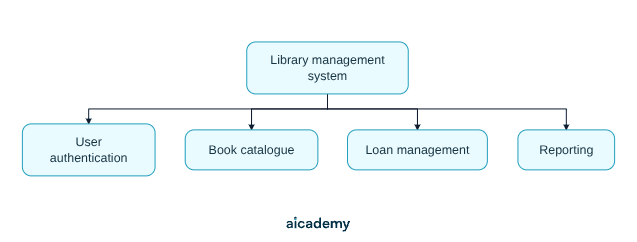
Benefits of decomposition:
- Sub-problems are simpler to design, implement, and test
- Different team members can work on different sub-problems in parallel
- Sub-solutions can be reused in other projects
Composition is the reverse: combining the solutions to sub-problems to produce the solution to the whole problem. The sub-solutions must have well-defined interfaces so they can be connected.
Decomposition and composition are core practices in structured and object-oriented programming. A function that calls other functions is an example of composition:
processOrder()composesvalidatePayment(),updateStock(), andsendConfirmation().
Information Hiding and Abstraction Layers
Information hiding (also called encapsulation in OOP) separates the what of a component from the how. External code depends only on the interface — it has no knowledge of the internal workings.
Example — a Stack ADT:
Interface (what):    push(item)  pop()  peek()  isEmpty()
Implementation (how): could be array-based or linked-list-based
Switching from an array implementation to a linked-list implementation does not affect any code that uses the stack — only the internal implementation changes.
Abstraction layers stack on top of each other in real systems:
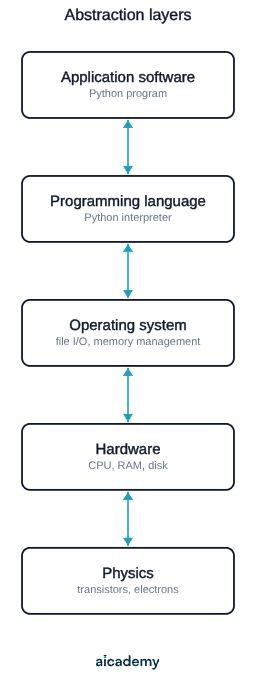
Each layer hides complexity from the layer above. A Python programmer does not need to understand transistor physics to read a file.
How much of this have you taken in?
Quiz yourself on this section, free, no card needed.
Key terms
- Abstraction
- The process of removing unnecessary detail to focus on what is essential for the task at hand.
- Representational abstraction
- Removing unnecessary detail from a model, such as a London Underground map distorting distances and removing surface geography.
- Generalisation / classification
- Identifying common properties and grouping similar entities into a class.
- Information hiding
- Concealing implementation details and exposing only the interface, making internal details inaccessible to external code rather than destroying them.
- Procedural abstraction
- Representing a process as a named subroutine, hiding the steps from the caller.
- Functional abstraction
- Treating a subroutine as a pure mapping from inputs to outputs, ignoring side effects.
- Data abstraction
- Hiding the implementation of a data structure behind its interface, as in an abstract data type (ADT).
- Problem reduction
- Transforming an unfamiliar or hard problem into a known problem with an existing solution.
- Decomposition
- Breaking a large problem into smaller, more manageable sub-problems that can each be solved independently.
- Composition
- Combining the solutions to sub-problems, via well-defined interfaces, to produce the solution to the whole problem.
- Automation
- The implementation of an abstract model as a program that a computer can execute.
- Computationally tractable
- Expressible as an algorithm that terminates in a reasonable time.
Frequently asked questions
The four stages are: define the problem (identify inputs, outputs, and constraints), abstract (represent the problem as a model, removing irrelevant detail), design an algorithm (a step-by-step solution to the abstract model), and automate (implement the algorithm as a program a computer can execute).
Decomposition is breaking a large problem into smaller sub-problems that can each be solved independently. Abstraction is removing irrelevant detail from a representation. They are complementary but distinct concepts and should not be confused.
No. Abstraction is not simply making things simpler; it is selectively removing irrelevant detail while preserving the properties needed for the task. The same real-world entity may be abstracted differently for different purposes.
Generate revision on any topic you study
Type any topic you're studying and Aicademy generates a complete lesson, quiz, and flashcard set, personalised to your level.
Lessons on anything
Structured, level-matched lessons on any topic you study
Practice quizzes
Find out what you actually know before the exam does
Flashcard sets
Lock in key concepts with instant revision cards
Ask Aica
Stuck on something? Get a clear explanation, any time
Dijkstra's Shortest Path Algorithm
Finite State Machines
Related lessons
7 min
6 min
9 min
6 min