Turing Machines

Aligned to the AQA 7517 specification
- Level
- Advanced
- Reading time
- 6 min
- Published
- 13 June 2026
- Updated
- 16 August 2026
On this page
Key takeaways
- A Turing machine is a theoretical model of computation made of a tape, a read-write head, a finite set of states Q, an alphabet Σ (including a blank symbol), and a transition function δ.
- The transition function δ(q, s) → (q′, s′, D) has five components: current state, current symbol, new state, symbol to write, and move direction D ∈ {L, R}.
- Halting states have no outgoing transitions, so the machine stops on entering one; there may be a separate accept state and reject state.
- A Universal Turing Machine can simulate any other Turing machine by taking an encoding of that machine plus its input, making it the theoretical model for the stored-program computer.
- Turing machines compute exactly the computable functions; the halting problem is non-computable, so a Turing machine cannot solve it for all inputs.
A Transition Table and Diagram
Machine: flip all 0s to 1s and all 1s to 0s on a tape, then halt
Alphabet: where = blank
| State | Symbol read | Write | Move | New state |
|---|---|---|---|---|
| 0 | 1 | R | ||
| 1 | 0 | R | ||
| R | (halt) |
State transition diagram:
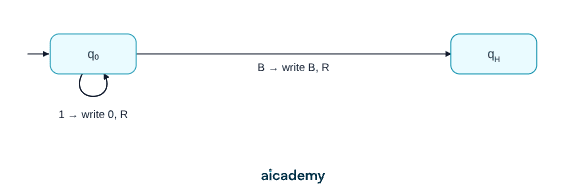
Trace — input tape: 0 1 1 0 B …
| Step | State | Head pos | Tape | Action |
|---|---|---|---|---|
| 1 | 1 | 0 1 1 0 B | read 0 → write 1, R | |
| 2 | 2 | 1 1 1 0 B | read 1 → write 0, R | |
| 3 | 3 | 1 0 1 0 B | read 1 → write 0, R | |
| 4 | 4 | 1 0 0 0 B | read 0 → write 1, R | |
| 5 | 5 | 1 0 0 1 B | read B → write B, R | |
| 6 | 6 | 1 0 0 1 B | halt |
Output: 1 0 0 1 (all bits flipped) ✓
Something not quite clicking?
Ask Aica to explain any part of this differently. Free, takes 30 seconds.
Key terms
- Turing machine
- A theoretical mathematical model of computation, proposed by Alan Turing in 1936, that defines what it means for a function to be computable.
- Tape
- An infinite sequence of cells, each holding one symbol, that extends infinitely in one direction and holds the machine's input and working data.
- Read-write head
- The component that reads the current cell, can write a new symbol to it, and moves one cell left or right.
- Transition function (δ)
- The function that, for each combination of current state and current symbol, defines the new state, the symbol to write, and the direction to move.
- Alphabet (Σ)
- The finite set of symbols the tape can contain, including a special blank symbol (B or ␣).
- Halting state
- A state with no outgoing transitions; when the machine enters one it stops. There may be an accept state and a reject state.
- Universal Turing Machine (UTM)
- A Turing machine that can simulate any other Turing machine, given an encoding of that machine and its input.
- Computable function
- A function that a Turing machine can compute; a function is computable if and only if a Turing machine can compute it.
- Halting problem
- The non-computable problem of deciding whether an arbitrary machine halts; Turing used the UTM to prove it is unsolvable.
- Church-Turing thesis
- The statement that any function computable by any algorithm can be computed by a Turing machine, setting the boundary of what is computable.
Frequently asked questions
An ordinary Turing machine solves one specific problem. A Universal Turing Machine (UTM) can simulate any other Turing machine by taking an encoding of that machine and its input on its tape, then simulating it step by step to produce the same output.
For each current state and current symbol, the transition function δ(q, s) → (q′, s′, D) specifies the new state to enter, the symbol to write on the current cell, and the direction to move the head, Left (L) or Right (R).
No. Turing machines can compute exactly the computable functions. The halting problem is an example of a non-computable function: no Turing machine can solve it for all inputs. The Church-Turing thesis sets Turing machines as the boundary of what is computable.
Generate revision on any topic you study
Type any topic you're studying and Aicademy generates a complete lesson, quiz, and flashcard set, personalised to your level.
Lessons on anything
Structured, level-matched lessons on any topic you study
Practice quizzes
Find out what you actually know before the exam does
Flashcard sets
Lock in key concepts with instant revision cards
Ask Aica
Stuck on something? Get a clear explanation, any time
Limits of Computation and Tractability
Number Systems and Bases
Related lessons
9 min
6 min