Finite State Machines

Aligned to the AQA 7517 specification
- Level
- Advanced
- Reading time
- 9 min
- Published
- 6 June 2026
- Updated
- 16 August 2026
On this page
Key takeaways
- A finite state machine is defined by five components: a finite set of states, an input alphabet, a transition function, a start state, and (for FSMs without output) a set of accepting states.
- An FSM without output accepts a string only if the machine is left in an accepting state after all input symbols have been consumed; stopping the trace early is incorrect.
- In a state transition diagram the start state is shown by an incoming arrow from outside and an accepting state by a double circle; omitting these standard markers loses marks.
- A Mealy machine is an FSM with output where each transition is labelled input/output and produces one output symbol per input symbol; it has no accepting states.
- AQA requires only FSMs without output and Mealy machines; Moore machines (output depends on current state only) are not in the specification.
State Transition Diagrams
A state transition diagram is the standard graphical representation of an FSM. Each component of the machine maps to a specific visual element:
| Component | Diagram notation |
|---|---|
| State | Circle labelled with the state name |
| Start state | Circle with an arrow pointing to it from outside (no source state) |
| Accepting state (FSMs without output) | Double circle |
| Transition | Arrow from one state to another, labelled with the input symbol |
| Self-loop | Arrow from a state back to itself |
Example — FSM over {0, 1} accepting strings that contain an even number of 1s:
States: (start, accepting),
Transitions:
- on input 0 → (self-loop: receiving a 0 does not change parity)
- on input 1 → (one 1 seen so far — odd count)
- on input 0 → (self-loop: 0 does not change parity)
- on input 1 → (second 1 seen — back to even count)
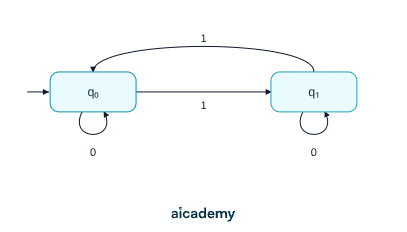
is a double circle (accepting). The machine ends in — and therefore accepts — if and only if the number of 1s in the input string is even (including zero 1s).
When drawing a diagram: label each arrow with the input symbol that causes that transition. If two different inputs from the same state lead to the same destination, either draw two separate arrows or label one arrow with both symbols separated by a comma.
Worth saving these ideas?
Turn what you've read into instant revision cards. Free to get started.
Mealy Machines: FSMs With Output
A Mealy machine is an FSM that produces an output symbol on each transition. The output depends on both the current state and the current input. Unlike FSMs without output, Mealy machines do not have accepting states — they produce a string of output symbols as they process the input.
Transition notation for Mealy machines: each arrow is labelled input/output — the input that triggers the transition followed by the output produced.
Example — a binary parity machine:
This Mealy machine reads a sequence of bits and outputs after each bit whether the total number of 1s seen so far is even (E) or odd (O).
States: (start),
| Current state | Input: 0 | Input: 1 |
|---|---|---|
| / E | / O | |
| / O | / E |
Each cell shows: next state / output symbol. As a diagram, each arrow is labelled input / output:
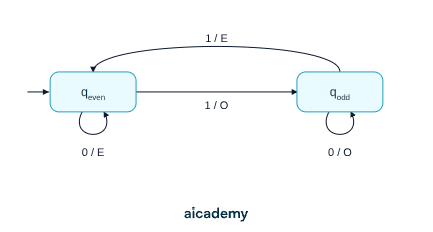
The output is produced at the moment of each transition — one output symbol per input symbol.
Key terms
- Finite state machine (FSM)
- An abstract model of computation that processes an input sequence one symbol at a time, always being in exactly one of a finite number of states.
- Transition function
- The rules that define the next state for each (current state, input) pair; it must be total for a complete FSM.
- Accepting state
- A state in an FSM without output that indicates a valid/accepted input string, drawn as a double circle.
- Start state
- The state the machine begins in, shown in a diagram by an arrow pointing to it from outside with no source state.
- State transition diagram
- The graphical representation of an FSM using labelled circles for states and labelled arrows for transitions.
- State transition table
- The tabular equivalent of a transition diagram, listing every (current state, input) combination and the resulting next state.
- Mealy machine
- An FSM that produces an output symbol on each transition, where the output depends on both the current state and the current input.
- Dead state
- A reject/trap state added to make the transition function total, with all its transitions looping back to itself.
- Self-loop
- A transition arrow that goes from a state back to itself.
Frequently asked questions
An FSM without output accepts or rejects strings using accepting states, while a Mealy machine produces an output symbol on each transition and has no accepting states. Mealy transitions are labelled input/output; FSM-without-output transitions are labelled with just the input symbol.
A string is accepted only if, after every input symbol has been consumed, the machine is in an accepting state. You must process the whole string before deciding; stopping at the first accepting state reached mid-trace is wrong.
No. AQA only requires Mealy machines (output produced on each transition) for FSMs with output. Moore machines, where output depends on the current state only, are not in the specification and should not appear in exam answers.
Generate revision on any topic you study
Type any topic you're studying and Aicademy generates a complete lesson, quiz, and flashcard set, personalised to your level.
Lessons on anything
Structured, level-matched lessons on any topic you study
Practice quizzes
Find out what you actually know before the exam does
Flashcard sets
Lock in key concepts with instant revision cards
Ask Aica
Stuck on something? Get a clear explanation, any time
Abstraction and Automation
Sets and Formal Languages
Related lessons
5 min
8 min
6 min