Guide
How to revise for A-level Computer Science (AQA)
A-level Computer Science mixes theory, programming and the maths of computation. Here is how to revise AQA 7517, the topics that lose marks, and a method that works.

GCSE & A-level tutor, Aicademy contributor
9 min read
A-level Computer Science catches out students who revise it like one subject, because it is really three: the theory you memorise, the programming you have to be fluent in, and the maths of computation that feels more like further maths than coding. Revise all three the same way and one of them always lets you down. Split them up and it becomes one of the more predictable A-levels, because so much of it rewards practice rather than luck.
This guide is written around AQA’s 7517 specification. It covers what the two papers and the coding project test, the topics students lose marks on, how to get fluent for the on-screen programming exam, and a weekly plan you can start this week.
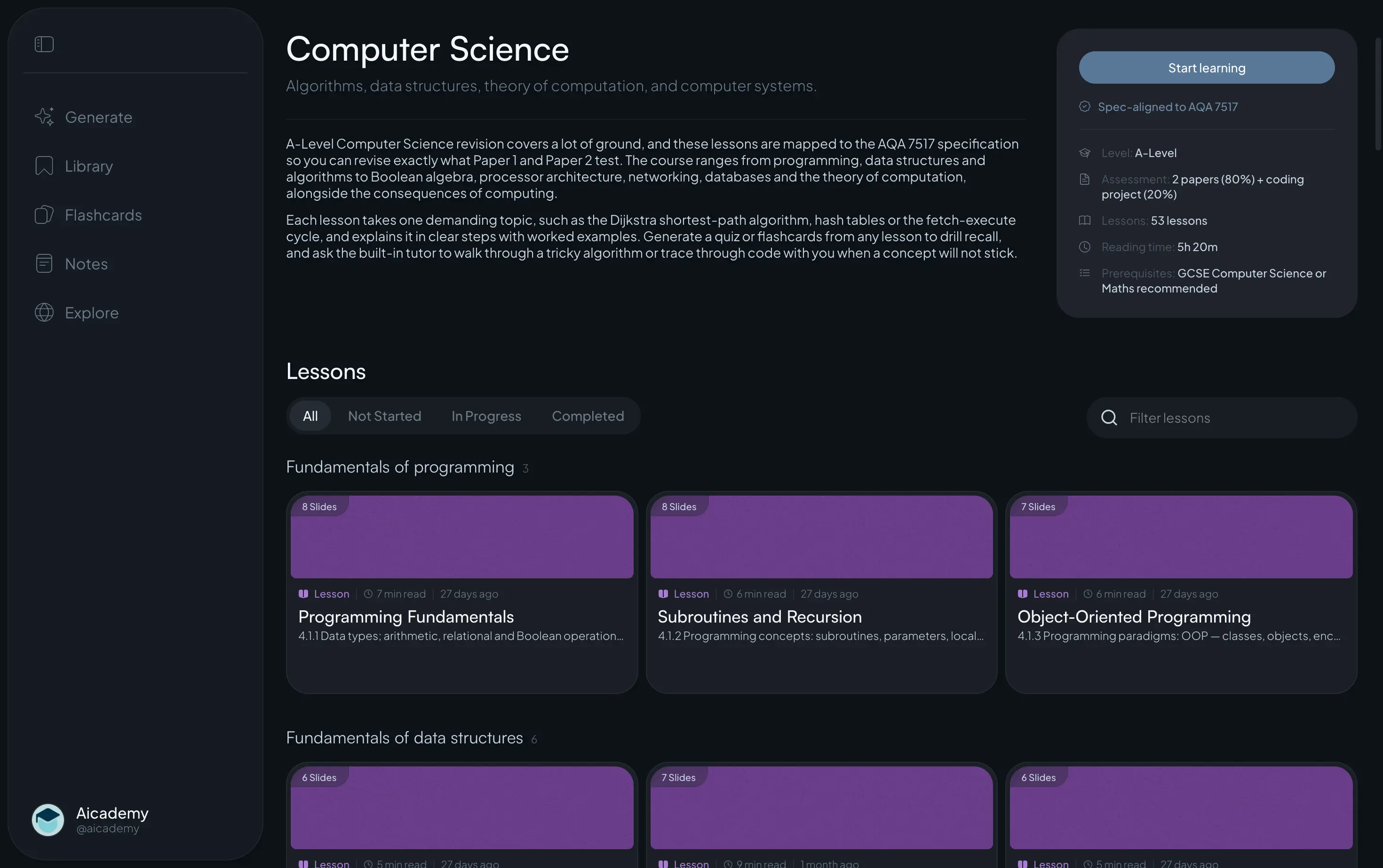
What AQA 7517 tests
Two exams worth 40% each and a coding project worth 20%. Knowing which paper a topic belongs to tells you how to revise it.
- Paper 1 (on-screen, 40%): programming, data structures, algorithms and the theory of computation, sat on a computer, usually with a pre-released skeleton program. This is mostly applied: writing, correcting and tracing code.
- Paper 2 (written, 40%): data representation, computer systems and architecture, networking, databases, big data, functional programming and the consequences of computing. This is mostly recall and explanation.
- NEA (20%): a substantial coding project you build, test and document.
The single most useful early move is to sort every topic into “write code” (Paper 1) or “learn and explain” (Paper 2), because they need completely different revision.
The topics that lose the most marks
A handful of topics decide grades year after year. Prioritise these.
Subroutines, scope and recursion. One of the most common exam areas. Know parameters, the difference between local and global scope, and how recursion uses the call stack. Trace a few recursive examples by hand until the stack behaviour is obvious.
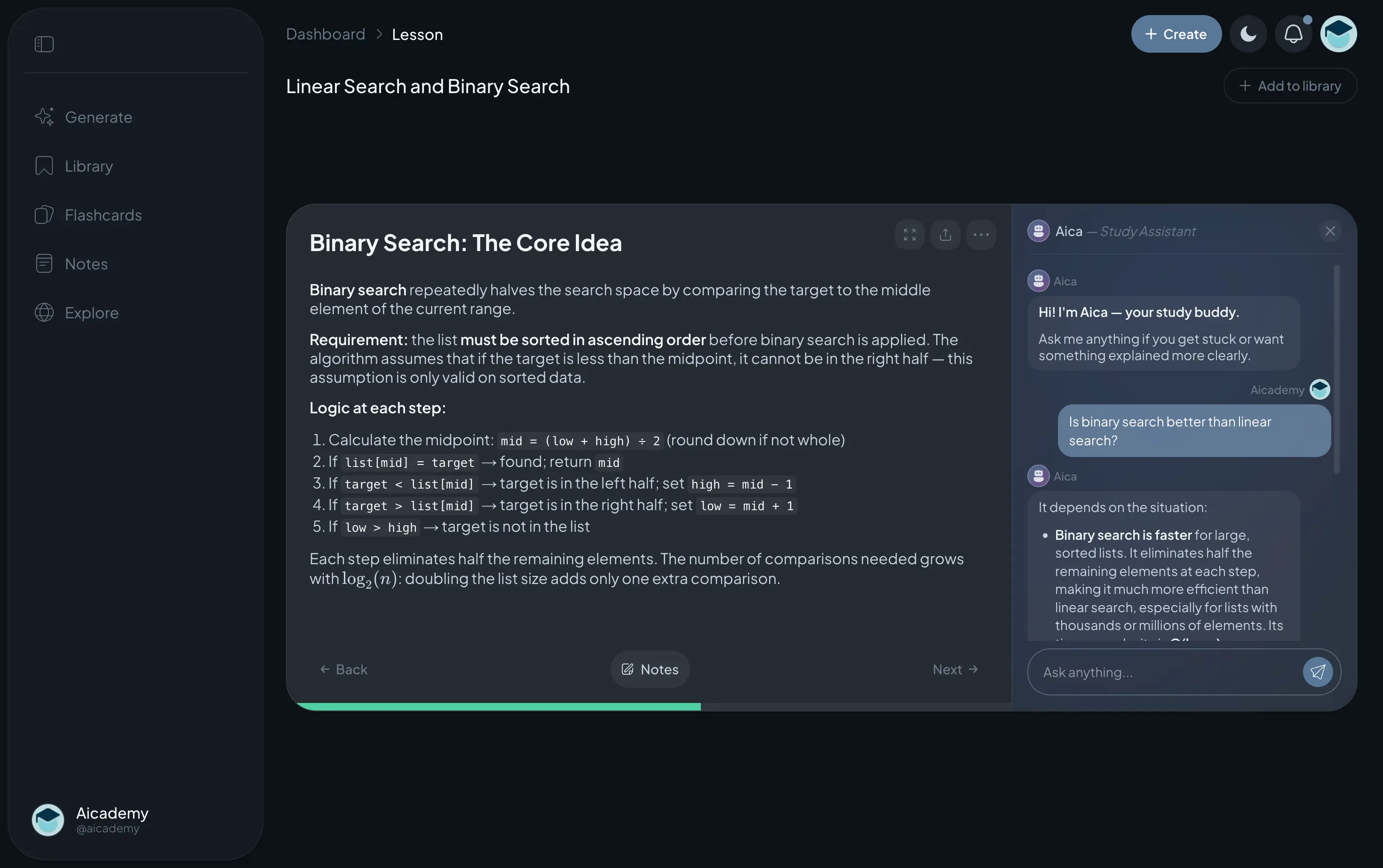
Algorithms and complexity. Be able to trace and compare the sorts (bubble, merge, insertion) and searches (linear, binary), and state their best, worst and average time complexity in Big-O. Graph and tree algorithms, especially Dijkstra’s shortest path and traversals, are high-value and very learnable by hand.
Theory of computation. Finite state machines, regular expressions, Backus-Naur Form, Turing machines, and tractable versus intractable problems and the halting problem. Abstract, so learn the precise definitions and do lots of small worked examples.
Data representation. Two’s complement, and floating-point representation and normalisation, plus Reverse Polish Notation. These are pure practice: do a few conversions a day and they stop being scary.
Databases and networking. Normalisation to third normal form and SQL for Paper 2, and the TCP/IP stack, IP addressing and client-server models. Make a compact card for each definition, this is classic recall you can bank with flashcards.
The programming paper
Paper 1 is sat on a computer, so reading code is not enough, you have to write it fluently under time pressure. Two things build that:
- Get fluent in your language and the skeleton program. AQA releases a skeleton program before the exam. Work through it, understand every subroutine, and predict what the examiners are likely to ask you to extend.
- Trace code by hand. Build trace tables for loops, conditions and recursion until you can predict the output of a piece of code without running it. This is heavily examined and very learnable.
The coding project (NEA)
The non-exam assessment is 20% of your grade, and it is where students either bank marks steadily or lose them in a last-minute panic. Three rules save most of the pain:
- Start early and pick a solvable problem. An ambitious project you cannot finish scores worse than a focused one you complete and document well.
- Document as you go. Marks are spread across analysis, design, technical solution, testing and evaluation, so keep a running log of decisions and test evidence from day one.
- Test continuously. Screenshots and a clear test plan with results are easy marks that are painful to reconstruct at the end.
The method that actually works
Re-reading the textbook feels productive and does very little. Two techniques do the heavy lifting, and they map onto the two papers.
- Active recall for Paper 2. Close the notes and retrieve definitions and processes, networking, databases, computation, from memory. Good flashcards are ideal for the volume of precise terms.
- Spaced repetition so abstract theory learned early does not fade. Short, frequent reviews beat cramming, and here is why it works.
- Write and trace code, and do past papers for Paper 1 and the applied questions. Mark against the official mark scheme so you learn what earns marks, not just whether you were roughly right.
A weekly plan you can start now
- Daily (10–15 minutes): a few two’s-complement or floating-point conversions and one algorithm traced by hand.
- Two or three recall sessions: flashcards on a Paper 2 topic (networking one day, databases the next), reviewing older decks as they come due.
- One programming session: work on the skeleton program or a past Paper 1 question, writing real code.
- Steady NEA progress and a timed past-paper section each week, marked against the scheme, feeding your weak topics back into next week’s revision.
Resources
Revise from the official AQA 7517 specification and its past papers so you learn the right detail, and work through the released skeleton program early. Our own A-level Computer Science lessons break the demanding topics, from Dijkstra’s algorithm to the theory of computation, into short, testable chunks.
If you want practice on a specific topic, Aicademy can generate a lesson, a quiz and spaced-repetition flashcards on any part of the course, and its tutor can trace through an algorithm with you. It is free to start, so you can drill the exact topics that keep costing you marks. If you are also brushing up GCSE, see how to revise for GCSE Computer Science.
Frequently asked questions
Treat it as three separate skills. Bank the theory with active recall and spaced repetition (Paper 2 content like networking, databases and computation). Build programming fluency by writing and tracing code by hand, not just reading it, for the on-screen Paper 1. And keep the coding project (NEA) moving, because it is 20% of the grade. Timed past papers with the mark scheme tie it all together.
Students most often struggle with the theory of computation (Turing machines, regular expressions, Backus-Naur Form, tractability and the halting problem), the maths of data representation (two's complement and floating-point normalisation), and complexity (Big-O of sorting and searching). They are abstract, so retrieval practice on precise definitions and lots of worked examples beat re-reading.
Two exams worth 40% each plus a non-exam assessment worth 20%. Paper 1 is sat on a computer and tests practical programming, data structures, algorithms and theory of computation, usually with a pre-released skeleton program. Paper 2 is a written exam on data representation, computer systems and architecture, networking, databases, big data, functional programming and the consequences of computing. The NEA is a coding project you build and document.
A lot. Paper 1 is sat on-screen and expects you to write, correct and trace real code, and the NEA project is a substantial program. You cannot revise programming by reading alone: you have to write code, trace it by hand with tables, and get fluent in your language and the AQA skeleton program before the exam.
Start early, pick a problem that is genuinely solvable in the time, and document as you go rather than at the end. The marks are spread across analysis, design, technical solution, testing and evaluation, so a working program with weak documentation loses just as many marks as strong documentation with a thin program. Keep a log of decisions and test evidence from day one.
A subroutine is a named block of code (a procedure or a function) you can call by name, with parameters passed in and, for functions, a value returned. Key exam points are the difference between local and global scope, passing by value versus reference, and how recursion uses the call stack. It comes up on both papers, so learn the definitions precisely and trace a few recursive examples by hand.
Sources
- AQA — A-level Computer Science 7517 specification (aqa.org.uk)
- AQA — 7517 past papers and mark schemes (aqa.org.uk)
- Education Endowment Foundation — evidence on retrieval practice and spaced learning (educationendowmentfoundation.org.uk)
Prices and features were checked as of the date shown and can change. Where a figure could not be confirmed from a primary source, we say so in the text.
GCSE & A-level tutor, Aicademy contributor
Liba is a first-class Computer Science graduate from the University of Birmingham who tutors GCSE and A-level students. She writes about revision technique and exam prep.
Disclosure: Aicademy is the study app made by the team that publishes this blog. We compare it fairly against other tools and cite our sources so you can check everything yourself.
Keep reading
How to revise for GCSE Computer Science (OCR J277)
A tutor's guide to revising GCSE Computer Science: what J277 Paper 1 and 2 test, the topics students lose marks on, and a weekly method that works.
How to revise for A-levels: a smarter method
How to revise for A-levels: evidence-based techniques applied to essays, problem subjects and exam technique, with a realistic independent-study plan.
Active recall and spaced repetition: the study methods that actually work
Why re-reading fails, and how active recall and spaced repetition — the two most evidence-backed study methods — turn revision into long-term memory.
Study with more than flashcards
Aicademy generates personalised lessons, quizzes and flashcards from any topic or your own notes, with spaced-repetition revision and an AI tutor.
Lessons on anything
Structured, level-matched lessons on any topic you study
Practice quizzes
Find out what you actually know before the exam does
Flashcard sets
Lock in key concepts with instant revision cards
Ask Aica
Stuck on something? Get a clear explanation, any time
Upgrade to Pro whenever you're ready