Guide
How to make flashcards that actually work
Most flashcards fail for the same few reasons. Here is how to write ones that don't, and how spaced repetition makes them stick.
GCSE & A-level tutor, Aicademy contributor
6 min read
Flashcards are one of the most effective revision tools there is, and also one of the most misused. Done well, they are pure retrieval practice: the single technique with the strongest evidence behind it. Done badly, they become a stack of paragraphs you nod along to without ever really testing yourself.
The difference is not the app you use. It is how you write the cards and how you review them. This guide covers both: the rules for cards that force real recall, and how spaced repetition turns a review session into long-term memory.
Why most flashcards fail
Two mistakes account for almost all bad flashcards. The first is putting too much on a card: a whole definition, a full process, or five facts at once. When the back of the card is a paragraph, you cannot honestly say whether you knew it, so you tick it off and move on. The second is writing cards you can answer by recognition rather than recall, so you are really just re-reading in a different shape.
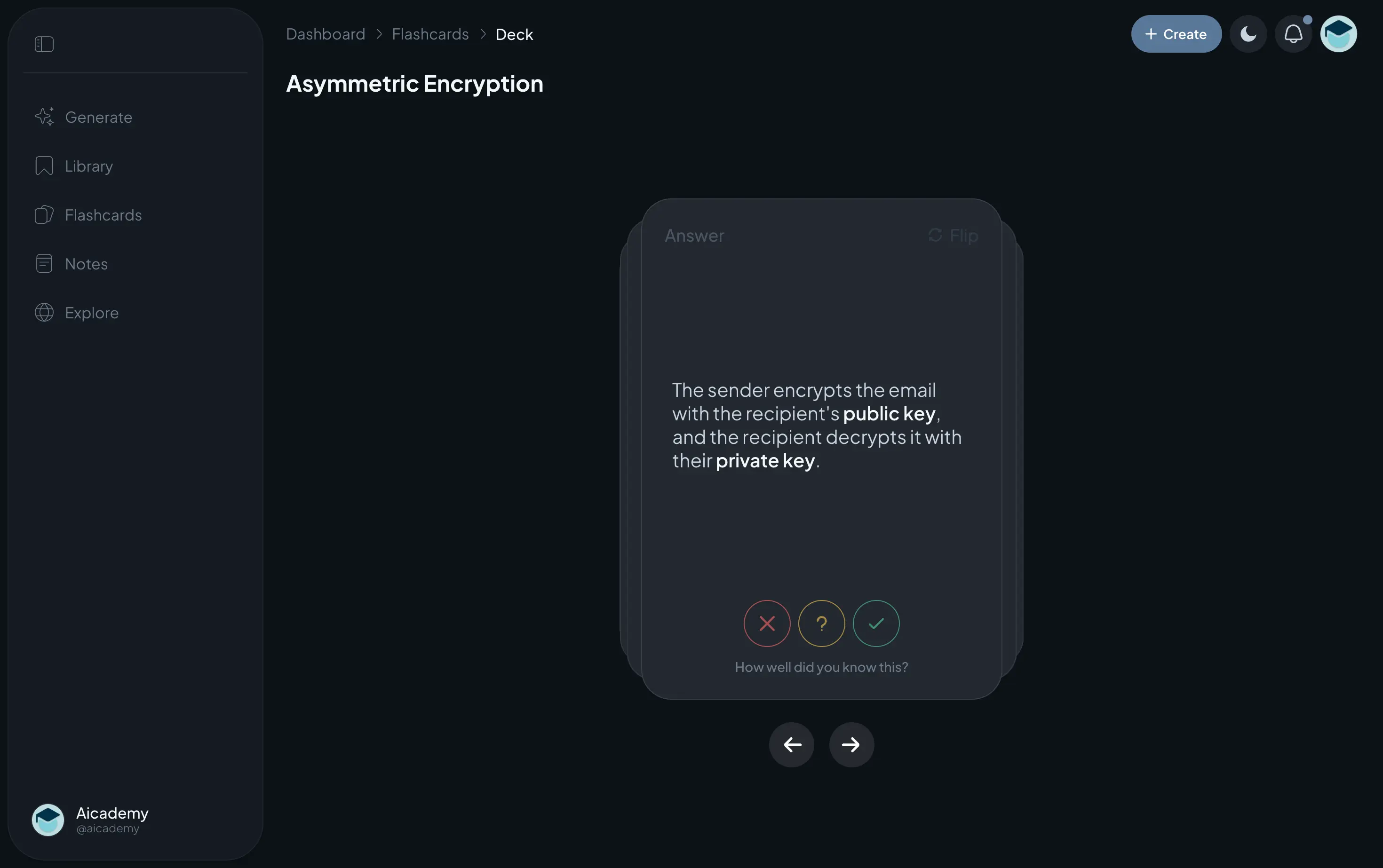
A flashcard only works if flipping it is a genuine test: a clear question, a moment of effort to retrieve the answer, then a check. If there is no effort, there is no learning.
How to write a good flashcard
A few simple rules cover most of it:
- One idea per card. If a card has an “and” in the answer, it is probably two cards.
- Ask a real question.“What does the mitochondrion do?” beats a card that just says “Mitochondria” with a paragraph on the back.
- Keep the answer short and specific enough that you can judge whether you got it right.
- Write some “why” and “how” cards, not only “what”, so you are reasoning, not just naming.
- Put it in your own words. The act of rephrasing is part of the learning.
| Card | Weak | Strong |
|---|---|---|
| Front | Osmosis | What is osmosis, in one sentence? |
| Back | A long paragraph copied from the textbook. | Diffusion of water across a semi-permeable membrane, from high to low water concentration. |
| Why it works | Nothing to recall; you just re-read. | Forces a specific answer you can check. |
Spaced repetition: the review that makes it stick
Writing good cards is half of it. The other half is when you review them. Memory fades on a predictable curve, and the best moment to review something is just as you are about to forget it. Spaced repetition schedules each card to reappear at growing intervals: a card you get wrong comes back tomorrow, a card you nail might not return for a week, then two, then a month.
This is far more efficient than reviewing every card equally. You spend your time on the cards you actually struggle with, and let the ones you know fade to the background. Doing this by hand is fiddly, which is why spaced-repetition apps like Anki exist, and why Aicademy’s flashcards schedule reviews for you based on how confidently you answer each one.
A simple flashcard workflow
- Make cards as you learn a topic, not the night before the exam. Deciding what deserves a card is itself revision.
- Keep them lean: one idea, real question, short answer.
- Review daily in short bursts and let the app resurface due cards, rather than grinding the whole deck each time.
- Be honest when you grade yourself. If you nearly had it but not quite, mark it wrong so it comes back sooner.
- Edit cards that keep tripping you up. A card you always get wrong is often a badly written card, not a hard fact.
If you would rather not build every deck by hand, Aicademy can generate a flashcard deck, plus a matching lesson and quiz, from any topic or your own uploaded notes, with spaced repetition built in. You can try it free, or see how the free flashcard apps stack up in our best Quizlet alternatives roundup.
Frequently asked questions
A good flashcard tests one thing, asks a real question that forces you to recall rather than recognise, and has a short, specific answer. Avoid cramming a whole topic onto one card, and avoid answers so long you cannot judge whether you got them right. One idea, one question, one clear answer.
Spaced repetition is reviewing each card at increasing intervals: cards you find hard come back soon, cards you know well come back less often. It works with the way memory decays, catching each card just as you are about to forget it, which is when review does the most good. Apps like Anki, and Aicademy's flashcards, schedule this for you automatically.
Fewer than you think, but higher quality. It is better to have 30 sharp cards you review consistently than 300 vague ones you never finish. Make cards for the facts and relationships you keep forgetting, not for everything in the textbook.
Paper is fine and the act of writing a card helps you learn it, but paper cannot schedule spaced repetition, so you tend to review everything equally or lose track. Digital apps handle the scheduling and travel in your pocket. Many students write a few by hand to learn them, then rely on an app for the review.
Making your own is a form of studying in itself, because you have to decide what matters and phrase it. Pre-made or AI-generated decks save time and are a great starting point, especially for large topics; the key is to still review them actively and edit any card that is unclear.
Mix in cards that ask 'why' and 'how', not only 'what'. Ask a card to explain a process, compare two things, or apply an idea to an example. Recall of isolated facts is useful, but cards that make you reason are what turn facts into understanding.
Sources
- Dunlosky et al. (2013), Improving Students' Learning With Effective Learning Techniques (SAGE)
- The Learning Scientists — retrieval practice and spacing
- Anki — spaced-repetition flashcard software
Prices and features were checked as of the date shown and can change. Where a figure could not be confirmed from a primary source, we say so in the text.
GCSE & A-level tutor, Aicademy contributor
Liba is a first-class Computer Science graduate from the University of Birmingham who tutors GCSE and A-level students. She writes about revision technique and exam prep.
Disclosure: Aicademy is the study app made by the team that publishes this blog. We compare it fairly against other tools and cite our sources so you can check everything yourself.
Keep reading
Active recall and spaced repetition: the study methods that actually work
Why re-reading fails, and how active recall and spaced repetition — the two most evidence-backed study methods — turn revision into long-term memory.
How to revise for GCSEs: a method that actually works
Evidence-based GCSE revision: retrieval practice, spaced repetition and past papers, turned into a simple weekly plan that actually sticks.
The 6 best Quizlet alternatives in 2026
Six Quizlet alternatives for 2026, from AI study platforms to spaced-repetition apps, compared on features, free tiers and price.
Study with more than flashcards
Aicademy generates personalised lessons, quizzes and flashcards from any topic or your own notes, with spaced-repetition revision and an AI tutor.
Lessons on anything
Structured, level-matched lessons on any topic you study
Practice quizzes
Find out what you actually know before the exam does
Flashcard sets
Lock in key concepts with instant revision cards
Ask Aica
Stuck on something? Get a clear explanation, any time
Upgrade to Pro whenever you're ready