Roundup
The 7 best Anki alternatives in 2026 (free & easier)
Anki's spaced-repetition engine is the gold standard. The setup, dated interface and building every card by hand are not. Here are the best Anki alternatives that keep the memory science and lose the friction.

Study content creator, Aicademy contributor
9 min read
Let’s be clear up front: Anki’s memory engine is the best there is. Its spaced-repetition algorithm (now FSRS) schedules your reviews to hit maximum retention for minimum effort, it is open-source, endlessly customisable, and free on desktop and Android. If you have the patience for it, nothing beats it.
But that word, patience, is why you are here. Most people looking for an Anki alternative do not have a problem with the science; they have a problem with everything around it: the dated interface, the intimidating settings, the $25 iOS app, and above all the fact that you build every single card by hand. These are the seven alternatives that keep the spaced repetition and lose the friction, and where each one is genuinely better or worse. Details were checked in August 2026 and are linked at the end.
Why students look for an Anki alternative
Anki is a permanent fixture for a reason, and for medical students and hardcore revisers it is often irreplaceable. But the same design choices that make it powerful also make it a slog for a lot of GCSE and A-level students:
- You build every card. Anki ships with no content. A deck is only as good as the hours you put into making it, and that is where most people quietly give up.
- The learning curve is steep. Note types, intervals, ease factors, add-ons: it is a lot before you have reviewed a single card.
- The interface feels dated. It is functional, not friendly, and on mobile the good version (iOS) costs a one-off $25.
- It is all on you. No lessons, no exam-board content, no nudge to keep going. The discipline has to come entirely from you.
So the trade every alternative makes is roughly the same: give up a little of Anki’s algorithmic purity and control in exchange for ease, content, and cards you do not have to build. Here is who does that best.
The 7 best Anki alternatives
| Tool | Free? | Makes cards for you | Spaced repetition | Best instead of Anki for |
|---|---|---|---|---|
| Aicademy | Partial | Yes | Yes | SRS decks generated from a topic or your notes |
| Knowt | Yes | Yes | Yes | The most generous free option |
| Quizlet | Partial | Partial | Partial | Ready-made sets & easy studying |
| Brainscape | Partial | No | Partial | Curated, high-quality decks |
| RemNote | Partial | Partial | Yes | SRS built into your note-taking |
| Memrise | Partial | Partial | Yes | Learning languages |
| StudySmarter | Partial | Partial | Partial | An AI study app with content |
Free tiers and features as of August 2026, from public sources. Confirm current details on each site before relying on one.
1. Aicademy — spaced repetition without building the cards
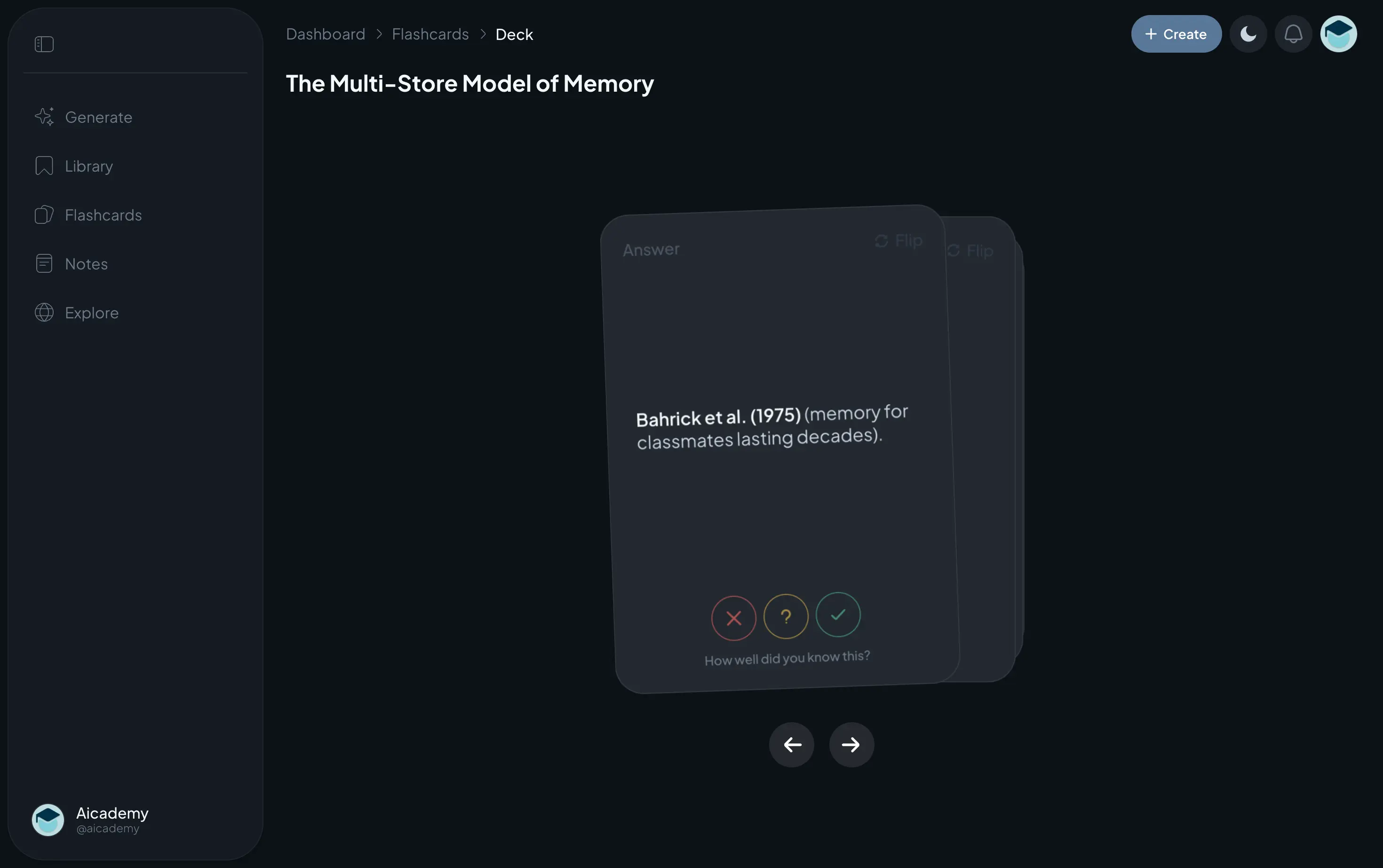
If the one thing keeping you from Anki is the card-building, Aicademy is the most direct fix. Give it any topic, or upload your notes or a PDF, and it generates a full flashcard deck (plus a matching lesson and quiz) in seconds, then reviews it with spaced repetition so the cards you find hard come back sooner. It is built for UK GCSE and A-level, and there is an AI tutor on hand for the cards that keep tripping you up.
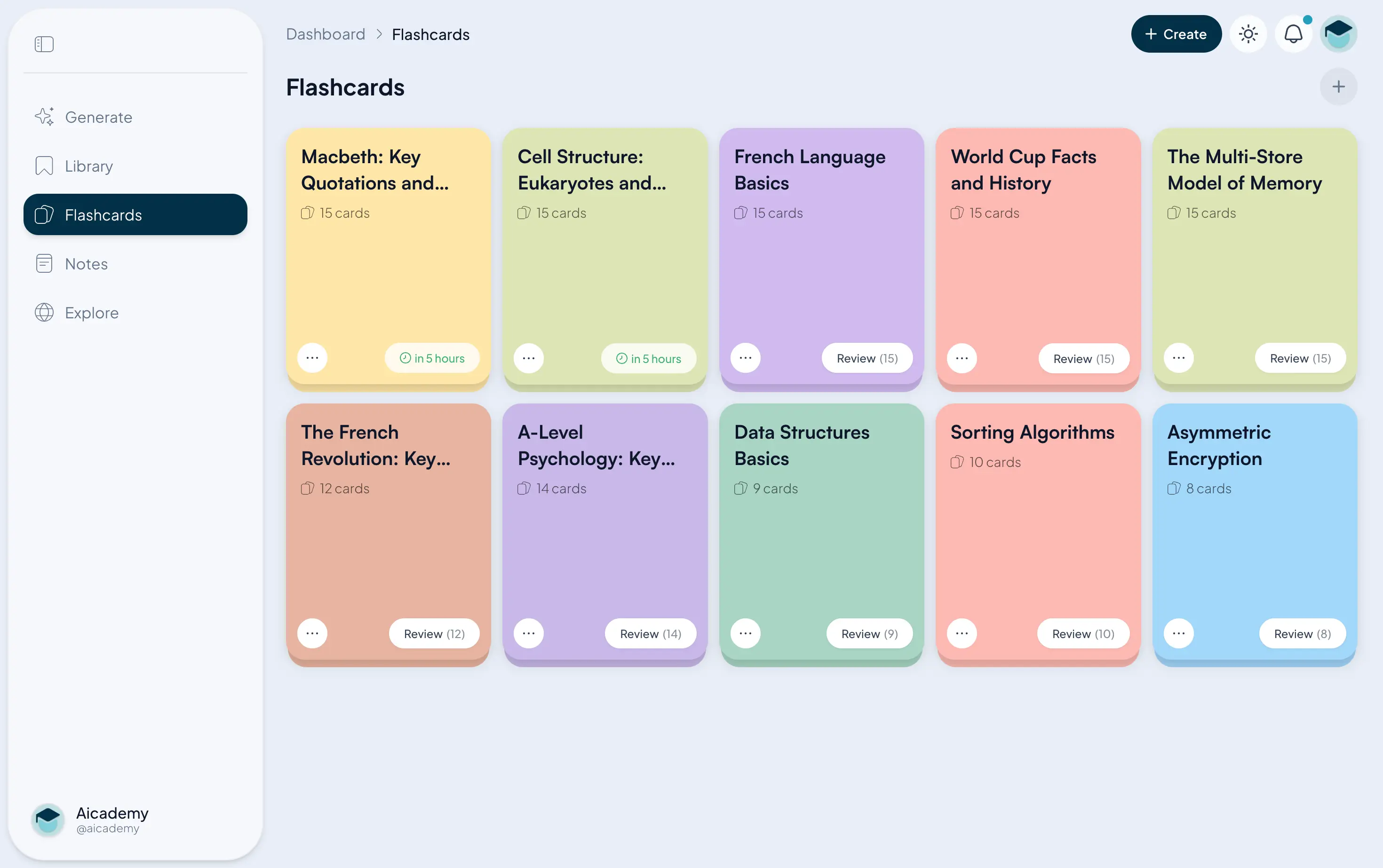
The honest limit: Aicademy’s spaced repetition is not as deeply configurable as Anki’s FSRS, and hardcore users, think medical students running tens of thousands of cards, will still want Anki’s raw control and offline power. Aicademy is for the far larger group who want the benefit of spaced repetition without the setup. It is free to start; unlimited generation and the tutor are £9.99 a month, or £59.99 a year. Anki is free, so what you are paying for is the hours of card-building, plus the lesson, quiz and tutor around the deck. We put the two side by side in Aicademy vs Anki.
Best for: the spaced repetition Anki fans want, minus the card-building and the setup · Free · £9.99/mo
2. Knowt — the most generous free option
Knowt grew up on the backlash to Quizlet’s paywall, and it shows in the best way: its study modes, including spaced repetition, are free with no usage caps, and it will turn your notes, a PDF, or even a video into a deck with AI, again for free. If your budget is zero, this is the tool to try first.
It is not as algorithmically hardcore as Anki, its content leans on user-generated sets you should sanity-check, and it is more US-oriented than UK-exam-specific. But as a genuinely free, card-generating Anki alternative, it is the standout, and we would rather point you to it than pretend it does not exist.
Best for: a genuinely free tool that also generates cards from your notes · Free · paid tiers
3. Quizlet — the easy, ready-made one
Quizlet is the opposite of Anki in temperament: friendly, fast, and backed by millions of ready-made sets, so for many topics you can study in minutes without making anything. Its Learn mode adds a light adaptive element that nudges toward spaced repetition.
The catches are that its scheduling is lighter than true SRS, and it has moved more of its best features behind a paywall in the last couple of years. See Anki vs Quizlet for the full head-to-head, and the best Quizlet alternatives if it is Quizlet’s paywall you are escaping.
Best for: ready-made sets and the gentlest learning curve · Free · paid Plus
4. Brainscape — for curated, high-quality decks
Brainscape uses a confidence-based system: you rate how well you knew each card from 1 to 5, and it schedules accordingly. It is polished, and its real strength is curated, expert-made decks, so you get quality content without building it yourself.
Its scheduling is less precise than Anki’s true SRS, and the free tier caps decks at 100 cards with the best certified content behind Pro. For curated quality over raw algorithm, though, it is a strong pick.
Best for: curated, high-quality decks with confidence-based review · Free tier · paid Pro
5. RemNote — Anki’s power, for note-takers
RemNote is the closest thing to Anki’s power with a gentler on-ramp. You take notes as normal, and turn any line into a spaced-repetition flashcard as you go, so your cards are a by-product of studying rather than a separate chore. The SRS underneath is genuinely strong.
It still has a learning curve (less than Anki, more than Quizlet), and the heaviest features sit on a paid plan. But if you liked the idea of Anki and bounced off the friction, this is the one to try.
Best for: building spaced-repetition cards straight from your notes · Free · paid tiers
6. Memrise — for languages
If your cards are mostly vocabulary, Memrise is worth a look. It pairs spaced repetition with native-speaker video clips and a course structure built specifically for language learning, which is a job Anki does well but plainly.
Outside languages it is much less useful, and it has leaned harder into languages and AI chat over general study. For MFL vocab, though, it is a friendlier ride than a hand-built Anki deck.
Best for: memorising vocabulary for language learning · Free tier · paid
7. StudySmarter — an AI study app with content
StudySmarter wraps flashcards and spaced repetition in a broader study app, with explanations and a library of study sets including some UK GCSE and A-level material. If you want cards as part of a wider app rather than a dedicated SRS tool, it is a reasonable all-rounder.
Content quality and exam-board fit vary by subject, it relies on user-generated sets, and more features move behind a subscription over time, so treat the material critically. Handy, but not a pure spaced-repetition specialist.
Best for: flashcards inside a wider AI study app · Free tier · paid
How to choose (and when to just stick with Anki)
Start honestly: if the friction is not actually stopping you, stay on Anki. Nothing here beats its algorithm or control, and for heavy, long-term memorisation it is still the best, for free, on desktop and Android.
If the friction is stopping you revising, switch to the tool that removes your specific blocker. Hate building cards? Aicademy or Knowt generate them. Skint? Knowt. Want ease and ready-made sets? Quizlet. Want curated quality? Brainscape. Loved Anki’s idea but not its interface? RemNote. Whatever you pick, the thing that actually works is the habit underneath, which is worth understanding in active recall and spaced repetition, and doing well, covered in how to make flashcards that actually work.
To be upfront: Aicademy is our own app, and we have put it first. We have been just as honest about what Anki does better, its algorithm and control are still unmatched, and we have happily pointed you to Knowt as the best free option even though it is not ours. You can try Aicademy free and generate a deck on your weakest topic in seconds.
Frequently asked questions
For pure long-term memory, yes. Anki's spaced-repetition algorithm (now FSRS) is more powerful than Quizlet's, and it is free on desktop and Android. Quizlet is easier to pick up and has millions of ready-made sets, but its scheduling is lighter. We compare them fully in Anki vs Quizlet.
It has a reputation for it, and fairly. The interface looks dated, the settings are deep, and you build every card yourself unless you download a shared deck or add a plugin. That friction, not the memory science, is the main reason students look for an alternative.
Knowt is the most generous genuinely free option, with unlimited study modes and AI that turns your notes or a PDF into cards. Anki itself is free on desktop and Android (only iOS costs a one-off $25). Aicademy has a free tier that generates spaced-repetition decks from any topic or your own notes.
For GCSE and A-level, an easier tool that makes the cards for you usually wins, because the barrier is getting started, not raw algorithm power. Aicademy, Knowt and Quizlet all generate cards quickly. If you specifically want Anki's power with a gentler on-ramp, RemNote is the closest.
With Anki, essentially yes, either by writing them or importing a shared deck. That is exactly what most alternatives fix: tools like Aicademy and Knowt generate a full deck from a topic, your notes or a PDF in seconds, so you spend your time revising rather than building.
Sources
- Anki — downloads & pricing (apps.ankiweb.net)
- Knowt (knowt.com)
- Brainscape (brainscape.com)
- RemNote (remnote.com)
Prices and features were checked as of the date shown and can change. Where a figure could not be confirmed from a primary source, we say so in the text.
Study content creator, Aicademy contributor
Kieran, known online as @sturdythoughts, is a study and productivity creator with a large student following. He shares practical advice on study habits, focus and revision.
Disclosure: Aicademy is the study app made by the team that publishes this blog. We compare it fairly against other tools and cite our sources so you can check everything yourself.
Keep reading
Anki vs Quizlet: which flashcard app is better?
Anki vs Quizlet compared on spaced repetition, ease of use, free tiers and price, with a clear steer on which flashcard app fits you.
The 6 best AI flashcard makers in 2026
The best AI flashcard makers in 2026, compared: apps that generate cards from your notes or a PDF, with spaced repetition, free tiers and prices.
How to make flashcards that actually work
Why most flashcards don't work, how to write ones that do, and how spaced repetition turns them into long-term memory.
Study with more than flashcards
Aicademy generates personalised lessons, quizzes and flashcards from any topic or your own notes, with spaced-repetition revision and an AI tutor.
Lessons on anything
Structured, level-matched lessons on any topic you study
Practice quizzes
Find out what you actually know before the exam does
Flashcard sets
Lock in key concepts with instant revision cards
Ask Aica
Stuck on something? Get a clear explanation, any time
Upgrade to Pro whenever you're ready