Track progress, take quizzes and save notes on this lesson.

Free forever · no card needed

Start free
Foundational

The Pomodoro Technique

AicademyAicademy
·Study Skills
Level
Foundational
Reading time
10 min
Published
6 June 2026
Updated
1 July 2026
On this page
  1. 1.How the Pomodoro Technique Works
  2. 2.Why Breaks Are Not Optional
  3. 3.Running Your First Pomodoro Session
  4. 4.What Counts as a Good Break
  5. 5.Adapting Pomodoro to Different Study Types
  6. 6.Tracking Output: Making Progress Visible
  7. 7.Common Mistakes With the Pomodoro Technique

Key takeaways

  • The Pomodoro Technique structures study into 25-minute focused blocks separated by 5-minute breaks, with a longer 15-30 minute break after every 4 blocks - the breaks are a functional part of the learning process, not a reward.
  • Long unbroken revision sessions front-load the productive work - a student studying for 3 hours without a break often gets one focused hour followed by a long tail of diminishing returns.
  • A broken Pomodoro does not count - if an interruption occurs, reset the timer rather than subtracting time and continuing, because the log only has value if it reflects genuine uninterrupted focus.
  • The Pomodoro Technique manages time and attention but does not determine what you do with that time - combine it with active recall methods for genuine learning gains.

How the Pomodoro Technique Works

The Pomodoro Technique is a time-management method developed by Francesco Cirillo in the late 1980s. It structures study into fixed-length focused blocks separated by short breaks, using a timer to enforce the boundaries.

The standard cycle:

StepDurationDescription
Work block (one Pomodoro)25 minutesSingle task, no interruptions
Short break5 minutesStep away from the work completely
Repeat× 4 Pomodoros
Long break15–30 minutesAfter every 4 Pomodoros

The cycle below shows the rhythm: four work-and-break pairs, then a longer break before the next set begins.
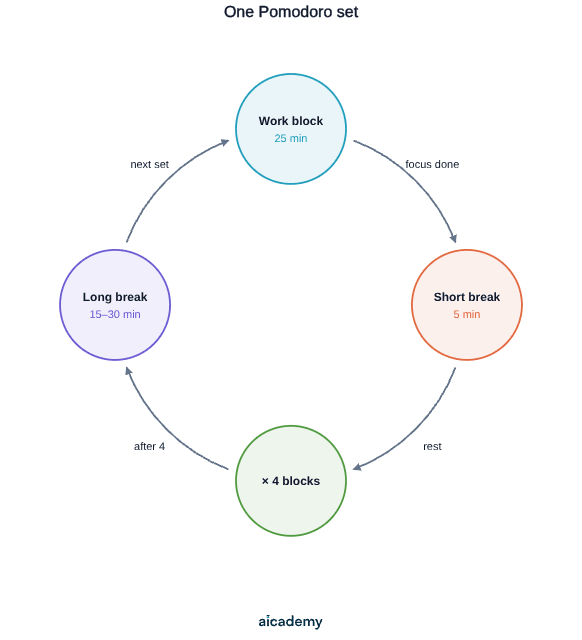
The name comes from the tomato-shaped (pomodoro in Italian) kitchen timer Cirillo used as a student. Any timer works identically — a phone, a watch, a browser extension.

The 25-minute interval was arrived at empirically, not from laboratory research. It is a practical default, not a fixed rule. Many students find that 45- or 50-minute blocks work better for tasks with high start-up cost (essay writing, dense reading) once the basic habit is established. Start with 25 minutes and adjust based on what you observe.

The technique does two things simultaneously: it creates a defined unit of output (one Pomodoro = one block of focused work), and it makes rest mandatory — which is where most students resist it.

Why Breaks Are Not Optional

The breaks in the Pomodoro cycle are not a reward for working — they are a functional part of the learning process.

Sustained focused attention is cognitively demanding. After 20–45 minutes of demanding cognitive work (the exact threshold varies between individuals and tasks), performance on attention-dependent tasks tends to decline — concentration drifts, errors increase, and processing slows. This is a consistent observation in attention research.

Short breaks allow attention to recover. Research on attention restoration (Kaplan, 1989) suggests that rest — particularly passive, undirected rest — reduces the accumulated fatigue of sustained directed attention in a way that simply switching tasks does not. The break is not wasted time; it gives the attentional system a chance to reset before the next work block.

The practical consequence: long unbroken sessions tend to front-load the productive work. A student who studies for 3 hours without a break may get one highly focused hour followed by a long tail of diminishing returns. Structuring work into blocks with enforced breaks tends to distribute focused attention more evenly across the available time.

Working through breaks is not a productivity strategy. It is the primary reason revision sessions feel exhausting and produce little retention.

This also explains why students who study all day can feel they've "done nothing" — long unbroken sessions accumulate hours at the desk while delivering a fraction of the expected learning.

Running Your First Pomodoro Session

Before the session:

  • Write a short task list for the session — no more than 4–6 tasks
  • Rank tasks by difficulty; tackle harder tasks in the first 1–2 Pomodoros, when mental energy is highest
  • Clear the workspace: phone in another room or on Do Not Disturb, browser tabs closed to everything not directly needed for the current task

During a Pomodoro:

  • Work on one task only — do not switch tasks mid-block
  • If something off-topic surfaces (an errand to do, a text to send), write it on a separate distraction list and return to it after the session
  • If an interruption occurs that cannot be ignored, end the Pomodoro — do not try to subtract time and continue. A broken Pomodoro does not count; reset the timer

After each Pomodoro:

Record what you completed in one line. "Finished Q3–Q6 on past paper; identified gaps in enzyme questions" is enough. This log becomes useful after a week.

Example session (2 hours, 4 Pomodoros):

PomodoroTaskBreak
1Attempt past paper Q1–Q4 (timed)Walk, water
2Mark Q1–Q4 using mark scheme; log errorsSit quietly, no screen
3Flashcard review targeting error topicsShort walk
4Free recall: write everything you know about the topic from memoryLong break — 20 min

What Counts as a Good Break

The break determines whether the Pomodoro cycle works. A break that maintains mental load negates the purpose of stopping.

Breaks that work:

  • A short walk (even 5 minutes around the house or outside)
  • Looking out of a window or sitting quietly
  • Light stretching
  • A drink of water or a snack
  • Brief, low-stakes conversation

Breaks that don't work:

  • Scrolling social media or reading news — this keeps the attentional system engaged and prevents the mental reset the break is meant to provide
  • Watching YouTube or any video content
  • Starting a different demanding cognitive task
  • Replying to messages, particularly if the messages are stressful or require a considered response

Research on attention restoration (Kaplan, 1989) shows that recovery requires the absence of directed attention — passive, undirected activity lets the attentional system recover. Research on smartphone interference (Ward et al., 2017) found that even the visible presence of a phone within reach reduces working memory performance and available cognitive capacity, regardless of whether the phone is in use or face-down.

For a break to function as recovery, the prefrontal cortex needs something non-demanding — or nothing at all. Most screen activities do not satisfy this.

During the long break after 4 Pomodoros: eating, a 15-minute walk, or a short nap are all appropriate. Do not use the long break to "get ahead" on another subject — the purpose is recovery, not output.

Something not quite clicking?

Ask Aica to explain any part of this differently. Free, takes 30 seconds.

Ask Aica

Adapting Pomodoro to Different Study Types

The standard 25/5 cycle is a useful starting point but does not fit every task equally well.

Task typeRecommended blockBreakReason
Flashcard review20–25 min5 minShort tasks fit naturally; easy to complete many cycles
Past paper questions25–30 min5 minAligns with typical question timing
Essay writing45–50 min10 minHigh start-up cost — reaching flow takes ~10 min, interrupting at 25 min wastes it
Dense textbook reading25–30 min5–10 minAttention fades; note-taking during the block adds active processing
Problem sets (maths/physics)25–30 min5 minWorks naturally; each problem is a natural checkpoint
Free recall / blank page20 min5 minCognitively demanding; shorter blocks maintain quality

Adjusting the long break interval:

The standard is a long break after every 4 Pomodoros. If using 45-minute blocks, take the long break after every 3 blocks instead — the total focused time (3 × 45 = 135 min) is similar to 4 × 25 before the long break.

When to start with shorter blocks:

If you find yourself drifting after 10–15 minutes, start with 15-minute blocks for one week. The goal is to complete every block without a broken Pomodoro — short completed blocks are more effective than long broken ones.

Tracking Output: Making Progress Visible

Tracking how many Pomodoros you complete per day replaces vague effort ("I studied a lot today") with a concrete, comparable measure.

A simple weekly log:

DateSubjectPomodorosTasks completedNotes
Mon 2 JunChemistry4Topic summary, 8 past QsStruggled with equilibrium Qs
Tue 3 JunMaths3Integration practiceRan out of time on Q12–Q14
Wed 4 JunChemistry4Flashcard review, error drillingImproved on equilibrium
Thu 5 JunBiology4Past paper section B (timed)Missed marks on osmosis explanation
Fri 6 JunMaths3Integration + past paper QsMuch better on definite integrals

After one week, this log shows: how many hours of focused work you actually produced (not just time at the desk), which subjects received attention and which didn't, and where specific gaps appeared across sessions. This is more actionable than a timetable.

The average revision session that feels like 3 hours of work often contains 60–90 minutes of actual focused output. Tracking Pomodoros makes this visible — not as a judgment, but as data you can use to set realistic targets and build the habit gradually.

A useful target for most students: 4–6 Pomodoros per day alongside school or college. That is 100–150 minutes of genuine focused work — more than most students currently achieve in 3 hours at the desk.

Common Mistakes With the Pomodoro Technique

1. Using the phone during the 5-minute break

The most common reason Pomodoro sessions fail. Five minutes of social media reliably extends to 15–20 minutes. Leave the phone in a different room, or use a time-blocking app that prevents access during designated periods. This is not willpower advice — removing the phone physically is more effective than choosing not to use it.

2. Counting interrupted Pomodoros

A Pomodoro that was interrupted — by a conversation, a notification you acted on, a long distraction — is not a completed Pomodoro. Reset the timer. Counting partial blocks inflates the session log and removes its value as a measure of actual focused output.

3. Skipping breaks when a session is going well

When a session is going well, breaking at 25 minutes feels counterproductive. It occasionally is fine to extend a block that's working — experienced practitioners do this. The problem is doing it every session, which removes the structure that makes the technique effective on ordinary days when motivation is low.

4. Using Pomodoro as the entire strategy

The technique manages time and attention. It does not determine what you do with that time. A Pomodoro spent re-reading notes is still re-reading notes. Combine the timing structure with active recall methods — flashcards, past questions, free recall — for the approach to produce real learning gains.

5. Planning too many Pomodoros per day

Planning ten Pomodoros and completing three creates negative feedback and discourages continuation. Planning five and completing five creates the opposite. Start with a conservative target — 3 or 4 per day — and build upward week by week based on your actual completion rate.

Key terms

Pomodoro Technique
A time-management method developed by Francesco Cirillo that structures study into fixed focused blocks (typically 25 minutes) separated by short breaks, with a longer break after every 4 blocks.
attention restoration
The process by which passive, undirected rest reduces the fatigue of sustained directed attention - the theoretical basis for why Pomodoro breaks improve overall session quality.

Frequently asked questions

Sustained focused attention degrades over time - after 20-45 minutes of demanding cognitive work, concentration drifts and processing slows. Short breaks allow the attentional system to recover. Research on attention restoration shows rest reduces accumulated fatigue in a way that simply switching tasks does not.

A short walk, looking out of a window, light stretching, or a drink of water. Social media, YouTube, and replying to messages all keep the attentional system engaged and prevent the mental reset the break is meant to provide. Research shows even the visible presence of a phone reduces working memory performance.

25 minutes is a practical default, not a fixed rule. Essay writing and dense reading have high start-up costs and may work better in 45-50 minute blocks once the habit is established. If you drift after 10-15 minutes, start with 15-minute blocks until you can complete every block without interruption.

Generate revision on any topic you study

Type any topic you're studying and Aicademy generates a complete lesson, quiz, and flashcard set, personalised to your level.

Lessons on anything

Structured, level-matched lessons on any topic you study

Practice quizzes

Find out what you actually know before the exam does

Flashcard sets

Lock in key concepts with instant revision cards

Ask Aica

Stuck on something? Get a clear explanation, any time

Prev

Spaced Repetition and the Forgetting Curve

Related lessons

Top students don’t revise more. They revise what counts.

Start revising free

Free to start. No card needed.