How to Use Past Papers Effectively

- Level
- Foundational
- Reading time
- 11 min
- Published
- 6 June 2026
- Updated
- 16 August 2026
On this page
Key takeaways
- Past papers combine active recall, exam-condition retrieval, and targeted feedback in one activity - the combination is more powerful than any single revision method used separately.
- The difference between students who improve on past papers and those who do not is whether they extract specific, actionable information from each paper - the score tells you little, the specific errors tell you everything.
- Self-marking must be done point by point against the mark scheme, not by overall impression - lenient marking produces inflated scores and misleading feedback about where the actual gaps are.
- Past papers are a finite resource and should be spread deliberately across the revision period - use individual topic questions early, save complete papers for the exam simulation phase in the final weeks.
- Every mark in an exam is worth the same - a 1-mark question you spend 5 minutes on costs you exactly as much as a 5-mark question you leave blank, so time allocation must track mark allocation.
Want more lessons like this one?
Generate lessons on anything you study. Free account, no card needed.
Error Logging — Converting Mistakes into Targets
Completing a past paper produces raw data: marks per question, topics attempted, and specific errors made. Error logging converts this data into a revision plan, and it works as a loop: each marked paper feeds the next round of targeted revision.
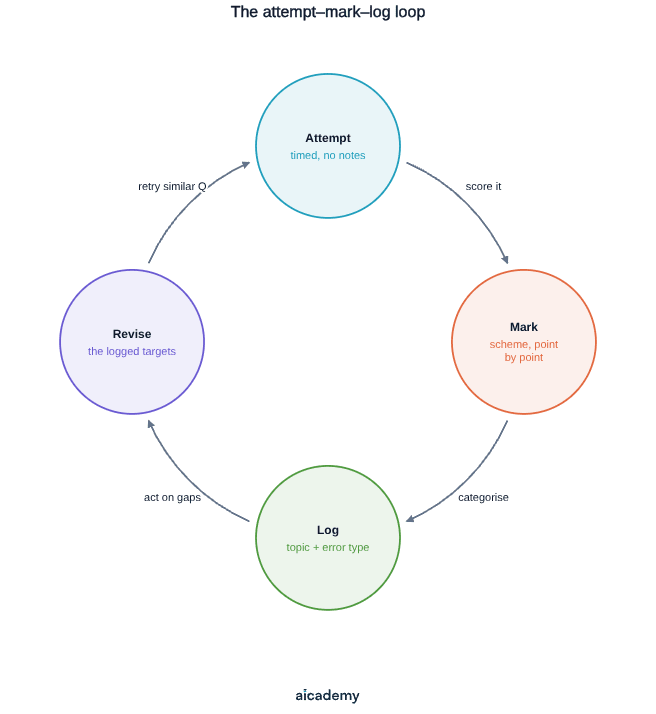
A simple error log format:
| Date | Paper | Question | Topic | Error type | Action taken |
|---|---|---|---|---|---|
| 1 Jun | AQA Bio 2023 P2 | Q3b | Alveoli adaptations | Missing knowledge | Added 2 flashcards (moist lining, capillaries) |
| 1 Jun | AQA Bio 2023 P2 | Q6a | Enzyme denaturation | Missing technique | Rewrote answer using mark scheme language |
| 1 Jun | AQA Bio 2023 P2 | Q8 | Osmosis calculation | Missing knowledge | Re-read osmosis notes; practised 3 more questions |
| 3 Jun | AQA Bio 2022 P2 | Q5c | Osmosis explanation | Missing technique | Wrote model answer using mark scheme; practised again |
After two or three papers, patterns emerge. Osmosis appears in the log four times across two papers — that is the revision priority, not topics where you're already scoring full marks.
The log also prevents a hidden trap: students who do multiple papers without logging errors often repeat the same mistakes across several papers without realising it. The error log makes repeat errors visible and shows whether targeted revision between papers is working.
Targets from error types:
| Error type | Action |
|---|---|
| Missing knowledge | Flashcards; re-read specific section; free recall the topic |
| Missing technique | Study mark scheme language; rewrite the answer correctly; attempt again |
| Misread question | Practise underlining command words before answering |
| Time | Adjust time allocation; practise writing shorter, more direct answers |
Key terms
- error log
- A record of past paper mistakes organised by date, paper, topic, and error type - used to identify patterns across papers and direct targeted revision between attempts.
- deliberate practice
- Practice that incorporates specific, targeted feedback on errors, as described by Ericsson (1993) - past papers with mark schemes are a direct application of this principle.
- command word
- The instruction word in an exam question that specifies the type of response required, such as state, describe, explain, evaluate, or calculate - each carries different mark scheme expectations.
Frequently asked questions
Avoid full papers until content is covered. Use individual topic questions extracted from past papers as you complete each unit. Move to full untimed sections 4-6 weeks before the exam, then full timed papers in the final 2-4 weeks. Save the last few complete papers for exam simulation when timed practice matters most.
Mark each answer against the mark scheme point by point, not by overall impression. For every mark missed, identify whether it was missing knowledge, missing technique, a misread question, or time. Record the specific topic and error type - this becomes your revision target, not the broad subject area.
Describe requires a detailed account of what happens in the correct sequence. Explain requires both a description and the reason why - both parts must be present for full marks. State or name requires only a single correct fact. Using the wrong response type for a command word is one of the most common sources of avoidable mark loss.
Generate revision on any topic you study
Type any topic you're studying and Aicademy generates a complete lesson, quiz, and flashcard set, personalised to your level.
Lessons on anything
Structured, level-matched lessons on any topic you study
Practice quizzes
Find out what you actually know before the exam does
Flashcard sets
Lock in key concepts with instant revision cards
Ask Aica
Stuck on something? Get a clear explanation, any time
Active Recall vs Passive Re-reading
Interleaving Practice
Related lessons
7 min
9 min
10 min
10 min
11 min