Computational Thinking

Aligned to the OCR J277 specification
- Topic
- Algorithms
- Level
- Foundational
- Reading time
- 9 min
- Published
- 11 June 2026
- Updated
- 16 August 2026
On this page
Key takeaways
- Computational thinking has three core principles: abstraction (removing irrelevant detail), decomposition (breaking a problem into sub-problems), and algorithmic thinking (designing a precise step-by-step solution).
- Abstraction is not just simplifying - you must name the specific details removed and explain why they are unnecessary to solve the problem.
- Decomposition sub-problems must each be distinct, concrete, and independently solvable; restating the original problem as a sub-problem scores no marks.
- A correct algorithm must be finite (it terminates), unambiguous (each step has one interpretation), and correct (right output for all valid inputs).
Decomposition — Breaking Problems Down
Decomposition means breaking a large, complex problem into smaller sub-problems that can each be understood, designed, and solved independently.
Why decompose?
- Large problems are too complex to tackle in one step
- Sub-problems can be worked on by different developers simultaneously
- Each sub-problem can be tested separately, making bugs easier to find
- Smaller components are easier to maintain and update
Worked example — decompose "build a quiz game":
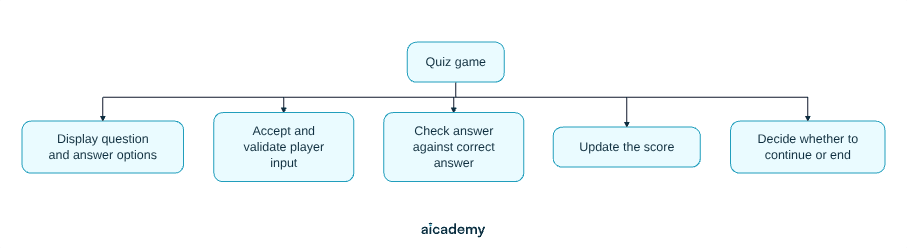
Each box is now a clearly scoped, independently solvable task. None of them requires understanding the others to be designed. Together, they make up the complete problem.
Decompose until each sub-task is small enough to write as a short algorithm.
Studying this for an exam?
Generate a personalised learning path for this subject. Free to get started.
Decomposition in Practice
Each sub-problem from the first decomposition can be decomposed further. Continue until every task is simple enough to write as a straightforward algorithm.
Worked example — expanding "Accept and validate player input":
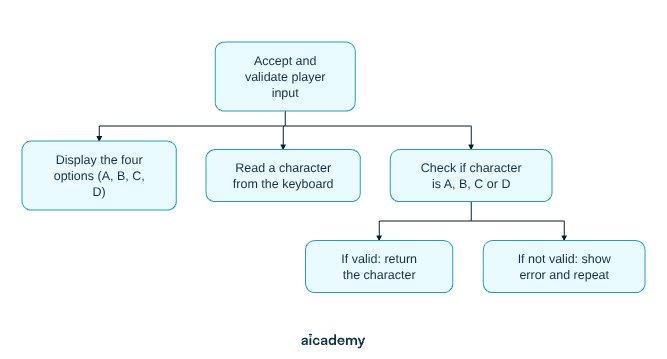
This level of decomposition is concrete enough to turn directly into pseudocode.
Recognising good decomposition — each sub-problem should be:
- A distinct task (not just the original problem reworded)
- Small enough to design in isolation
- Something that produces a clear output or result
| Good sub-problem | Poor sub-problem |
|---|---|
| "Read and validate a player's answer (A–D)" | "Handle the player" |
| "Compare answer to correct answer and return true/false" | "Do the answer stuff" |
| "Add 1 to score if answer is correct" | "Manage the score" |
Key terms
- Computational thinking
- The process of approaching a problem in a way that can be solved by a computer, using abstraction, decomposition, and algorithmic thinking.
- Abstraction
- Identifying and keeping only the details relevant to solving a problem, and deliberately ignoring everything else.
- Decomposition
- Breaking a large, complex problem into smaller sub-problems that can each be understood, designed, and solved independently.
- Algorithmic thinking
- Designing a precise, ordered, finite sequence of steps unambiguous enough for a computer to execute exactly.
- Sub-problem
- A smaller, distinct part of a larger problem produced by decomposition, each solvable independently and contributing to the overall solution.
- Structure diagram
- A hierarchy diagram showing how a problem is decomposed into sub-tasks, with child boxes connected to their parent by lines.
- Algorithm
- A finite, unambiguous, and correct step-by-step process that solves a problem and produces the right output for all valid inputs.
Frequently asked questions
Abstraction means deciding which details are relevant and removing the rest. Decomposition means splitting one large problem into multiple smaller sub-problems. They are separate skills and may be tested separately in the same question.
Each sub-problem should be a distinct task, small enough to design in isolation, and producing a clear output. Vague sub-problems like 'handle the player' or 'do the answer stuff' are not good decomposition - be specific about inputs, processing, and outputs.
A correct algorithm must be finite (it terminates after a defined number of steps), unambiguous (each step has exactly one interpretation), and correct (it produces the right output for all valid inputs).
Generate revision on any topic you study
Type any topic you're studying and Aicademy generates a complete lesson, quiz, and flashcard set, personalised to your level.
Lessons on anything
Structured, level-matched lessons on any topic you study
Practice quizzes
Find out what you actually know before the exam does
Flashcard sets
Lock in key concepts with instant revision cards
Ask Aica
Stuck on something? Get a clear explanation, any time
Designing and Refining Algorithms
Related lessons
9 min
7 min
9 min