Informal Powers of the President

Aligned to the Pearson Edexcel 9PL0 specification
- Topic
- US Presidency
- Level
- Intermediate
- Reading time
- 14 min
- Published
- 9 September 2026
- Updated
- 9 September 2026
On this page
- 1.Why Presidents Need More Than Article II
- 2.The Electoral Mandate and How Quickly It Fades
- 3.Executive Orders: Law Without Congress
- 4.National Events: Crisis as a Source of Power
- 5.The Cabinet: Advice Without Authority
- 6.EXOP: The President's Own Bureaucracy
- 7.The Power to Persuade
- 8.Exam Focus: Common Mistakes
Key takeaways
- Informal powers are not written into the Constitution: the electoral mandate, executive orders, national events, the cabinet, the powers of persuasion and the Executive Office of the President.
- Executive orders direct federal officials and have the force of law, but a successor can revoke them and the courts can strike down executive action that exceeds the statute it relies on, as in Biden v Nebraska (2023).
- The Executive Office of the President was created in 1939 and contains the White House Office, the National Security Council and the Office of Management and Budget.
- The US cabinet advises but does not decide: there is no collective responsibility, members head separate departments and presidents are free to ignore them.
- Richard Neustadt argued that presidential power is essentially the power to persuade, because a president who has to command has already been forced onto weak ground.
Studying this for an exam?
Generate a personalised learning path for this subject. Free to get started.
EXOP: The President's Own Bureaucracy
The Executive Office of the President was created in 1939, after a review concluded that the president needed help. It is the institutional answer to the problem that cabinet departments have their own agendas: EXOP staff work for the president alone.
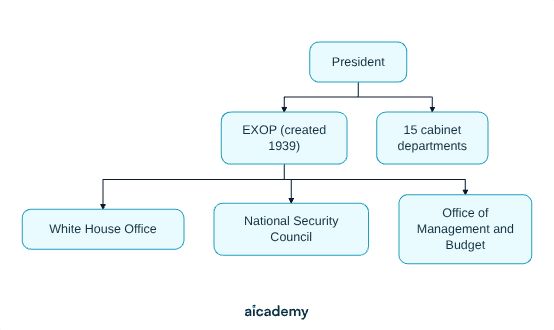
The specification names three bodies within EXOP:
The White House Office (WHO)
The president's closest political and personal staff, headed by the chief of staff, who controls access to the Oval Office. WHO appointments need no Senate confirmation, which makes them fast to make and easy to reverse — and means the staff answer to the president rather than to Congress.
The National Security Council (NSC)
Created by the National Security Act 1947 to coordinate foreign, defence and intelligence advice. Its head, the National Security Adviser, is often more influential than the Secretary of State because of proximity: the NSC staff sit in the White House complex. Obama's NSC ran the planning for the raid that killed Osama bin Laden in May 2011. Trump's first term ran through four national security advisers, beginning with Michael Flynn, who resigned in February 2017 after less than a month in post.
The Office of Management and Budget (OMB)
Descended from the Bureau of the Budget created in 1921 and renamed in 1970, the OMB builds the president's annual budget request and reviews major regulations before agencies issue them. That regulatory review is a quiet but substantial lever: it lets a president shape what the federal bureaucracy does without passing a single law.
Key terms
- Informal powers
- Powers a president exercises that have grown up around the office through practice and precedent rather than being set out in the constitutional text.
- Electoral mandate
- The authority a president claims to pursue a programme because voters chose them and their platform at the election.
- Executive order
- A numbered written instruction from the president to officials of the executive branch, published in the Federal Register and carrying legal force until revoked or struck down.
- Powers of persuasion
- A president's ability to get others to act as they wish by bargaining, trading favours and drawing on the standing of the office rather than by issuing commands.
- EXOP
- The Executive Office of the President: the cluster of agencies and staff that work directly for the president, established in 1939.
- White House Office
- The part of EXOP holding the president's closest political and personal staff, led by the chief of staff and appointed without Senate confirmation.
- Bully pulpit
- The president's use of the visibility of the office to speak over the heads of politicians and press a case directly to the public.
Frequently asked questions
Formal powers are written into the Constitution, chiefly Article II — the veto, treaty-making, appointment, command of the armed forces. Informal powers have grown up around the office without constitutional text, such as executive orders, the electoral mandate and the power to persuade.
Yes. An executive order is an instruction from the president to the executive branch, so a successor can revoke it with a stroke of the pen. The same applies to executive agreements: Trump announced withdrawal from the Paris accord in June 2017 and Biden rejoined it in January 2021, by executive action, not by treaty.
The Executive Office of the President, created in 1939, is the president's own bureaucracy. Its three key bodies are the White House Office (political and personal staff), the National Security Council (foreign and defence advice) and the Office of Management and Budget (the budget and regulations).
Generate revision on any topic you study
Type any topic you're studying and Aicademy generates a complete lesson, quiz, and flashcard set, personalised to your level.
Lessons on anything
Structured, level-matched lessons on any topic you study
Practice quizzes
Find out what you actually know before the exam does
Flashcard sets
Lock in key concepts with instant revision cards
Ask Aica
Stuck on something? Get a clear explanation, any time
Formal Powers of the President
Limits on Presidential Power
Related lessons
15 min
13 min
14 min