Track progress, take quizzes and save notes on this lesson.

Free forever · no card needed

Start free
Intermediate

Formal Powers of the President

Paper 3A, 3.1 Formal sources of presidential power

Aligned to the Pearson Edexcel 9PL0 specification

Level
Intermediate
Reading time
15 min
Published
9 September 2026
On this page
  1. 1.Article II: The Constitutional Grant of Power
  2. 2.Head of State: Speaking for the Nation
  3. 3.Head of Government: Directing the Executive Branch
  4. 4.The Veto and the Override Arithmetic
  5. 5.Commander-in-Chief and the Treaty Power
  6. 6.Appointments: The Power That Outlasts a Presidency
  7. 7.How Much Do the Formal Powers Actually Deliver?
  8. 8.Exam Focus: Common Mistakes

Key takeaways

  • The president's formal powers come from Article II, plus the veto in Article I, Section 7: command of the armed forces, treaty-making, appointment, pardon and the duty to execute the laws faithfully.
  • The president is head of state and head of government at once, unlike the UK where the two roles are held by different people. The same person embodies the nation and directs its government.
  • A veto is overturned only by two-thirds of both chambers. Between 2001 and 2025 four US presidents issued 47 vetoes and Congress overrode six of them.
  • Treaties need the consent of two-thirds of senators, which is why presidents since 2000 have preferred executive agreements such as the 2015 Iran nuclear deal and the Paris climate accord.
  • Judicial appointments outlast a presidency: five of the six Republican appointees on the Supreme Court as of September 2026 were nominated between 2005 and 2020, and the sixth, Clarence Thomas, in 1991.

Article II: The Constitutional Grant of Power

The president's formal powers are the ones written down in the Constitution. Almost all of them sit in Article II, with the crucial exception of the veto, which appears in Article I.

Article II is strikingly short — around a thousand words, under half the length of the article that creates Congress. That brevity matters: the Founders spent far longer describing the legislature than the executive, and the gaps they left have been filled by two centuries of argument.

PowerWhat the Constitution grantsWhere
Vesting clause"The executive Power shall be vested in a President of the United States"Art. II, §1
Commander-in-chiefCommand of the army, navy and the state militias when called into federal serviceArt. II, §2
PardonReprieves and pardons for offences against the United States, except in impeachment casesArt. II, §2
Treaty-makingPower to make treaties, with the consent of two-thirds of senators presentArt. II, §2
AppointmentNomination of ambassadors, federal judges and senior officers, with Senate confirmationArt. II, §2
State of the UnionReports to Congress and recommends measures for its considerationArt. II, §3
Take care clauseDuty to "take Care that the Laws be faithfully executed"Art. II, §3
VetoReturns a bill to Congress with written objectionsArt. I, §7

Two later amendments shape the office as much as Article II does. The 22nd Amendment (1951) limits a president to two elected terms. The 25th Amendment (1967) sets out succession and what happens if a president becomes incapable of serving.

Almost every one of these powers is shared. The treaty power needs the Senate, the appointment power needs the Senate, the veto can be beaten by Congress, and the money to act on any of them is voted by Congress. The pardon is the standout exception — it needs nobody else's agreement at all.

Head of State: Speaking for the Nation

The Constitution gives one person two jobs that most democracies split. As head of state, the president is the ceremonial and symbolic embodiment of the United States — a role the UK gives to the monarch, not the Prime Minister.

The head-of-state role covers:

  • Chief diplomat. Receiving ambassadors, hosting state visits, representing the US at summits, and negotiating with foreign governments.
  • Commander-in-chief. Standing at the head of the armed forces, including at moments of national mourning.
  • Chief citizen. Speaking for the country after disasters, attacks and tragedies.
  • Clemency. The federal pardon power, exercised in the nation's name.

Worked example — the head-of-state role at full strength. Three days after the attacks of 11 September 2001, George W. Bush stood on the rubble at Ground Zero with a bullhorn and addressed rescue workers. His Gallup approval rating reached 90% later that month, the highest ever recorded for a president in that poll. Nothing in Article II produced that authority: it came from occupying the one office that can speak for the whole country at once.

Worked example — the pardon power. In July 2007 Bush commuted the 30-month prison sentence of Lewis "Scooter" Libby, a former vice-presidential chief of staff, while stopping short of a full pardon; Donald Trump pardoned Libby outright in April 2018. In January 2017 Barack Obama commuted the 35-year sentence of Chelsea Manning. The power is close to unreviewable, but it reaches federal offences only — a president cannot pardon a state crime, and cannot pardon an impeachment.

Head of Government: Directing the Executive Branch

As head of government, the president runs the federal executive: roughly two million civilian employees across fifteen departments and hundreds of agencies. The constitutional hook is the take care clause, the duty to see that the laws are faithfully executed.

Three formal levers define the job:

  1. Appointing the people who run it. Cabinet secretaries and senior officials are nominated by the president and confirmed by the Senate.
  2. Proposing the budget. Since the Budget and Accounting Act 1921 the president submits an annual budget request. Congress holds the purse, but the president sets the opening terms of the argument.
  3. Setting the legislative agenda. The Constitution requires the president to recommend measures to Congress. In practice that means the State of the Union address and a programme of flagship bills.

Worked example — the legislative agenda since 2000. Each president's domestic record can be read directly off the bills they drove through Congress:

PresidentFlagship domestic legislationParty control of Congress at the time
George W. BushNo Child Left Behind Act (2002); Medicare prescription drug expansion (2003)Republican House throughout 2001–07; the Senate was Democratic-held from June 2001 until January 2003, so No Child Left Behind cleared a Democratic Senate
Barack ObamaAffordable Care Act (2010); Dodd-Frank financial reform (2010)Democratic in both chambers, 2009–11
Donald Trump (first term)Tax Cuts and Jobs Act (2017)Republican in both chambers, 2017–19
Joe BidenInfrastructure Investment and Jobs Act (2021); Inflation Reduction Act (2022)Democratic by the narrowest of margins, 2021–23

The pattern is worth noticing early: the signature achievements cluster in the window when the president's party controlled Congress. The formal power to recommend legislation delivers very little on its own.

The Veto and the Override Arithmetic

The veto is the president's sharpest formal weapon against Congress. A bill passed by both chambers goes to the president, who has ten days (Sundays excepted) to act.

The routes a bill can take are set out below.
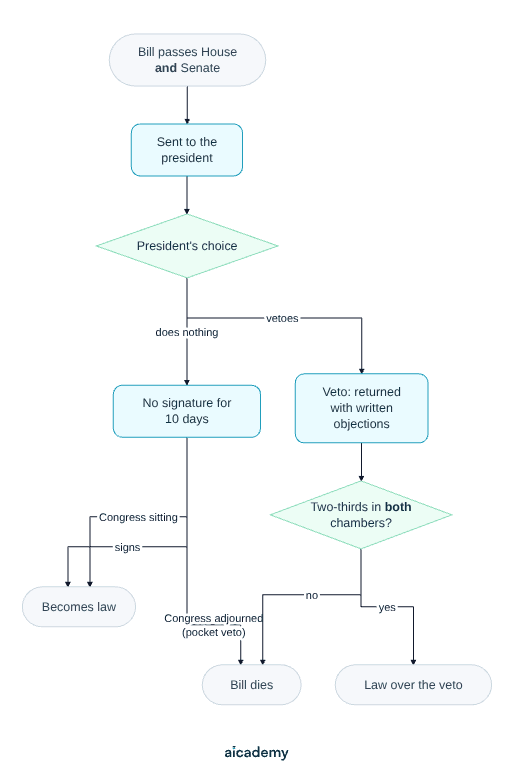
Flowchart of a bill reaching the president: signing makes it law; a veto returns it to Congress, where two-thirds of both chambers can still pass it; no action for ten days makes it law if Congress is sitting but kills it if Congress has adjourned.

An override needs two-thirds of those voting in each chamber — in a full House, 290 of 435 votes, and in the Senate 67 of 100. The record since 2001 shows how rarely that happens:

PresidentVetoesOverridden by Congress
George W. Bush (2001–09)124
Barack Obama (2009–17)121
Donald Trump (2017–21)101
Joe Biden (2021–25)130

Worked example — the one that got through. In September 2016 Obama vetoed the Justice Against Sponsors of Terrorism Act, which let families of 9/11 victims sue Saudi Arabia. Congress overrode him within days: 97–1 in the Senate and 348–77 in the House. It was the only override of his eight years, and it came on an issue where opposing the bill looked politically impossible for members of either party.

Worked example — an override by a president's own party. Trump vetoed the National Defense Authorization Act on 23 December 2020, objecting to a provision renaming military bases named after Confederate commanders. The Republican-led Senate overrode him 81–13 on 1 January 2021, after a House vote of 322–87. A veto is beaten when the issue splits the president from his own party in Congress, not when the opposition simply dislikes it.

Something not quite clicking?

Ask Aica to explain any part of this differently. Free, takes 30 seconds.

Ask Aica

Commander-in-Chief and the Treaty Power

In foreign affairs the president's formal powers look strongest — and it is here that the gap between the text and the practice is widest.

Commander-in-chief. The Constitution gives Congress the power to declare war and the president the power to direct the forces. Congress has not formally declared war since June 1942. Instead it passes broad authorisations:

  • The Authorization for Use of Military Force, passed on 14 September 2001 by 98–0 in the Senate and 420–1 in the House, was still being used to justify operations under Bush, Obama, Trump and Biden.
  • A separate authorisation in October 2002 preceded the invasion of Iraq in March 2003.
  • Obama ordered the raid that killed Osama bin Laden in May 2011 and committed US forces to the Libya intervention the same year without seeking congressional authorisation.
  • Trump ordered the strike that killed the Iranian commander Qasem Soleimani in January 2020; when Congress passed a war powers resolution restraining further action, he vetoed it in May 2020 and the Senate could not override.
  • Biden ordered the completion of the withdrawal from Afghanistan in August 2021.

The War Powers Resolution 1973 requires a president to notify Congress within 48 hours of committing forces and to withdraw them within 60 days without congressional authorisation. Presidents since 2000 have reported under it while disputing that it binds them, and Congress has not enforced it against any of them.

Treaty-making. A treaty needs the consent of two-thirds of senators — 67 votes if all are present. Obama secured that for the New START nuclear arms treaty with Russia in December 2010, ratified 71–26. He did not attempt it for the 2015 Iran nuclear agreement or the Paris climate accord, handling both as executive agreements instead.

That choice has a price. Trump withdrew the US from the Iran agreement in May 2018 and announced withdrawal from the Paris accord in June 2017; Biden rejoined the Paris accord in January 2021. What one president can do alone, the next can undo alone.

Appointments: The Power That Outlasts a Presidency

The appointment power is the formal power with the longest reach. Federal judges, including Supreme Court justices, serve for life, so a nomination confirmed today shapes policy decades after a president leaves office.

PresidentSupreme Court justices confirmed
George W. BushJohn Roberts as Chief Justice (2005); Samuel Alito (2006)
Barack ObamaSonia Sotomayor (2009); Elena Kagan (2010)
Donald Trump (first term)Neil Gorsuch (2017); Brett Kavanaugh (2018); Amy Coney Barrett (2020)
Joe BidenKetanji Brown Jackson (2022)

Worked example — the power that failed. Justice Antonin Scalia died in February 2016. Obama nominated Merrick Garland the following month, but the Republican-controlled Senate declined to hold hearings, arguing that the seat should be filled after the November election. The vacancy was filled by Gorsuch in 2017. Obama held the formal power to nominate; he did not hold the Senate, and the power delivered nothing.

The consequences are still visible. As of September 2026 the Supreme Court has a 6–3 majority of Republican-appointed justices — Roberts, Thomas, Alito, Gorsuch, Kavanaugh and Barrett, against Sotomayor, Kagan and Jackson. Every one of those Republican appointees except Clarence Thomas was nominated between 2005 and 2020, which is to say by presidents within this specification's reference window.

Senate confirmation applies to executive appointments too, though rejection is rare. Nominees who look likely to fail usually withdraw first, as Trump's first Labor Secretary nominee Andrew Puzder did in February 2017.

How Much Do the Formal Powers Actually Deliver?

The specification asks for the significance of these powers with reference to presidents since 2000. The honest answer is that significance varies enormously, and three factors explain most of the variation.

1. Whether the president's party controls Congress. Bush passed his tax cuts and education reform with Republican majorities; after the 2006 midterms his vetoes started being overridden, beginning with the Water Resources Development Act in November 2007. Obama's two landmark statutes both date from 2010, the last year he held both chambers.

2. Whether the power is shared or unilateral. The pardon, the direction of military operations and the recognition of foreign governments need no other institution's agreement. The treaty power, the appointment power and the budget all do. Presidents since 2000 have drifted steadily towards the unilateral end — which is why executive agreements have displaced treaties.

3. Whether the country is in crisis. The same commander-in-chief clause produced near-unanimous congressional support for Bush in September 2001 and sustained criticism of Obama over Libya in 2011. The text did not change; the political weather did.

A strong exam judgement is that the formal powers are best understood as opportunities rather than guarantees. They define what a president is entitled to attempt. Whether the attempt succeeds is settled by Congress, the courts and public opinion — which is the subject of the informal powers and the limits on power.

Exam Focus: Common Mistakes

1. Treating the formal powers as a list to be recited

Each Paper 3A Section C essay is worth 30 marks and carries 10 for AO3. Listing Article II powers earns AO1 credit only. Every power you name should be attached to a president since 2000 and to a judgement about whether it worked.

2. Using presidents from before 2000

Issue 4 of the specification moved the reference window: the required range now runs from George W. Bush (2001–09) onwards. Examples drawn from Bill Clinton or George H. W. Bush sit outside it, and past papers you may find online still use the older 1992 window. Build your case on Bush, Obama, Trump and Biden.

3. Confusing head of state with head of government

These are two roles held by one person, not two names for the same thing. Comforting a grieving town is head of state; forcing a budget through Congress is head of government. Comparative questions with the UK turn on exactly this distinction, since the UK splits the roles between the monarch and the Prime Minister.

4. Saying the president "declares war"

Congress declares war. The president commands the forces once they are committed. Since 2000 the practical route has been a broad congressional authorisation, or no authorisation at all — describe what actually happens rather than what the textbook diagram implies.

5. Calling every presidential document an executive order

Vetoes, executive orders, executive agreements, signing statements and presidential memoranda are distinct instruments with different legal footings. Only the veto is a formal Article I power; the others belong in the informal-powers material and should be labelled as such.

6. Forgetting that formal powers are shared

The strongest answers make the sharing the argument rather than a footnote. Treaty-making without 67 senators, appointment without confirmation and a veto without a sustaining third of one chamber are all incomplete powers. Say so, and you are already doing AO2.

Key terms

Formal powers
The powers a president holds because the text of the Constitution grants them, chiefly through Article II.
Executive branch
The arm of the federal government that carries out and enforces federal law, headed by the president and staffed by the departments and agencies.
Head of state
The role in which a president represents and speaks for the nation as a whole, above party, in ceremony and in dealings with other countries.
Head of government
The role in which a president directs the machinery of the federal government, sets a policy agenda and takes responsibility for delivering it.
Veto
The president's power to reject a bill passed by Congress by returning it with written objections, blocking it unless two-thirds of each chamber vote again in favour.
Pocket veto
A bill that dies because the president neither signs nor returns it within ten days and Congress adjourns before the period ends, leaving Congress with no way to override.
Executive agreement
A binding international understanding reached by a president without submitting it to the Senate as a treaty, and therefore reversible by a later president.

Frequently asked questions

The powers written into the Constitution: commander-in-chief of the armed forces, making treaties with Senate consent, nominating judges and officials, granting federal pardons, recommending legislation, executing the laws faithfully, and vetoing bills passed by Congress.

Both. The Constitution fuses the two roles in one office, so the president is simultaneously the ceremonial embodiment of the nation and the working chief executive who runs the federal government. In the UK those roles are split between the monarch and the Prime Minister.

By passing the vetoed bill again with a two-thirds majority in both the House and the Senate. That is a high bar: Barack Obama had one veto overridden in eight years, Donald Trump one in his first term, and Joe Biden none at all.

Generate revision on any topic you study

Type any topic you're studying and Aicademy generates a complete lesson, quiz, and flashcard set, personalised to your level.

Lessons on anything

Structured, level-matched lessons on any topic you study

Practice quizzes

Find out what you actually know before the exam does

Flashcard sets

Lock in key concepts with instant revision cards

Ask Aica

Stuck on something? Get a clear explanation, any time

Prev

Congressional Oversight

Next

Informal Powers of the President

Related lessons

14 min

Lesson

Informal Powers of the President

A-Level Politics · Pearson Edexcel 9PL0

2 hours ago

13 min

Lesson

Limits on Presidential Power

A-Level Politics · Pearson Edexcel 9PL0

2 hours ago

13 min

Top students don’t revise more. They revise what counts.

Start revising free

Free to start. No card needed.