Track progress, take quizzes and save notes on this lesson.

Free forever · no card needed

Start free
Intermediate

Limits on Presidential Power

Paper 3A, 3.3 The presidency (3.3.1 relationships·3.3.2 limitations)

Aligned to the Pearson Edexcel 9PL0 specification

Level
Intermediate
Reading time
13 min
Published
9 September 2026
On this page
  1. 1.The Same Office, Very Different Amounts of Power
  2. 2.The Presidency and Congress: A Relationship That Shifts
  3. 3.The Presidency and the Supreme Court
  4. 4.Congress as a Limit: Money, Laws, Oversight, Impeachment
  5. 5.The Courts and the Constitution as Limits
  6. 6.The Election Cycle: Power Across a Term
  7. 7.Divided and Unified Government
  8. 8.Exam Focus: Common Mistakes

Key takeaways

  • Presidential power varies with the calendar: it is highest in the honeymoon year, falls after the midterms, which the president's party lost in every contest from 2006 to 2022, and falls again in a second term.
  • Unified government means one party holds the presidency, the House and the Senate; divided government means the president's party does not. As of September 2026 Trump has had unified government since January 2025.
  • Congress limits a president through the purse, legislation, confirmation, oversight, veto overrides and impeachment. Trump was impeached in December 2019 and January 2021, and the Senate acquitted him both times.
  • The Supreme Court struck down Trump's IEEPA tariffs and his federalising of the Illinois National Guard, yet of 26 rulings on challenges to his administration in 2025 the administration won 21.
  • The 22nd Amendment caps a president at two elected terms, which converts a re-elected president into a lame duck with declining leverage over Congress.

The Same Office, Very Different Amounts of Power

The specification asks why limitations on presidential power vary between presidents. The answer is that the constitutional limits barely change while the political conditions around them change constantly.

Four categories of limitation are named, and they interlock:

LimitWhat it can stopWhat makes it bite harder or softer
CongressLegislation, funding, appointments, treaties, warParty control, size of majority, party unity, presidential approval
Supreme Court and ConstitutionExecutive action that exceeds statute or the ConstitutionIdeological balance of the Court, who appointed the justices
Term in officeEverything, graduallyHoneymoon, midterms, lame-duck status under the 22nd Amendment
Election cycle and divided governmentAlmost any domestic agendaWhether the president's party holds the House and the Senate

The test of any limit is not whether it exists on paper but whether it has recently been used. Congress has held the power of the purse since 1789; it became a serious constraint on Barack Obama only after November 2010, and on Donald Trump only after November 2018.

The Presidency and Congress: A Relationship That Shifts

Section 3.3.1 asks about the relationship between the presidency and Congress and why it varies. Five variables do most of the explaining.

  1. Which party holds each chamber. This is the largest single factor and is settled by elections the president does not control.
  2. The size of the majority. Biden's Senate in 2021–23 was split 50–50 with the Vice-President breaking ties, so a single Democratic senator could stop a bill.
  3. Party unity. A nominal majority is worthless when it splits. Trump held Republican majorities in both chambers in 2017 and still lost the vote to repeal the Affordable Care Act.
  4. Presidential approval. Members of Congress from marginal districts run towards a popular president and away from an unpopular one.
  5. Where the president is in the term. Legislative wins cluster in the first two years.

Worked example — one senator as the limit. Biden's Build Back Better package passed the House in November 2021. In December 2021 Senator Joe Manchin, a Democrat from West Virginia, announced he would not support it, and with a 50–50 Senate that ended the bill. A much smaller package became the Inflation Reduction Act, signed in August 2022. Unified government did not deliver what the president asked for.

Worked example — a majority that split. In July 2017 Trump had unified government and had campaigned on repealing the Affordable Care Act. The Senate rejected the repeal bill 49–51 when three Republican senators, including John McCain, voted against. Party control produced the opportunity; party unity determined the outcome.

The Presidency and the Supreme Court

The relationship with the Court runs in both directions. Presidents shape it through appointments; it constrains them through judicial review.

What the president brings to the relationship: nomination of justices, who then serve for life; the Solicitor General, who argues the administration's case; and the choice of which policies to defend in court.

What varies: how many vacancies arise on a president's watch, whether the Senate will confirm, and how the sitting justices read the law. Trump nominated three justices in a single term. Obama, over eight years, nominated two who were confirmed and one who received no hearing.

Worked example — the Court as a brake. In Hamdan v Rumsfeld (2006) the Court held that the military commissions Bush had established at Guantánamo Bay were not authorised; in Boumediene v Bush (2008) it held that detainees there could challenge their detention in federal court. In NLRB v Noel Canning (2014) it invalidated recess appointments made by Obama. In Biden v Nebraska (2023) it struck down the administration's student loan forgiveness scheme.

Worked example — the Court as an enabler. In Trump v Hawaii (2018) the Court upheld the third version of the travel ban. In July 2024 it held that a president is immune from criminal prosecution for most acts carried out in an official capacity — a ruling that expanded the protection around the office rather than restricting it.

As of September 2026 the Court has a 6–3 majority of Republican-appointed justices. Commentators increasingly describe a three-way split rather than a simple bloc: a liberal group of Sotomayor, Kagan and Jackson; a centre-right pair in Roberts and Kavanaugh; and Thomas, Alito, Gorsuch and Barrett more consistently conservative. That structure explains why the Court has ruled against a Republican president in specific, high-profile cases.

Congress as a Limit: Money, Laws, Oversight, Impeachment

Congress holds six practical instruments against a president. Each has been used since 2000.

The power of the purse

Congress can refuse to fund what a president wants. Obama signed an executive order on his second full day in office in January 2009 directing that the Guantánamo Bay detention facility be closed; Congress attached provisions to successive defence bills barring the transfer of detainees, and the facility was still open when he left in 2017.

Refusing to legislate

Bush's plan to part-privatise Social Security in 2005 died without a floor vote under a Republican Congress. Biden's voting rights legislation failed in the Senate in January 2022 because the filibuster could not be set aside.

Control of appointments

The Senate declined to hold hearings on Merrick Garland's nomination to the Supreme Court in 2016, leaving the vacancy for the next president to fill.

Oversight

Committee hearings, subpoenas and investigations impose political costs even when they change no law. The 2019 House inquiry into Trump's dealings with Ukraine drew testimony from serving diplomats, including the acting ambassador to Ukraine, and produced the evidence for the first impeachment.

The veto override

Congress overrode Trump's veto of the National Defense Authorization Act by 322–87 in the House on 28 December 2020 and 81–13 in the Senate on 1 January 2021 — a Republican-led Senate overriding a Republican president.

Impeachment

Worked example — the limit that did not bind. Trump was impeached by the House in December 2019 on charges of abuse of power and obstruction of Congress. The Senate acquitted him on 5 February 2020, by 52–48 on the first article and 53–47 on the second; conviction needed 67 votes. He was impeached again in January 2021 for incitement of insurrection and acquitted by 57–43, ten votes short. Seven Republican senators voted to convict on that occasion, and ten Republican members of the House had voted to impeach.

The point worth making in an essay is the reason for the failure: in an era of intense party loyalty, senators of the president's party face a greater threat from their own primary voters than from the charge itself. Impeachment is the most dramatic form of oversight and the least likely to succeed.

How much of this have you taken in?

Quiz yourself on this section, free, no card needed.

Test myself

The Courts and the Constitution as Limits

The Constitution. The 22nd Amendment caps a president at two elected terms. Federalism reserves large areas of policy — policing, education, elections — to the states, which is why state officials and state courts appear so often in disputes with the White House. Amending the Constitution requires two-thirds of both chambers and ratification by three-quarters of the states, so a president who loses a constitutional argument has almost no route around it.

The courts in the second Trump term. Two rulings show the limit working:

  • In December 2025 six justices held that Trump lacked the authority to take control of the Illinois National Guard and deploy it to Chicago over the objections of local officials.
  • In February 2026 the same six held that he could not use the International Emergency Economic Powers Act 1977 to impose sweeping import tariffs, because the Constitution reserves taxing powers to Congress. Chief Justice Roberts, Amy Coney Barrett and Neil Gorsuch joined the three liberal justices; two of the three were Trump's own appointees.

The counter-evidence matters just as much. Of 26 rulings on challenges to administration actions during 2025, the administration won 21. A limit that operates in a fifth of contested cases is real but partial, and the honest judgement is that the Court has restrained this president at the outer edges rather than across his programme.

A useful distinction for essays: the courts limit the method far more often than the goal. A policy struck down for exceeding a statute can frequently be reintroduced on a different legal basis, or pursued through Congress instead.

The Election Cycle: Power Across a Term

Presidential power follows a predictable arc, and the midterm elections are the sharpest break in it.
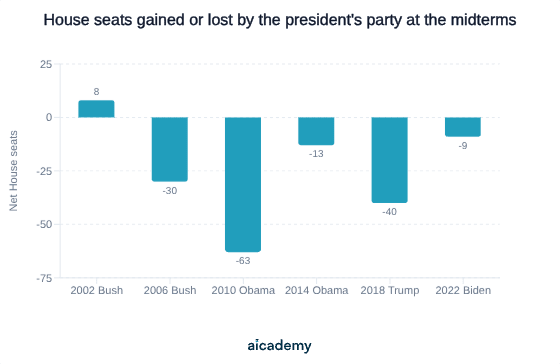
Bar chart of House seat changes for the president's party: a gain of 8 in 2002 under Bush, then losses of 30 in 2006, 63 in 2010 under Obama, 13 in 2014, 40 in 2018 under Trump and 9 in 2022 under Biden.

The 2002 result is the exception that proves how the arc works. Fourteen months after the attacks of 11 September 2001, Bush's party gained House seats — the crisis had suspended the normal midterm penalty. Every midterm from 2006 to 2022 went the other way, with the scale of the loss tracking the president's standing: Obama lost 63 seats in 2010 amid the backlash to the Affordable Care Act, and Biden lost only 9 in 2022.

The arc has three phases:

  1. The honeymoon. Approval is at its peak, the mandate is fresh, and the president's party has just been elected alongside them. Almost every major statute since 2000 dates from this phase.
  2. The midterm correction. The majority shrinks or disappears. Bush faced a Democratic Congress from 2007, Obama a Republican House from 2011, Trump a Democratic House from 2019, Biden a Republican House from 2023.
  3. The lame duck. Barred from re-election by the 22nd Amendment, a second-term president has less to offer allies and less to threaten opponents with. Attention moves to the successor.

The next test is fixed: the midterm elections fall on 3 November 2026. Republicans are defending 22 of the 35 Senate seats being contested, and the House majority is narrow enough that a small number of losses would change control.

Divided and Unified Government

Unified government means one party holds the presidency, the House and the Senate. Divided government means it does not. Since 2003 the pattern has flipped repeatedly — and in the two years before that, Bush lost control of the Senate mid-Congress when a Republican senator left the party in June 2001:

PeriodCongressGovernmentWhat it produced
2003–07RepublicanUnified under BushTax cuts, Medicare drug expansion — but Social Security reform still failed
2007–09DemocraticDivided under BushFour veto overrides in Bush's final two years
2009–11DemocraticUnified under ObamaRecovery Act, Affordable Care Act, Dodd-Frank
2011–17Republican HouseDivided under ObamaGovernment shutdown in October 2013; Garland nomination blocked
2017–19RepublicanUnified under TrumpTax Cuts and Jobs Act; failed health care repeal
2019–21Democratic HouseDivided under TrumpTwo impeachments; the 35-day shutdown over border wall funding
2021–23Democratic, 50–50 SenateUnified under BidenInfrastructure Act, Inflation Reduction Act
2023–25Republican HouseDivided under BidenDebt ceiling standoff, resolved by the Fiscal Responsibility Act in June 2023
2025–27RepublicanUnified under TrumpHouse 220–215 and Senate 53–47 at the start of the Congress

Worked example — divided government at its sharpest. After Democrats took the House in the 2018 midterms, Trump could not get funding for a border wall. The dispute closed much of the federal government for 35 days from December 2018 to January 2019, the longest shutdown in US history. Trump then declared a national emergency in February 2019 to redirect military construction funds. Congress passed a resolution terminating the emergency; he vetoed it, and Congress could not reach the two-thirds needed to override.

That single episode contains the whole topic: Congress blocking a policy, a president routing around the block by informal means, Congress responding formally, and the veto settling it. Unified government since January 2025 removes the first move in that sequence — which is exactly why the November 2026 midterms carry so much weight.

Exam Focus: Common Mistakes

1. Listing checks and balances instead of explaining variation

Section 3.3.2 asks why limitations vary between presidents. An answer that describes the veto override, judicial review and impeachment in the abstract answers a different question. Anchor every limit to a named president, a date and an outcome.

2. Treating impeachment as an effective check

It has been brought against a president four times in US history — Andrew Johnson in 1868, Bill Clinton in 1998 and Donald Trump twice — and has produced no conviction. Trump's acquittals in 2020 and 2021 are the strongest available evidence that party loyalty, not the evidence, determines the result. Describe it as the most dramatic and least effective instrument Congress holds.

3. Assuming unified government guarantees success

Bush had unified government and lost on Social Security in 2005. Trump had it and lost on health care in 2017. Biden had it and lost Build Back Better in 2021. Unified government removes one obstacle; party unity, the filibuster and individual senators remain.

4. Overstating the Supreme Court as a check

The tariffs and National Guard rulings are genuine defeats for a president, and they are the exception in the record they come from: the administration won 21 of the 26 rulings on challenges to its actions in 2025. Quote both figures and the judgement writes itself.

5. Using presidents from before 2000

Issue 4 moved the reference window to George W. Bush (2001–09) onwards. Watergate and Nixon remain useful for defining the imperial presidency debate, but the evidence Pearson expects for 3.3 comes from Bush, Obama, Trump and Biden. Older mark schemes still use the 1992 window.

6. Writing about the 2026 midterms as though they have happened

They fall on 3 November 2026. Write about them in the future tense — as a test the president's unified government has yet to face — and date-stamp every claim about party control alongside it.

Key terms

Divided government
A situation in which the presidency is held by one party while the opposing party controls the House of Representatives, the Senate, or both.
Unified government
A situation in which one party simultaneously holds the presidency and majorities in both chambers of Congress.
Lame duck
A president in the closing stage of a term who cannot seek re-election, and whose ability to reward or threaten other politicians falls away as a result.
Impeachment
The process by which the House of Representatives charges a federal office-holder with misconduct and the Senate tries the charge, with conviction requiring two-thirds of senators.
Judicial review
The power of the courts to declare an act of the executive or of Congress incompatible with the Constitution and therefore of no legal effect.
Oversight
The scrutiny Congress exercises over the executive branch through committee hearings, investigations, subpoenas and control of funding.
Midterm elections
Congressional elections held midway through a presidential term, in which the whole House and a third of the Senate are contested.

Frequently asked questions

Divided government is when the president's party does not control both chambers of Congress. Unified government is when it controls the presidency, the House and the Senate. As of September 2026 the Republicans hold all three, so government is unified.

Congress through legislation, funding, confirmation, oversight and impeachment; the Supreme Court through judicial review; the Constitution itself, including the 22nd Amendment two-term limit; and the electoral cycle, which erodes a president's leverage across a term.

A president is strongest in the honeymoon period after inauguration. Midterm losses shrink the congressional majority, members start focusing on their own re-election, and a second-term president cannot run again, so has less to offer and less to threaten.

Generate revision on any topic you study

Type any topic you're studying and Aicademy generates a complete lesson, quiz, and flashcard set, personalised to your level.

Lessons on anything

Structured, level-matched lessons on any topic you study

Practice quizzes

Find out what you actually know before the exam does

Flashcard sets

Lock in key concepts with instant revision cards

Ask Aica

Stuck on something? Get a clear explanation, any time

Prev

Informal Powers of the President

Next

The Imperial and Imperilled Presidency

Related lessons

15 min

Lesson

Formal Powers of the President

A-Level Politics · Pearson Edexcel 9PL0

2 hours ago

14 min

Lesson

The Imperial and Imperilled Presidency

A-Level Politics · Pearson Edexcel 9PL0

2 hours ago

17 min

Lesson

Congressional Oversight

A-Level Politics · Pearson Edexcel 9PL0

2 hours ago

Top students don’t revise more. They revise what counts.

Start revising free

Free to start. No card needed.