US Federalism

Aligned to the Pearson Edexcel 9PL0 specification
- Level
- Intermediate
- Reading time
- 17 min
- Published
- 9 September 2026
- Updated
- 9 September 2026
On this page
Key takeaways
- US federalism rests on three provisions: the enumerated federal powers of Article I Section 8, the supremacy clause of Article VI, and the Tenth Amendment reserving all remaining powers to the states.
- The balance has shifted over time — dual federalism to the 1930s, cooperative federalism after the New Deal, creative federalism in the 1960s, then new federalism under Nixon and Reagan.
- Federal money is the main instrument of federal power: categorical grants attach tight conditions, block grants leave discretion, and mandates impose duties states must fund themselves.
- States still diverge sharply on the death penalty, cannabis, abortion after Dobbs (2022), minimum wages above the federal floor of $7.25 an hour unchanged since 2009, and the running of elections.
- The USA remains federal in law — anti-commandeering survives Printz (1997) — but the federal government's spending power and emergency claims keep pressing on that balance.
From Dual to Cooperative Federalism
The balance between the levels has moved repeatedly. Examiners reward candidates who can name the phases and attach a cause to each shift.
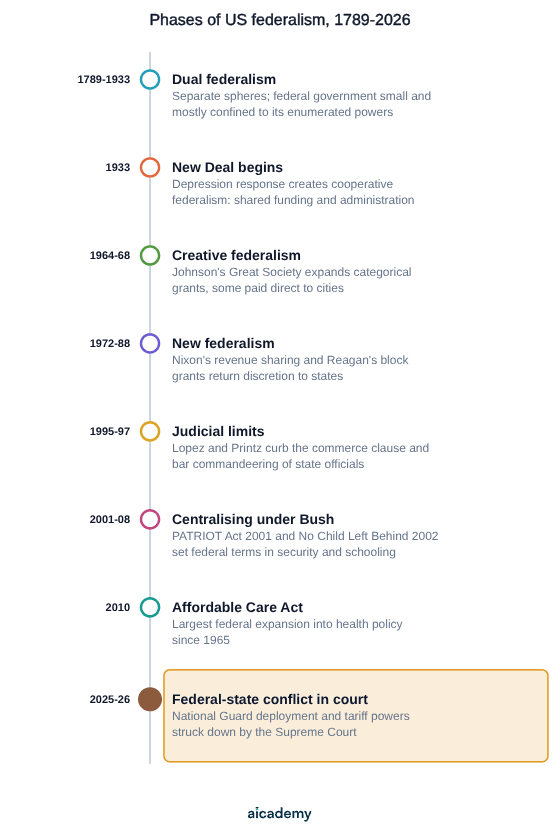
Dual federalism — the model to roughly 1933 — kept the levels in separate lanes. The federal government ran defence, foreign policy, currency and the post; almost everything a citizen dealt with was state business. It is pictured as a layer cake.
Cooperative federalism arrived with the New Deal after 1933. Mass unemployment was beyond the reach of any single state, so Franklin Roosevelt's administration built programmes that Washington funded and states delivered. Responsibility became shared and tangled — a marble cake. The Supreme Court, after initial resistance, accepted a far broader reading of the commerce clause, and that reading is still the constitutional basis for most federal domestic policy.
Creative federalism under Lyndon Johnson (1964–68) pushed further. Great Society programmes multiplied categorical grants, attached detailed federal conditions, and in some cases paid money straight to city governments, bypassing state capitals entirely.
Studying this for an exam?
Generate a personalised learning path for this subject. Free to get started.
Key terms
- Federalism
- A constitutional split of authority between a national government and regional governments, in which each level holds powers the other cannot simply remove.
- Reserved powers
- The powers left to the states or the people by the Tenth Amendment, being everything the Constitution neither grants to the federal government nor denies to the states.
- Concurrent powers
- Powers exercised by both levels of government at once, such as taxing, borrowing, running court systems and enforcing law.
- Supremacy clause
- The provision in Article VI making the Constitution and valid federal law override conflicting state law.
- Dual federalism
- A model in which national and state governments operate in separate spheres with little overlap, often pictured as a layer cake.
- Cooperative federalism
- A model in which both levels share responsibility for the same policy areas, jointly funding and administering programmes; pictured as a marble cake.
- New federalism
- The effort, associated with Nixon and Reagan, to return discretion to the states by replacing narrowly conditioned funding with broader grants.
- Categorical grant
- Federal funding tied to a specific programme and released only if the recipient state meets detailed federal conditions.
- Block grant
- Federal funding for a broad policy field, leaving the recipient state wide discretion over how it is spent.
- Unfunded mandate
- A legal duty imposed on state or local government by federal law without accompanying money to carry it out.
- Anti-commandeering
- The doctrine that Congress may not order state officials to administer or enforce a federal programme, established in Printz v United States (1997).
Frequently asked questions
Federalism splits sovereign authority: US states hold powers under the Constitution that Congress cannot simply take back. Devolution delegates powers: a sovereign parliament grants them and could in principle legislate them away. Federalism is constitutional; devolution is statutory.
A categorical grant funds a narrow purpose with tight federal conditions, so Washington controls how the money is spent. A block grant funds a broad policy area and leaves states discretion over the detail, so it shifts power towards the states.
In law, yes: the Tenth Amendment stands, Printz (1997) bars Congress from commandeering state officials, and Dobbs (2022) returned abortion policy to the states. In practice federal spending conditions and emergency powers give Washington leverage far beyond its enumerated powers.
Generate revision on any topic you study
Type any topic you're studying and Aicademy generates a complete lesson, quiz, and flashcard set, personalised to your level.
Lessons on anything
Structured, level-matched lessons on any topic you study
Practice quizzes
Find out what you actually know before the exam does
Flashcard sets
Lock in key concepts with instant revision cards
Ask Aica
Stuck on something? Get a clear explanation, any time
The US Constitution
US Congress: Structure and Powers
Related lessons
17 min
12 min
20 min