Track progress, take quizzes and save notes on this lesson.

Free forever · no card needed

Start free
Intermediate

The Executive: Structure, Role and Powers

Paper 2, 3.1 The structure, role, and powers of the Executive

Aligned to the Pearson Edexcel 9PL0 specification

Level
Intermediate
Reading time
14 min
Published
9 September 2026
On this page
  1. 1.Who Actually Sits Inside the Executive
  2. 2.Departments, Ranks and the Payroll Vote
  3. 3.The Three Roles the Specification Names
  4. 4.Royal Prerogative Powers
  5. 5.How the Prerogative Has Been Cut Back
  6. 6.Initiating Legislation: The Executive's Grip on Parliament
  7. 7.Secondary Legislative Power
  8. 8.Exam Focus: Common Mistakes on the Executive

Key takeaways

  • The Executive is the Prime Minister, the Cabinet and the junior ministers who run government departments, served by a permanent, politically neutral civil service that stays when governments change.
  • Its three spec-listed roles are proposing legislation, proposing a budget, and taking policy decisions inside the law and budget Parliament has approved.
  • Royal prerogative powers legally belong to the Crown but are used by ministers: appointing the Cabinet, deploying the armed forces, making treaties and granting pardons.
  • Miller (2017) and Miller (2019) showed the courts will police the limits of the prerogative, and the Dissolution and Calling of Parliament Act 2022 returned dissolution to it.
  • Secondary legislation lets ministers change the law by statutory instrument; Parliament can approve or reject an SI but cannot amend it, and rejections are very rare.

Who Actually Sits Inside the Executive

The Executive is the branch of the UK state that governs: it makes policy, runs public services and takes the decisions that Parliament then authorises or scrutinises. It is not a building or a party — it is a defined set of office-holders.
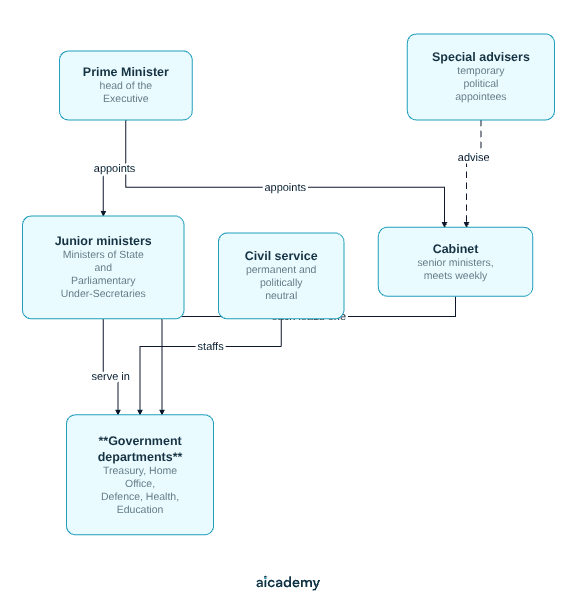
Hierarchy of the UK Executive: the Prime Minister appoints the Cabinet and around a hundred junior ministers, who lead and staff government departments; departments are run day to day by permanent civil servants, while special advisers are political appointees answering to ministers.

Two boundaries matter for the exam. First, the civil service is inside the machinery but outside the political Executive: officials are permanent, neutral and stay when governments change. Second, the Executive is drawn from the legislature — ministers sit as MPs or peers — so the UK has a fusion, not a separation, of powers.

Departments, Ranks and the Payroll Vote

A government department owns one field of policy. Each has an identical rank structure, and knowing it stops you writing "minister" when you mean "Cabinet minister".

RankRoleIn Cabinet?
Secretary of StatePolitically accountable head of the department; sets its directionYes
Minister of StateRuns a major portfolio inside the department (for example prisons, or schools)No
Parliamentary Under-Secretary of StateMost junior ministerial rank; handles a narrower briefNo
Permanent SecretaryMost senior civil servant; runs the department as an organisationNo — not a politician
Special adviserTemporary civil servant, appointed by the minister for political and policy adviceNo

Statute limits how large the political Executive can be. The House of Commons Disqualification Act 1975 caps at 95 the number of ministers who may sit and vote in the Commons at any one time; the Ministerial and other Salaries Act 1975 caps the number of Cabinet-level salaries, which is why some ministers "also attend Cabinet" without formally holding Cabinet rank.

Every minister who sits in the Commons is bound to vote with the government or resign, and the parliamentary private secretaries who assist them are bound alongside. That block is the payroll vote, and it is the single largest guaranteed bloc in any Commons division.

The Three Roles the Specification Names

Section 3.1 lists three main roles. Answer them in that order and you cover the content area cleanly.

1. Proposing legislation. The government sets Parliament's legislative programme, announced at the State Opening in the King's Speech. Standing Order No. 14 gives government business precedence at almost every sitting; a session normally reserves only 20 Opposition days and 13 Fridays for private members' bills. The overwhelming majority of Acts begin life as government bills.

2. Proposing a budget. The Chancellor of the Exchequer presents the annual Budget, setting taxation and spending. Only ministers may propose new taxation or public expenditure — a rule dating from the Crown's historic right of financial initiative — and the Budget is then given legal force by a Finance Bill.

3. Making policy decisions within laws and budget. Between statutes, the Executive governs: deciding NHS priorities, responding to a strike, setting immigration rules, reacting to a foreign crisis. This is the bulk of what government does and the least visible to voters.

RoleInstrument usedWho checks it
Proposing legislationBills, King's SpeechBoth Houses; public bill committees
Proposing a budgetBudget statement, Finance BillCommons alone; the Lords cannot block supply
Policy decisionsMinisterial directions, prerogative actsSelect committees, courts, the media

Royal Prerogative Powers

The royal prerogative is the set of historic powers that legally belong to the Crown but that ministers exercise in the monarch's name. Their defining feature is that they require no fresh authority from Parliament — the power already exists.

Prerogative powerWho exercises it nowRecent illustration
Appointing and dismissing ministersPrime MinisterFormation of a new government on entering office
Deploying the armed forcesPrime Minister and CabinetUK airstrikes on Syria, April 2018
Negotiating and ratifying treatiesForeign SecretaryPost-Brexit trade agreements
Granting honoursPrime Minister (some lists by the monarch personally)Twice-yearly honours lists
Prerogative of mercy (pardons)Justice SecretaryPosthumous pardons for historic convictions
Organising the civil servicePrime Minister as Minister for the Civil ServiceDepartmental reorganisations
Appointing the Prime MinisterThe monarch personally20 July 2026

Worked example — the appointment of a Prime Minister, June–July 2026. No statute says how a Prime Minister is chosen; the whole process runs on prerogative and convention.

  1. Labour lost around 35 councils at the May 2026 local elections, and roughly 103 Labour MPs called on Sir Keir Starmer to go.
  2. Andy Burnham, then Mayor of Greater Manchester, was not an MP. The sitting Makerfield MP stood down and Burnham won the resulting by-election on 18 June 2026 — the first by-election deliberately engineered to bring a party leader into the Commons since Leyton in 1965. Four days later, on 22 June 2026, Starmer announced his resignation.
  3. Burnham was elected Labour leader unopposed on 17 July 2026 with 379 MP nominations, over 94% of the parliamentary party.
  4. On 20 July 2026 the monarch, exercising the personal prerogative of appointment, invited the person able to command the confidence of the Commons to form a government. Burnham became Prime Minister.

No general election took place. The example is worth memorising because it demonstrates the constitutional doctrine that the UK elects a Parliament, not a Prime Minister — and it hands you a ready-made counter-argument in any question about mandate and legitimacy.

Want more lessons like this one?

Generate lessons on anything you study. Free account, no card needed.

Start generating

How the Prerogative Has Been Cut Back

The prerogative is powerful precisely because it escapes the legislative process, so every constraint on it is examinable. Four kinds of limit have developed.

1. Statute overrides the prerogative

Where Parliament legislates on a subject, the statute wins. The Constitutional Reform and Governance Act 2010 put treaty ratification on a statutory footing: a treaty must be laid before Parliament for 21 sitting days before the government may ratify it.

2. The courts police its boundaries

In R (Miller) v Secretary of State for Exiting the European Union [2017] UKSC 5 the Supreme Court held by 8–3 that ministers could not trigger Article 50 by prerogative alone, because withdrawal would remove rights created by statute. Parliament had to pass an Act. In R (Miller) v The Prime Minister [2019] UKSC 41 the Court held unanimously that a five-week prorogation of Parliament was unlawful, void and of no effect.

3. Convention restrains its use

Since the Commons vote of 18 March 2003 on Iraq, governments have normally sought parliamentary approval before committing troops. The convention is political, not legal: in April 2018 the government ordered airstrikes on Syria and reported to the Commons afterwards, and no legal consequence followed.

4. Parliament can hand a power back

The Fixed-term Parliaments Act 2011 abolished the prerogative of dissolution. The Dissolution and Calling of Parliament Act 2022 repealed that Act and revived the prerogative, which is how the 2024 general election was called.

Direction of travel is the analytical point. The prerogative has been narrowed by statute and by the courts, but 2022 shows Parliament reversing itself — the trend is contested, not one-way.

Initiating Legislation: The Executive's Grip on Parliament

The second listed power is the initiation of legislation, and it is stronger than the formal picture of a sovereign Parliament suggests.

The Executive controls what Parliament debates. Government bills get priority, government whips manage the timetable through programme motions, and government majorities dominate the public bill committees that examine bills line by line — so a government with a working majority can expect its clauses to survive.

Worked example — the Representation of the People Bill, 2026. Trace a government bill through the system.

StageDateWhat happened
Introduced (Commons first reading)12 February 2026Government bill implementing manifesto commitments
Second reading2 March 2026Debate on the principle; passed
Public bill committee18 March – 16 April 2026Nine sittings of line-by-line scrutiny
Remaining stages and third reading2 September 2026Passed by 411 votes to 102 (Division 2416)
House of LordsFrom September 2026Still before the Lords, with no Royal Assent as of 9 September 2026

Four provisions were carried on the government's initiative: votes at 16, automatic voter registration, bank cards as accepted voter ID, and tighter rules on foreign political donations. A backbench MP with the same ideas would have had a 13-Friday queue and, realistically, no chance.

The counterweight is the Lords, which lacks a government majority and can delay. As of September 2026 the Bill sat there — a reminder that initiating legislation is not the same as guaranteeing it.

Secondary Legislative Power

The third listed power is secondary legislation: law made by ministers under authority that an Act of Parliament has already delegated to them. The parent Act sets the frame; the minister fills in the detail, normally through a statutory instrument (SI).

Two scrutiny procedures exist, and the parent Act decides which applies:

ProcedureHow it worksPractical effect
NegativeThe SI becomes law unless either House annuls it, normally within 40 sitting daysMost SIs pass without a debate at all
AffirmativeBoth Houses must actively approve the SI before it takes effectGuarantees a debate, usually a short one

Three features make this genuine executive power rather than administrative housekeeping:

  • Parliament cannot amend an SI. It may approve or reject the whole thing, so rejecting a defective instrument means losing the policy entirely.
  • Rejection is vanishingly rare. The Commons has rejected a statutory instrument only a handful of times since 1950; the Lords voted one down over Greater London Authority election rules in 2000 and a super-casino order in 2007.
  • "Henry VIII" clauses let ministers use an SI to amend or repeal primary legislation. The European Union (Withdrawal) Act 2018 conferred such powers on a large scale to correct retained EU law.

Worked example — lockdown by statutory instrument, March 2020. The first national coronavirus restrictions were not an Act. Ministers made The Health Protection (Coronavirus, Restrictions) (England) Regulations 2020 under powers in the Public Health (Control of Disease) Act 1984. The regulations came into force on 26 March 2020, criminalising leaving home without reasonable excuse, and MPs debated and approved them weeks afterwards. The most sweeping restriction on liberty in modern peacetime was imposed by a minister's signature, retrospectively endorsed.

The strongest recent check came in October 2015, when the Lords voted to delay tax credit regulations rather than approve them, and the government abandoned the cuts. That single episode is the exception students should be able to name.

Exam Focus: Common Mistakes on the Executive

1. Treating "the Executive" and "Parliament" as separate institutions

They overlap by design. Ministers are MPs and peers, and the payroll vote — up to 95 Commons ministers under the 1975 cap, plus the parliamentary private secretaries bound alongside them — sits inside the legislature. Any answer that describes a clean separation of powers has misdescribed the UK system.

2. Saying the prerogative belongs to the monarch in practice

Legally the powers are the Crown's; politically almost all of them are exercised by ministers on the monarch's behalf. Only a small residue — appointing a Prime Minister, granting Royal Assent — is personal. Make that distinction explicitly.

3. Listing prerogative powers without discussing limits

Section 3.1 rewards analysis, not inventory. Pair each power with a constraint: treaty-making with the Constitutional Reform and Governance Act 2010, war powers with the 2003 convention, prorogation with Miller (2019).

4. Describing secondary legislation as "minor detail"

Coronavirus lockdowns, sanctions regimes and benefit rates have all been set by statutory instrument. The volume of law made this way exceeds the volume made by Act, and Parliament cannot amend a word of it.

5. Using out-of-date office-holders

Politics is marked on currency. Sir Keir Starmer ceased to be Prime Minister on 20 July 2026, when Andy Burnham took office. Date-stamp every contemporary claim — "as of September 2026" costs three words and protects the whole paragraph.

6. Ignoring the synoptic requirement

Paper 2 Section A non-source questions expect you to draw on Component 1. A question on executive power is stronger if it reaches for first-past-the-post majorities, party discipline or the mandate a government claims from a general election.

Key terms

Executive
The branch of government that governs day to day: the Prime Minister, the ministers who run departments and their juniors, supported by the civil service.
Cabinet
The senior decision-making committee of the Executive, chaired by the Prime Minister and made up of the most important ministers, normally meeting weekly.
Minister
An MP or peer given a job in government by the Prime Minister, normally with a defined brief inside one department.
Government department
A branch of Whitehall that owns one field of policy — the Treasury for public finances, the Home Office for policing and immigration — and is led by a Secretary of State.
Royal prerogative
Historic powers that legally belong to the Crown but which ministers use on the monarch's behalf, without needing fresh authority from Parliament.
Secondary legislation
Law written by ministers using authority that an Act of Parliament has delegated to them, usually issued as a statutory instrument.
Statutory instrument
The standard legal form of secondary legislation: a document signed by a minister that changes the detail of the law under powers in a parent Act.
Payroll vote
The block of MPs who hold government jobs and are therefore bound by collective responsibility to vote with the government or resign.

Frequently asked questions

They describe the same set of people. The Executive is the branch that runs the country: the Prime Minister at its head, the Cabinet below, and junior ministers below that, all supported by the civil service. In everyday language that group is called the government.

Prerogative powers are historic Crown powers that ministers now exercise without needing a new Act of Parliament: appointing and sacking ministers, ordering military action, negotiating treaties, granting honours and issuing pardons.

Because ministers, not Parliament, write it. MPs and peers can approve or reject a statutory instrument but cannot amend one, debates are short, and rejections have happened only a handful of times since 1950 — so scrutiny is thin.

Generate revision on any topic you study

Type any topic you're studying and Aicademy generates a complete lesson, quiz, and flashcard set, personalised to your level.

Lessons on anything

Structured, level-matched lessons on any topic you study

Practice quizzes

Find out what you actually know before the exam does

Flashcard sets

Lock in key concepts with instant revision cards

Ask Aica

Stuck on something? Get a clear explanation, any time

Prev

How Parliament Scrutinises the Executive

Next

Ministerial Responsibility

Related lessons

14 min

Lesson

Ministerial Responsibility

A-Level Politics · Pearson Edexcel 9PL0

2 hours ago

15 min

Lesson

The Prime Minister and the Cabinet

A-Level Politics · Pearson Edexcel 9PL0

2 hours ago

17 min

Lesson

Prime Ministerial Power: Thatcher and Blair

A-Level Politics · Pearson Edexcel 9PL0

2 hours ago

Top students don’t revise more. They revise what counts.

Start revising free

Free to start. No card needed.