Track progress, take quizzes and save notes on this lesson.

Free forever · no card needed

Start free
Intermediate

Static Electricity and Electric Fields

4.2.5.1 Static charge·4.2.5.2 Electric fields

Aligned to the AQA 8463 specification

Level
Intermediate
Reading time
7 min
Published
2 July 2026
On this page
  1. 1.Charging by Rubbing
  2. 2.Like and Unlike Charges
  3. 3.Electric Fields
  4. 4.Explaining Forces Using Fields
  5. 5.Sparking
  6. 6.Common Exam Mistakes

Key takeaways

  • Rubbing two insulators together transfers electrons: the material that gains electrons becomes negatively charged and the one that loses electrons becomes positively charged. This is Separate Physics only.
  • Like charges repel and unlike charges attract, and this is a non-contact force that acts at a distance without the objects touching.
  • A charged object creates an electric field around it that is strongest close to the object and gets weaker further away.
  • A second charged object placed in the field feels a force, and that force gets larger as the two objects move closer together.
  • When the pd between a charged object and an earthed object is large enough, electrons can jump across the air gap, producing a spark.

Charging by Rubbing

(Separate Physics only) Static electricity and electric fields (spec 4.2.5) are assessed in AQA GCSE Physics but not in Combined Science Trilogy. If you are sitting Combined Science, you do not need this topic.

When two insulators are rubbed together, some electrons are transferred from one to the other. This is how a plastic rod picks up a static charge when rubbed with a cloth.

Only electrons move. Electrons are negatively charged, so the material that gains electrons ends up with more electrons than protons and becomes negatively charged. The material that loses electrons is left with fewer electrons than protons and becomes positively charged.

Rubbing insulators transfers electrons. The object that gains electrons becomes negative; the object that loses electrons becomes positive. Protons never move.

Worked example. A polythene rod is rubbed with a dry cloth and becomes negatively charged. What happened to the electrons, and what is the charge on the cloth?

The rod is negative, so it must have gained electrons. Those electrons came from the cloth, so the cloth lost electrons and is left positively charged. The two objects always end up with equal and opposite charges, because every electron the rod gains is one the cloth lost.

Like and Unlike Charges

Once objects carry a charge, they exert forces on each other. The direction of the force depends only on the two charges.

  • Two objects with the same type of charge (both positive, or both negative) repel each other.
  • Two objects with opposite charges (one positive, one negative) attract each other.

Like charges repel; unlike charges attract.

This force is a non-contact force: it acts even when the objects are not touching. You can see the evidence for yourself. A charged plastic rod held near small pieces of paper pulls them up before it touches them, and two charged rods hung on threads swing apart or together without contact.

The two chargesForce between them
Positive and positiveRepel (push apart)
Negative and negativeRepel (push apart)
Positive and negativeAttract (pull together)

The fact that the force acts across a gap is the evidence that a charged object affects the space around it, which leads to the idea of an electric field.

Electric Fields

A charged object creates an electric field in the space around it. An electric field is the region where another charge would feel a force.

The field is strongest close to the object and gets weaker further away. So a second charge placed near the object feels a large force, and the same charge placed further away feels a smaller force. The force increases as the separation decreases: the closer the two charges, the stronger the push or pull.

We picture the field with field lines. For an isolated charged sphere, the field lines are straight and point radially, spreading out evenly in all directions. The arrows point away from a positive charge (the direction a small positive test charge would be pushed) and towards a negative charge. The lines are closer together near the sphere, showing the field is stronger there.
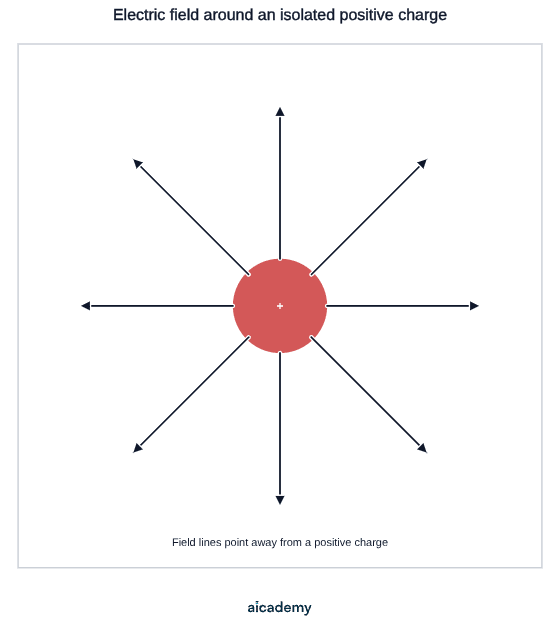
The field is strongest close to the object; the force on a second charge increases as the separation decreases.

For a negative charge the pattern is identical but every arrow points inward, towards the charge.

Explaining Forces Using Fields

The electric field is what lets two charges affect each other without touching. Thinking in fields gives a clear explanation of the non-contact force.

A charged object sets up an electric field in the space around it. When a second charged object is placed in that field, it feels a force from the field. Neither object has to touch the other; the field carries the interaction across the gap.

This explains the earlier observations directly:

  • A charged rod near paper: the rod's field acts on charges in the paper, pulling the paper towards the rod.
  • Two like charges: each sits in the other's field and is pushed away, so they repel.
  • Bringing the charges closer: the field is stronger nearer the object, so the force grows as the separation shrinks.

The force between charges is a non-contact force explained by the electric field: each charge sits in the field of the other and feels a force through it.

Describing the force this way, rather than as something mysterious acting at a distance, is what AQA questions on electric fields are looking for.

Studying this for an exam?

Generate a personalised learning path for this subject. Free to get started.

Create a learning path

Sparking

If a charged object builds up enough charge, the potential difference between it and a nearby earthed (or oppositely charged) object can become very large. When it is large enough, electrons jump across the air gap and a spark is produced.

The mechanism follows from the field idea. A large charge means a strong electric field in the gap. If the field is strong enough, it pulls electrons out of the air particles in the gap, letting charge flow suddenly across it. That sudden flow of charge is the spark, often seen as a flash and heard as a crack.

Everyday examples:

  • Touching a metal door handle after walking on a carpet and feeling a small shock.
  • Getting a shock from a car door after sliding across the seat.
  • Lightning, which is a very large spark between charged clouds and the ground.

A spark happens when the pd between a charged object and another object is large enough for electrons to jump the air gap between them.

Reducing the charge, for example by earthing an object so charge can flow safely away, reduces the pd and prevents dangerous sparks.

Common Exam Mistakes

1. Saying protons are transferred

Only electrons move during rubbing. A positive charge is caused by losing electrons, not by gaining protons. Never write that protons or "positive charges" are transferred between the insulators.

2. Getting the charge sign the wrong way round

The material that gains electrons becomes negative; the one that loses electrons becomes positive. Work out which way the electrons moved, then assign the signs from that.

3. Forgetting that both objects end up charged

Rubbing charges both objects, with equal and opposite charges. If the rod is negative, the cloth must be positive by the same amount.

4. Not describing the field pattern correctly

For an isolated charged sphere the field lines are radial (straight lines spreading out evenly). They point away from a positive charge and towards a negative charge, and they are closer together near the object where the field is stronger.

5. Saying the force is constant

The force between charges is not fixed. It increases as the separation decreases, because the field is stronger closer to the charged object. State this direction of change when asked how distance affects the force.

Key terms

Static electricity
Electric charge that builds up on the surface of an insulator and stays there rather than flowing as a current.
Electron transfer
The movement of electrons from one insulator to another during rubbing, which leaves one object negative and the other positive.
Electric field
The region around a charged object in which another charged object feels a non-contact force.
Non-contact force
A force that acts between two objects without them touching, such as the force between two charges.
Spark
A sudden flow of charge across an air gap, produced when the potential difference is large enough to make electrons jump the gap.

Frequently asked questions

By rubbing two insulators together, electrons are transferred from one to the other. The material that gains electrons becomes negatively charged; the material that loses electrons is left with fewer electrons than protons, so it becomes positively charged. Only electrons move, never protons.

An electric field is the region around a charged object where another charge feels a force. The field is strongest close to the object and gets weaker with distance, so a second charge feels a bigger force the closer it is.

Because the force between charges is a non-contact force. A charged object sets up an electric field, and any other charge placed in that field feels a force through the field, so the objects push or pull each other without touching.

Generate revision on any topic you study

Type any topic you're studying and Aicademy generates a complete lesson, quiz, and flashcard set, personalised to your level.

Lessons on anything

Structured, level-matched lessons on any topic you study

Practice quizzes

Find out what you actually know before the exam does

Flashcard sets

Lock in key concepts with instant revision cards

Ask Aica

Stuck on something? Get a clear explanation, any time

Prev

The National Grid

Next

Density of Materials

Related lessons

6 min

5 min

Top students don’t revise more. They revise what counts.

Start revising free

Free to start. No card needed.