The National Grid

Aligned to the AQA 8463 specification
- Topic
- Electricity
- Level
- Intermediate
- Reading time
- 6 min
- Published
- 2 July 2026
- Updated
- 16 August 2026
On this page
Key takeaways
- The National Grid is a nationwide system of cables and transformers that carries electrical power from power stations to homes and businesses.
- A step-up transformer raises the potential difference to a very high value for transmission across the grid; a step-down transformer lowers it again to a safer value for use in homes.
- Transmitting at high potential difference means a lower current is needed to deliver the same power, and a lower current wastes far less energy heating the cables.
- Power wasted heating the cables depends on the square of the current (P = I²R), so cutting the current sharply cuts the energy lost, which is why the grid is efficient.
- Transformers change the potential difference without changing the total power delivered, so raising the pd lowers the current in the same proportion.
How much of this have you taken in?
Quiz yourself on this section, free, no card needed.
Why the Grid Is Efficient Overall
Putting the pieces together explains why the National Grid is an efficient way to transfer energy across a country.
The reasoning runs in a chain:
- Step-up transformers raise the potential difference to a very high value.
- Because power is delivered at high pd, only a small current is needed ().
- A small current wastes very little energy heating the cables (, current squared).
- Step-down transformers then lower the pd to a safe value for consumers.
Transformers themselves are very efficient, so the energy they lose is small compared with the huge saving from transmitting at a low current. The diagram below shows the split for a simplified 400 MW supply based on the earlier figures.
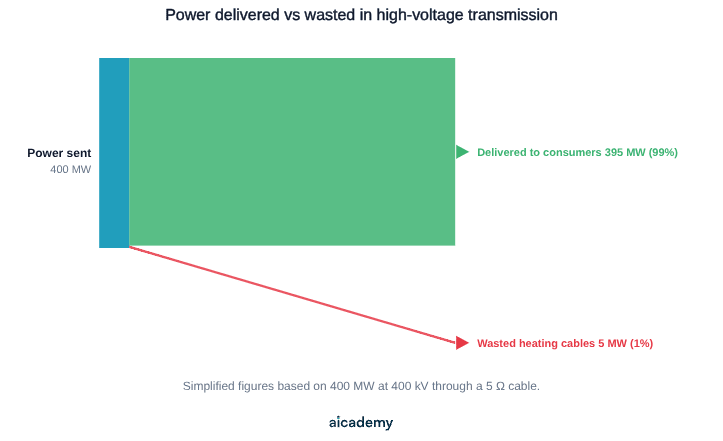
Transmitting the same power at a low voltage would waste far more, so the grid design keeps the losses small.
Key terms
- National Grid
- The nationwide network of cables and transformers that transfers electrical power from power stations to consumers.
- Step-up transformer
- A transformer that increases the potential difference and decreases the current, used before long-distance transmission.
- Step-down transformer
- A transformer that decreases the potential difference to a safer value for use in homes and businesses.
- Transformer
- A device that changes the size of an alternating potential difference in a circuit.
Frequently asked questions
A high potential difference lets the same power be delivered with a much smaller current. Since power wasted heating the cables depends on the current squared (P = I²R), a smaller current wastes far less energy, making transmission much more efficient.
A step-up transformer increases the potential difference (and decreases the current) for efficient transmission across the grid. A step-down transformer decreases the potential difference to a safer, usable value for homes and businesses.
No. Transformers are very efficient devices, so the energy saved by transmitting at a low current far outweighs any small losses in the transformers themselves. Overall this makes the grid an efficient way to transfer energy.
Generate revision on any topic you study
Type any topic you're studying and Aicademy generates a complete lesson, quiz, and flashcard set, personalised to your level.
Lessons on anything
Structured, level-matched lessons on any topic you study
Practice quizzes
Find out what you actually know before the exam does
Flashcard sets
Lock in key concepts with instant revision cards
Ask Aica
Stuck on something? Get a clear explanation, any time
Electrical Power and Energy Transfers
Static Electricity and Electric Fields
Related lessons
6 min
5 min
7 min