Track progress, take quizzes and save notes on this lesson.

Free forever · no card needed

Start free
Intermediate

Conservation and Dissipation of Energy

4.1.2.1 Energy transfers in a system

Aligned to the AQA 8463 specification

Topic
Energy
Level
Intermediate
Reading time
7 min
Published
2 July 2026
On this page
  1. 1.The Principle of Conservation of Energy
  2. 2.Closed Systems
  3. 3.Useful and Wasted Energy
  4. 4.Reducing Unwanted Transfers
  5. 5.Thermal Conductivity and Rate of Cooling
  6. 6.Required Practical 2: Thermal Insulation
  7. 7.Why the Practical Works, and a Conservation Check
  8. 8.Common Exam Mistakes

Key takeaways

  • Energy cannot be created or destroyed, only transferred, stored or dissipated. This is the principle of conservation of energy.
  • In a closed system there is no net change to the total energy; energy transferred usefully plus energy dissipated equals the energy input.
  • Dissipated (wasted) energy is energy transferred to the surroundings, usually to a thermal store, in a way that is not useful.
  • Unwanted transfers are reduced by lubrication to cut friction and by thermal insulation to slow conduction; thicker walls and lower thermal conductivity slow the rate of energy transfer.

The Principle of Conservation of Energy

Energy is one of the most tightly controlled quantities in physics. It moves between stores endlessly, but the total never changes.

Energy cannot be created or destroyed. It can only be transferred usefully, stored, or dissipated. This is the principle of conservation of energy.

"Dissipated" means spread out to the surroundings in a way that is no longer useful. When a phone battery runs down, its chemical store has not vanished; the energy has been transferred to light, sound and, mostly, the thermal store of the phone and the air around it.

This principle underpins the whole of energy at GCSE. Whenever you describe or calculate an energy change, the energy you start with must be fully accounted for by the stores you end with.

Closed Systems

A closed system is one in which no energy enters or leaves. It is a useful idea because it makes conservation of energy easy to state precisely.

In a closed system there is no net change to the total energy. Energy is only transferred between the stores inside the system.

A well-insulated flask of hot water is close to a closed system over a short time: the energy stays inside, moving between the thermal stores of the water, the flask and any air trapped above it, but the total remains almost constant.

No real system is perfectly closed, because some energy always finds a way to the surroundings. Treating a system as closed is a modelling choice that lets you apply conservation cleanly, then account for the small losses separately.

Useful and Wasted Energy

When a device transfers energy, only some of the output does the intended job. The rest is dissipated, or "wasted", almost always ending up in a thermal store of the surroundings.

Take an ordinary filament lamp. Its job is to produce light, but most of the electrical energy supplied is transferred to the thermal store instead.
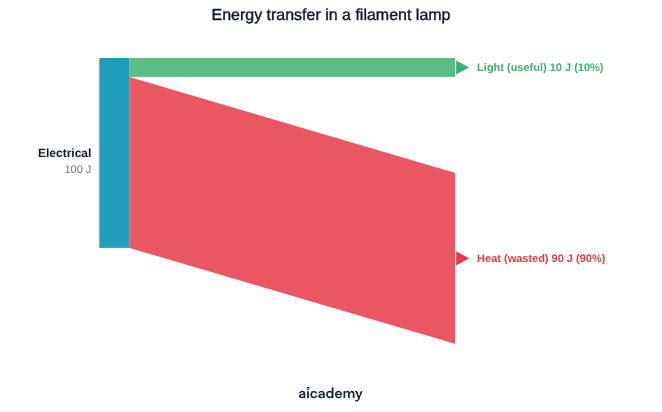
For every 100 J of electrical energy supplied, only about 10 J leaves as light; the other 90 J is dissipated to the surroundings as thermal energy. The wasted energy is not destroyed, but it is spread out so thinly that it can no longer be used. Reducing this waste is what the rest of this lesson is about.

Reducing Unwanted Transfers

Two methods on the specification reduce the energy dissipated by a system: lubrication and thermal insulation.

  • Lubrication — adding oil or grease between surfaces that rub together reduces friction. With less friction, less work is done against it, so less energy is dissipated to the thermal store as the surfaces slide. This is why engines and hinges are oiled.
  • Thermal insulation — surrounding an object with a material that transfers energy slowly reduces the energy dissipated by conduction. Loft insulation, cavity-wall insulation and the double walls of a vacuum flask all work this way.

Lubrication tackles energy wasted through friction in moving parts; thermal insulation tackles energy wasted through conduction to the surroundings.

Both methods keep more of the input energy in the useful store, which raises the efficiency of the device (the subject of the next lesson).

Something not quite clicking?

Ask Aica to explain any part of this differently. Free, takes 30 seconds.

Ask Aica

Thermal Conductivity and Rate of Cooling

How quickly a building loses energy through its walls depends on the material and the thickness of those walls.

A material with a higher thermal conductivity transfers energy by conduction at a higher rate. (The definition of thermal conductivity is not required.)

This gives two ways to slow the rate at which a building cools:

FactorTo slow cooling…Why
Thermal conductivity of wallsChoose a lower valueLower conductivity means a lower rate of conduction
Thickness of wallsMake them thickerEnergy must conduct through more material, slowing the rate

So a house built with thick walls of low-conductivity material cools more slowly and needs less energy to keep warm. Cavity walls filled with insulating foam combine a low-conductivity material with extra thickness to reduce the rate of energy transfer.

Required Practical 2: Thermal Insulation

(Separate Physics only) Required practical 2 is assessed in GCSE Physics but not in Combined Science.

This practical investigates how effective different materials are as thermal insulators, and the factors that affect insulation.

Apparatus

  • A small can or beaker to hold hot water
  • Different insulating materials to wrap around it (for example bubble wrap, felt, newspaper, cotton wool)
  • A thermometer, a lid, a stopwatch and a measuring cylinder

Method

  1. Pour a fixed volume of hot water into the can and record the starting temperature.
  2. Wrap the can in one layer of the first insulating material and fit the lid.
  3. Record the water temperature every minute for a fixed time, such as 10 minutes.
  4. Repeat with each material, using the same volume and starting temperature of water each time.
  5. The smallest temperature drop identifies the best insulator.

To study the effect of thickness, repeat with increasing numbers of layers of the same material and compare the temperature drops.

Why the Practical Works, and a Conservation Check

Controlling the variables is what makes the comparison fair, and conservation of energy explains the results.

VariableRoleWhy
Insulating material (or thickness)Independent variableIt is what you deliberately change
Temperature drop over the timeDependent variableIt measures how much energy the water lost
Volume and starting temperature of water, timeControl variablesKept the same so the comparison is fair

The lid reduces energy lost by evaporation and convection so that the test focuses on conduction through the wrapping. The energy leaving the water is not destroyed; it is dissipated to the thermal store of the surroundings, and a good insulator simply slows that rate.

Worked example — a 0.20 kg sample of water cools from 80°C to 72°C over the test. Using with J/kg°C:

So 6720 J were dissipated to the surroundings. A better insulator gives a smaller temperature drop and therefore a smaller energy loss over the same time.

Common Exam Mistakes

1. Saying energy is "lost" or "used up"

Energy is dissipated, not destroyed. Wasted energy is transferred to the thermal store of the surroundings, where it spreads out and becomes hard to use.

2. Confusing lubrication and insulation

Lubrication reduces energy wasted through friction between moving surfaces. Thermal insulation reduces energy wasted through conduction to the surroundings. They address different transfers.

3. Trying to define thermal conductivity

The specification does not require the definition of thermal conductivity. You only need that a higher conductivity gives a higher rate of energy transfer by conduction.

4. Ignoring wall thickness

The rate of cooling depends on both the thermal conductivity and the thickness of the walls. Thicker walls slow the transfer even if the material is the same.

5. Not controlling variables in the practical

Use the same volume, starting temperature and timing for every material. Changing more than one factor at a time makes the comparison of insulators unfair.

Key terms

Conservation of energy
The principle that energy cannot be created or destroyed, only transferred, stored or dissipated.
Dissipation
The transfer of energy to the surroundings in a way that is not useful, usually spreading to a thermal store.
Closed system
A system in which no energy enters or leaves, so its total energy stays constant.
Thermal conductivity
A property of a material; a higher thermal conductivity gives a higher rate of energy transfer by conduction.

Frequently asked questions

Dissipation is when energy is transferred to the surroundings in a way that is not useful, usually spreading out to a thermal store. The energy is not destroyed, but it becomes less useful.

A closed system is one where no energy enters or leaves, so the total energy stays the same. Energy is transferred between stores within it, but the overall amount does not change.

Thick walls with a low thermal conductivity transfer energy by conduction slowly, so the building cools more slowly. Increasing wall thickness or lowering thermal conductivity reduces the rate of energy transfer.

Generate revision on any topic you study

Type any topic you're studying and Aicademy generates a complete lesson, quiz, and flashcard set, personalised to your level.

Lessons on anything

Structured, level-matched lessons on any topic you study

Practice quizzes

Find out what you actually know before the exam does

Flashcard sets

Lock in key concepts with instant revision cards

Ask Aica

Stuck on something? Get a clear explanation, any time

Related lessons

7 min

Lesson

Energy Stores and Systems

AQA GCSE Physics · AQA 8463

19 days ago

6 min

Lesson

Efficiency

AQA GCSE Physics · AQA 8463

19 days ago

Top students don’t revise more. They revise what counts.

Start revising free

Free to start. No card needed.