Track progress, take quizzes and save notes on this lesson.

Free forever · no card needed

Start free
Intermediate

Efficiency

4.1.2.2 Efficiency

Aligned to the AQA 8463 specification

Topic
Energy
Level
Intermediate
Reading time
6 min
Published
2 July 2026
On this page
  1. 1.What Efficiency Measures
  2. 2.The Efficiency Equation
  3. 3.Working in Percentages
  4. 4.Efficiency from Power
  5. 5.Seeing Where the Energy Goes
  6. 6.Rearranging the Equation
  7. 7.Increasing Efficiency (Higher Tier)
  8. 8.Common Exam Mistakes

Key takeaways

  • Efficiency = useful output energy transfer ÷ total input energy transfer. It can also be found from useful power output ÷ total power input.
  • Efficiency has no units. It is always between 0 and 1 as a decimal, or 0% and 100%; multiply the decimal by 100 to get a percentage.
  • No real device is 100% efficient because some energy is always dissipated to the surroundings, usually as wasted thermal energy.
  • (Higher Tier) Efficiency can be increased by reducing wasted energy transfers, for example with lubrication to cut friction or thermal insulation to cut heat loss.

What Efficiency Measures

Every device is given energy to do a job, but not all of it reaches the useful store. Some is always dissipated (spread out and wasted) to the surroundings, usually as thermal energy. Efficiency tells you what fraction of the input actually does the useful job.

Efficiency = useful output energy transfer ÷ total input energy transfer.

A device with high efficiency wastes little of its input; a low-efficiency device wastes a lot. Efficiency is a ratio of two energy values, so it has no units. As a decimal it lies between 0 and 1, and as a percentage between 0% and 100%.

Consider a lamp supplied with 100 J of electrical energy that transfers 20 J usefully as light. The other 80 J is dissipated as thermal energy. The useful fraction, 20 out of 100, is what efficiency captures.

The Efficiency Equation

The energy form of the equation compares the useful output with the total input.

This equation is not on the Physics equation sheet. You must recall and apply it.

The total input is always the larger number, so a correct efficiency is never greater than 1 (or 100%). To turn a decimal into a percentage, multiply by 100.

Worked example — an electric motor is supplied with 300 J of electrical energy and transfers 240 J usefully to the kinetic energy store of a load. Find its efficiency.

As a percentage: .

So 80% of the input does the useful job and the remaining 20% (60 J) is dissipated, mostly as thermal energy from friction and electrical resistance.

Working in Percentages

Exam questions often want the answer as a percentage. Divide as before, then multiply by 100.

Worked example — a kettle transfers 90 000 J of electrical energy. Of this, 63 000 J is usefully transferred to the thermal energy store of the water. Find the efficiency as a percentage.

The kettle is 70% efficient. The wasted 30% (27 000 J) heats the kettle body, the element and the surrounding air rather than the water.

The units of the two energy values must match before you divide. If one is in joules and the other in kilojoules, convert first, or the ratio will be wrong by a factor of 1000.

Efficiency from Power

Because power is the rate of energy transfer, you can also compare power values instead of energy values.

Efficiency = useful power output ÷ total power input. This form is also not on the equation sheet, so recall it.

Power is measured in watts (W), where 1 W = 1 J/s. The equation works identically because both quantities are rates measured over the same time.

Worked example — a filament lamp has a total power input of 60 W and a useful power output (as light) of 9 W. Find its efficiency.

Only 15% of the electrical power becomes light; the other 51 W is dissipated as thermal energy. This is why filament lamps have been replaced by LED lamps, which waste far less power as heat.

Something not quite clicking?

Ask Aica to explain any part of this differently. Free, takes 30 seconds.

Ask Aica

Seeing Where the Energy Goes

A Sankey diagram shows the split visually: the input arrow enters on the left, and its width divides into useful and wasted branches in proportion to their energy values. The wider the wasted branch, the lower the efficiency.

For the 80% efficient motor above, out of every 100 J of input, 80 J is transferred usefully and 20 J is wasted:
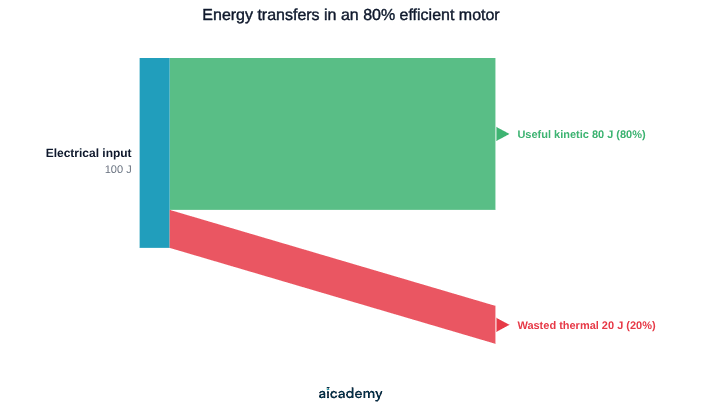
The total energy is conserved: the useful and wasted branches always add back up to the input, because energy cannot be created or destroyed. Reading efficiency straight off the diagram is quick, the useful branch here is 80 out of 100, giving 0.8.

Rearranging the Equation

The same equation finds a missing energy value when the efficiency is known. Rearrange it to make the unknown the subject.

Worked example — a device is 25% efficient and is supplied with 2000 J of energy. How much energy is usefully transferred?

First write the efficiency as a decimal: . Rearranging to make useful output the subject:

So 500 J is transferred usefully and 1500 J is wasted.

Worked example — a pump usefully transfers 450 J and is 60% efficient. Find the total energy input.

Check: . The rearrangement is confirmed.

Increasing Efficiency (Higher Tier)

(Higher Tier only) You must be able to describe ways to increase the efficiency of an intended energy transfer.

The strategy is always the same: reduce the unwanted energy transfers so a larger share of the input reaches the useful store. Common methods:

Wasted transferHow to reduce itEffect on efficiency
Friction between moving partsLubricate with oil or greaseLess energy wasted as heat and sound, so efficiency rises
Heat loss from a hot objectAdd thermal insulationLess thermal energy dissipated, so more stays useful
Air resistance on a moving objectStreamline the shapeLess energy wasted overcoming drag
Resistance in wiresUse lower-resistance conductorsLess electrical energy wasted as heat

No real device can reach 100% efficiency, because some energy is always dissipated during a transfer. The aim is to push efficiency as high as practical, not to eliminate waste entirely.

Common Exam Mistakes

1. Getting an efficiency above 1 or above 100%

The total input is always the largest energy value, so a correct efficiency never exceeds 1 (or 100%). If your answer is bigger, you have divided the wrong way round. Put the useful output on top and the total input underneath.

2. Forgetting to convert a decimal to a percentage

Dividing gives a decimal such as 0.7. If the question asks for a percentage, you must multiply by 100 to get 70%. A bare 0.7 written as "0.7%" loses the mark.

3. Mixing up useful and total input

The denominator is the total energy supplied, not the wasted part. If a question gives useful and wasted values, add them together to find the total input before dividing.

4. Not matching the units

Both energy values must be in the same unit before you divide. Convert kilojoules to joules (or vice versa) first, otherwise the ratio is out by a factor of 1000.

5. Claiming a device can be 100% efficient

Some energy is always dissipated to the surroundings, so a real device cannot be perfectly efficient. Reducing friction and heat loss raises efficiency but never removes waste completely.

Key terms

Efficiency
The proportion of the total input energy transfer that is transferred usefully, calculated as useful output divided by total input.
Useful energy transfer
The part of the input energy that is transferred to the store the device is designed to fill.
Dissipated energy
Energy transferred to the surroundings in non-useful ways, usually as thermal energy, so it becomes spread out and wasted.

Frequently asked questions

Efficiency = useful output energy transfer ÷ total input energy transfer. You can also use useful power output ÷ total power input. Multiply by 100 to give a percentage. This equation is not on the sheet, so recall it.

Because energy is always dissipated to the surroundings during a transfer, usually as wasted thermal energy from friction or electrical resistance. This wasted energy is spread out and cannot all be usefully recovered.

Multiply the decimal by 100. An efficiency of 0.8 is 80%. To go the other way, divide the percentage by 100, so 25% is 0.25.

Generate revision on any topic you study

Type any topic you're studying and Aicademy generates a complete lesson, quiz, and flashcard set, personalised to your level.

Lessons on anything

Structured, level-matched lessons on any topic you study

Practice quizzes

Find out what you actually know before the exam does

Flashcard sets

Lock in key concepts with instant revision cards

Ask Aica

Stuck on something? Get a clear explanation, any time

Prev

Conservation and Dissipation of Energy

Next

National and Global Energy Resources

Related lessons

4 min

Lesson

Power

AQA GCSE Physics · AQA 8463

19 days ago

Top students don’t revise more. They revise what counts.

Start revising free

Free to start. No card needed.