Track progress, take quizzes and save notes on this lesson.

Free forever · no card needed

Start free
Intermediate

Urbanisation: Trends, Causes and Megacities

AicademyAicademy
·GCSE Geography
3.2.1.1 Urban trends

Aligned to the AQA 8035 specification

Level
Intermediate
Reading time
10 min
Published
10 June 2026
Updated
1 July 2026
On this page
  1. 1.Global Urbanisation: Trends and Patterns
  2. 2.Causes of Urbanisation
  3. 3.Megacities: Definition and Distribution
  4. 4.Urbanisation in LICs/NEEs vs HICs
  5. 5.Counter-urbanisation and Reurbanisation
  6. 6.Common Exam Mistakes

Key takeaways

  • Urbanisation is the increasing proportion of a population living in towns and cities; the world passed the 50% urban threshold in 2007 and the UN projects 68% urban by 2050.
  • Urbanisation is driven by both rural-to-urban migration (push and pull factors) and natural increase, which can account for 40-60% of urban growth in many LICs.
  • A megacity is a city with a population of 10 million or more; their number grew from 2 in 1950 to 37 in 2024, with most now in Asia and a rising number in Africa and South America.
  • Urbanisation is the rise in the proportion of urban dwellers, while urban growth is the rise in the total number of urban residents; the two terms are not interchangeable.
  • Counter-urbanisation is movement away from large cities to suburbs, smaller towns and commuter settlements, not just rural villages, driven by transport links and remote working.

Global Urbanisation: Trends and Patterns

Urbanisation is the process by which an increasing proportion of a country's population lives in towns and cities. It is the defining demographic trend of the past two centuries.

Key statistics:

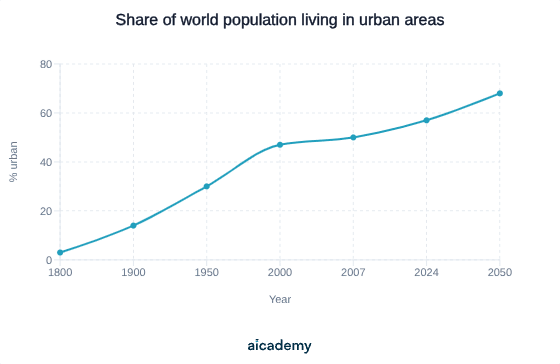
  • In 1800, approximately 3% of the world's population lived in urban areas
  • By 1950, the figure had risen to 30%
  • By 2007, the world passed the 50% threshold — for the first time, more than half the global population lived in urban areas
  • By 2024, approximately 57% of the world's population is urban
  • By 2050, the UN projects 68% urban — approximately 6.7 billion people in cities

The chart below shows the steep rise in the share of the world's population living in towns and cities since 1800.
The pattern is not uniform:

StageHIC trendLIC/NEE trend
PastRapid urbanisation driven by industrialisation (UK: 19th century)Largely rural; colonial economies were agricultural
PresentHigh levels of urbanisation (UK: ~84%; USA: ~83%); slow or no further growth; some counter-urbanisationRapid urbanisation underway; urban populations growing fast (sub-Saharan Africa, South/Southeast Asia)
FutureStable or mild growthWill account for nearly all global urban population growth to 2050

The urban transition in HICs largely occurred in the 19th and early 20th century. In LICs and NEEs, it is happening now — rapidly and on a much larger scale. By 2050, Africa and Asia are projected to add 2.5 billion more urban residents between them.

Causes of Urbanisation

Urbanisation is driven by two interconnected forces: rural-to-urban migration (people moving from the countryside to cities) and natural increase (the birth rate in cities exceeding the death rate).

Push factors (reasons people leave rural areas):

FactorExample
Agricultural mechanisationMachines replace farm workers; there is less employment in the countryside
Rural poverty and low wagesFarm incomes are often subsistence level; limited opportunities for advancement
Natural hazards and crop failuresDrought, flood, and crop disease drive migration from vulnerable rural areas
Lack of servicesLimited healthcare, schools, electricity, and internet access in remote areas
Conflict and insecurityRural areas in conflict zones become unsafe; people flee to cities

Pull factors (reasons people are attracted to cities):

FactorExample
Employment opportunitiesCities have factories, services, and informal economic activity — more work than the countryside
Higher wagesUrban wages are typically higher than rural, even in informal sector work
Better servicesHospitals, schools, universities, transport, entertainment
Social networksCommunities of migrants from the same region establish themselves in cities, attracting further migration
Perceived better quality of lifeCities represent opportunity and modernity, even if reality is harsh for new arrivals

Natural increase contributes significantly to urban population growth in LICs, where birth rates are high and cities attract younger people of reproductive age.

Megacities: Definition and Distribution

A megacity is a city with a population of 10 million or more. The number of megacities has grown dramatically:

YearNumber of megacities
19502 (Tokyo, New York)
199010
200018
202437

Characteristics of megacity distribution:

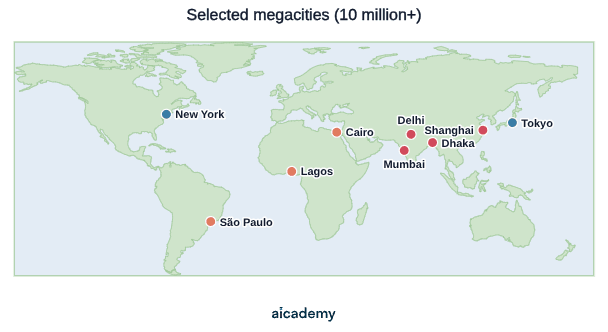
  • Most megacities are now in Asia — Tokyo (37m), Delhi (33m), Shanghai (29m), Dhaka (23m), Mumbai (21m), Beijing (22m), Osaka (19m), Karachi (17m) dominate the list
  • A growing number are in South America — São Paulo (22m), Buenos Aires (16m), Lima (11m), Rio de Janeiro (13m), Bogotá (11m)
  • Africa is rapidly generating new megacities — Lagos (15m), Cairo (22m), Kinshasa (16m); Dar es Salaam and Luanda growing rapidly towards the threshold
  • Only a small and declining proportion of megacities are in high-income countries — Tokyo, New York (19m), Los Angeles (13m), Osaka — reflecting the shift of urban growth to the developing world

The map below shows the main megacities, clustered heavily in Asia with a growing number in Africa and South America.
World cities (also called global cities) (extra context — beyond AQA 8035 spec): a related concept — cities that function as major nodes in the global economy through finance, media, and corporate headquarters (e.g. London, New York, Tokyo, Singapore). Not all megacities are world cities.

Urbanisation in LICs/NEEs vs HICs

The experience and character of urbanisation differs significantly between richer and poorer countries.

HIC urbanisation (e.g. UK):

  • Began in the 18th–19th centuries driven by industrialisation (coal, iron, textiles)
  • Now largely complete: the UK is 84% urban; growth has slowed
  • Current trends: counter-urbanisation (people moving from large cities to suburbs or smaller towns) and reurbanisation (people returning to regenerated city centres)
  • Cities are decentralising — out-of-town retail, business parks, edge cities
  • Problems of established cities: traffic congestion, ageing infrastructure, social inequality, housing affordability

LIC/NEE urbanisation (e.g. Nigeria, India, Bangladesh):

  • Began in the mid-to-late 20th century; accelerating rapidly
  • Driven by rural-to-urban migration and high natural increase
  • Infrastructure (housing, water, sanitation, roads, schools) cannot keep pace with population growth
  • Slums and informal settlements develop as new arrivals build their own housing on unserviced land: 1 billion people globally live in informal settlements
  • Both formal employment and informal economic activity (street vending, recycling, small manufacturing) characterise urban economies

Key difference: In HICs, urbanisation built wealth and improved living standards over time (with significant social costs). In LICs, urbanisation is occurring at such a rapid rate that infrastructure investment cannot keep up — producing informal settlements, overcrowding, and poor sanitation alongside economic growth.

Want more lessons like this one?

Generate lessons on anything you study. Free account, no card needed.

Start generating

Counter-urbanisation and Reurbanisation

These are key concepts for understanding urban trends in HICs.

Counter-urbanisation: Movement of people and businesses away from large urban centres to smaller towns, villages, and suburbs:

  • Driven by: improved road and rail links (commuting possible from further away), rising city house prices, desire for larger homes and green space, remote and flexible working, crime and congestion in large cities
  • Effect: growth of commuter settlements (settlements that expand as urban workers move in but commute for employment); rural areas and smaller towns grow; large cities lose population or grow slowly
  • UK example: towns in the commuter belt around London (Guildford, Reading, St Albans) have grown significantly as London professionals relocate

Reurbanisation: Population and economic activity moving back into city centres following decline:

  • Driven by: urban regeneration projects, new housing developments in former industrial areas, young professionals attracted to city-centre lifestyle amenities, gentrification
  • UK examples: Salford Quays (Manchester), Canary Wharf and Docklands (London), Glasgow Merchant City — former industrial or dockland areas converted to high-value residential, office, and retail uses
  • Reurbanisation can cause gentrification — rising property values and rents displace lower-income original residents

Common Exam Mistakes

1. Confusing urbanisation with urban growth

Urbanisation is the increase in the proportion of people living in urban areas. Urban growth is the increase in the total number of urban residents. A city can grow in total population without urbanisation increasing (if rural population grows at the same rate). These terms are not interchangeable.

2. Stating that only migration causes urbanisation

Urbanisation is driven by both rural-to-urban migration and natural increase (births exceeding deaths within cities). In many LICs, natural increase within cities accounts for 40–60% of urban growth. Ignoring natural increase gives an incomplete answer.

3. Treating all megacities as equally wealthy

Many of the world's largest megacities are in LICs and NEEs with widespread poverty, large informal settlements, and poor infrastructure. Tokyo (Japan) and Dhaka (Bangladesh) are both megacities of 30+ million, but with vastly different characteristics. Never assume megacity = wealthy city.

4. Forgetting the definition of a megacity

A megacity has a population of 10 million or more. Memorise this. Common errors include using 1 million or 5 million as the threshold. Large cities with fewer than 10 million people (e.g. Rome, Sydney) are not megacities.

5. Describing counter-urbanisation only as "people moving to the countryside"

Counter-urbanisation includes movement to suburbs, smaller towns, market towns, and commuter settlements — not just rural villages. Most counter-urbanisers remain within daily commuting range of the city. Include the role of improved transport and remote working in driving this trend.

Key terms

Urbanisation
The process by which an increasing proportion of a country's population lives in towns and cities.
Urban growth
The increase in the total number of people living in urban areas.
Megacity
A city with a population of 10 million or more.
Rural-to-urban migration
The movement of people from the countryside to cities, driven by push and pull factors.
Natural increase
Population growth where the birth rate exceeds the death rate, contributing significantly to urban growth in LICs.
Push factor
A reason people leave rural areas, such as agricultural mechanisation, rural poverty or lack of services.
Pull factor
A reason people are attracted to cities, such as employment, higher wages or better services.
Counter-urbanisation
The movement of people and businesses away from large cities to suburbs, smaller towns and commuter settlements.
Reurbanisation
Population and economic activity moving back into city centres following decline, often through regeneration.

Frequently asked questions

A megacity is a city with a population of 10 million or more. The number of megacities grew from 2 in 1950 (Tokyo and New York) to 37 in 2024, with most now in Asia and a growing number in Africa and South America. Cities below 10 million are not megacities.

Urbanisation is the increase in the proportion of people living in urban areas, while urban growth is the increase in the total number of urban residents. A city can grow in total population without urbanisation increasing if the rural population grows at the same rate.

Urbanisation is caused by rural-to-urban migration, driven by push factors like agricultural mechanisation and rural poverty and pull factors like employment and better services, combined with natural increase where city birth rates exceed death rates.

Generate revision on any topic you study

Type any topic you're studying and Aicademy generates a complete lesson, quiz, and flashcard set, personalised to your level.

Lessons on anything

Structured, level-matched lessons on any topic you study

Practice quizzes

Find out what you actually know before the exam does

Flashcard sets

Lock in key concepts with instant revision cards

Ask Aica

Stuck on something? Get a clear explanation, any time

Prev

Urban Sustainability: Planning for the Future

Next

Water Security: Scarcity, Demand and Sustainable Solutions

Top students don’t revise more. They revise what counts.

Start revising free

Free to start. No card needed.