Urban Sustainability: Planning for the Future

Aligned to the AQA 8035 specification
- Level
- Intermediate
- Reading time
- 10 min
- Published
- 10 June 2026
- Updated
- 16 August 2026
On this page
Key takeaways
- A sustainable city meets the needs of people today without compromising the ability of future generations to meet their own needs, balancing environmental, social and economic dimensions.
- Reducing waste sits higher up the waste hierarchy than recycling, which is better than recovering energy or landfill; reducing consumption is better than recycling it afterwards.
- Sustainable cities conserve water through metering (cutting use by around 15%), low-flow fixtures, SuDS and greywater recycling, as shown by Singapore's NEWater and desalination.
- No city is fully sustainable: Freiburg still has car ownership, Singapore relies on air conditioning, and Curitiba still has inequality and informal settlements, so examples should be balanced with limitations.
- Sustainable transport like Curitiba's Bus Rapid Transit (used by 70% of residents) and London's congestion charge cuts car use, but congestion charging can displace traffic and raises equity concerns.
Waste Recycling and Management
Urban waste generation is enormous: the average UK resident produces approximately 400 kg of household waste per year. Sustainable cities move toward a circular economy — minimising waste, maximising reuse and recycling.
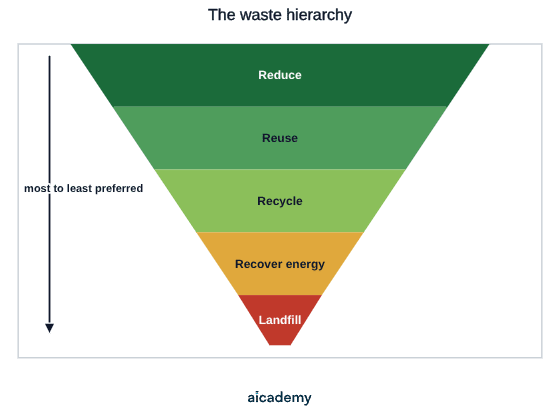
The waste hierarchy (preferred to least preferred):
The diagram below shows the hierarchy as a pyramid: the widest, most-preferred options (reduce, reuse) sit at the top, narrowing down to landfill as the last resort.
| Tier | Strategy | Example |
|---|---|---|
| 1 — Reduce | Use less in the first place | Packaging reduction legislation; reusable bags |
| 2 — Reuse | Use items multiple times | Refillable containers; charity shops; repair cafés |
| 3 — Recycle | Process materials back into new products | Kerbside collection of glass, metal, paper, plastics |
| 4 — Recover energy | Incinerate residual waste to generate electricity | Waste-to-energy (EfW) plants (e.g. Edmonton, London) |
| 5 — Landfill | Last resort | Releases methane as waste decomposes; least sustainable |
Strategies used by sustainable cities:
- Kerbside collection of separated waste streams: recycling, food waste, and general waste collected separately; food waste composted or converted to biogas via anaerobic digestion
- Zero-waste-to-landfill targets: e.g. San Francisco (80% diversion of waste from landfill); Seoul, South Korea (95% recycling rate through strict pay-per-bag waste charging)
- Extended producer responsibility: manufacturers required by law to fund collection and recycling of their packaging
London's waste: London generates approximately 3.5 million tonnes of household waste per year. The London Waste and Recycling Board sets targets for reducing landfill and increasing recycling. Energy Recovery Facilities (ERF/EFW plants) in Edmonton and Belvedere convert non-recyclable waste to electricity, powering approximately 55,000 homes combined.
How much of this have you taken in?
Quiz yourself on this section, free, no card needed.
Key terms
- Sustainable city
- A city that meets the needs of people living in it today without compromising the ability of future generations to meet their own needs.
- Waste hierarchy
- A ranking of waste strategies from most to least preferred: reduce, reuse, recycle, recover energy, and landfill.
- Circular economy
- An approach to waste that minimises waste and maximises reuse and recycling rather than disposal.
- Sustainable drainage systems (SuDS)
- Drainage features such as permeable paving, green roofs and wetlands that let rainwater infiltrate, reducing runoff and flood risk.
- Greywater recycling
- Treating and reusing wastewater from washing and bathing for purposes such as toilet flushing and garden irrigation.
- District heating network
- A system that distributes waste heat from power stations or industry via underground pipes to heat buildings efficiently.
- Bus Rapid Transit (BRT)
- A high-capacity bus system with dedicated lanes, pre-paid boarding and timed connections, used by 70% of residents in Curitiba.
- Congestion charging
- Charging drivers to enter the most congested areas to reduce traffic, as with the London Congestion Charge of £15 per day.
- Urban greening
- Creating and protecting green space such as parks, trees and green roofs to support biodiversity, air quality, mental health and flood reduction.
Frequently asked questions
A sustainable city meets present needs without compromising future generations, across three dimensions: environmental (minimising resource use, pollution and emissions, creating green space), social (equitable access to housing and services), and economic (employment and infrastructure investment).
The waste hierarchy ranks waste strategies from most to least preferred: reduce (use less), reuse, recycle, recover energy (incinerate to generate electricity), and landfill as the last resort. Reducing waste is better than recycling it, and landfill is the least sustainable option.
Examples include Curitiba in Brazil (Bus Rapid Transit used by 70% of residents, 52 m² of green space per person), Freiburg in Germany (40% renewable electricity and the car-free Vauban district), and Singapore (NEWater recycled wastewater and desalination for near-total water security).
Generate revision on any topic you study
Type any topic you're studying and Aicademy generates a complete lesson, quiz, and flashcard set, personalised to your level.
Lessons on anything
Structured, level-matched lessons on any topic you study
Practice quizzes
Find out what you actually know before the exam does
Flashcard sets
Lock in key concepts with instant revision cards
Ask Aica
Stuck on something? Get a clear explanation, any time
Urban Growth in a LIC or NEE City
Urbanisation: Trends, Causes and Megacities
Related lessons
11 min