Water Security: Scarcity, Demand and Sustainable Solutions

Aligned to the AQA 8035 specification
- Level
- Intermediate
- Reading time
- 13 min
- Published
- 10 June 2026
- Updated
- 16 August 2026
On this page
Key takeaways
- Water security means every person has reliable access to enough safe, affordable water; around 2.2 billion people lack safely managed drinking water and 4.2 billion lack safely managed sanitation.
- Physical water scarcity means not enough water exists, while economic water scarcity means water exists but cannot be accessed due to poverty, lack of infrastructure or conflict, as in much of sub-Saharan Africa.
- Water transfer schemes move water from surplus to deficit areas by canals and pipelines, not dams; China's South-North Water Transfer Project cost around $62 billion and relocated 345,000 people.
- Sustainable bottom-up schemes let local communities build and maintain their own water systems, like WaterAid-supported sand dams in Machakos District, Kenya, where over 600 dams each serve about 1,000 people.
- Demand-side strategies matter alongside new supply: greywater recycling, low-flow fixtures and leak repair (20-25% of UK treated water leaks) reduce demand without building new infrastructure.
Global Patterns of Water Surplus and Deficit
Water security exists when every person has reliable access to enough safe, affordable water to live a healthy and productive life. Access to safe water is one of the clearest dividing lines between human wellbeing and deprivation globally.
Global water availability — an unequal distribution:
| Region | Water availability situation |
|---|---|
| Canada, Scandinavia, Amazon Basin | High rainfall and low population density create significant water surplus; more fresh water per person than anywhere else |
| Western Europe, China, India, SE Asia | Generally adequate overall but locally stressed; demand in cities and agriculture approaches or exceeds local supply |
| Middle East, North Africa (MENA) | Most water-stressed region; 17 of the 25 most water-stressed countries globally are in the MENA region; severe water deficit in countries like Saudi Arabia, Libya, Jordan |
| Sub-Saharan Africa | Mixed: some areas (DRC, West Africa) have high rainfall; Sahel, Horn of Africa face structural water deficits; infrastructure limitations prevent use of available water in many areas |
The map below sketches the broad pattern: water surplus in the wet, sparsely populated regions and severe deficit across North Africa, the Middle East, and other arid zones.
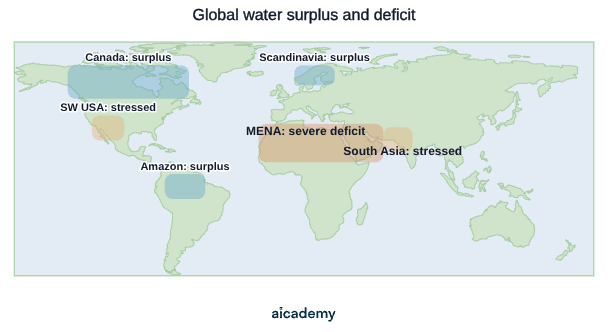
The scale of water insecurity: approximately 2.2 billion people lack safely managed drinking water services (UNICEF/WHO, 2022). Approximately 4.2 billion people lack safely managed sanitation. Approximately 4 billion people experience severe water scarcity for at least one month per year.
Why is water consumption increasing globally?
- Population growth: more people require more water for drinking, cooking, sanitation, and food production
- Rising incomes: higher-income countries and individuals consume more water — through longer showers, washing machines, dishwashers, and, most significantly, through higher meat consumption (1 kg of beef requires ~15,000 litres of "virtual water" in feed grain and grazing)
- Industrialisation: factories, power stations (cooling water), and mining operations consume enormous volumes of water; China's industrial water use has risen dramatically as manufacturing has grown
- Agricultural expansion: irrigation for larger cultivated areas to feed growing populations; global irrigated area has tripled since 1950
- Climate change: rising temperatures increase evaporation from soils and reservoirs, increasing the amount of rainfall needed to maintain the same effective water supply
Want more lessons like this one?
Generate lessons on anything you study. Free account, no card needed.
Key terms
- Water security
- When every person has reliable access to enough safe, affordable water to live a healthy and productive life.
- Physical water scarcity
- A situation where not enough water exists to meet demand, as in arid regions or where aquifers are overused.
- Economic water scarcity
- A situation where water exists but cannot be accessed because of poverty, lack of infrastructure or conflict.
- Over-abstraction
- Withdrawing water from rivers, lakes or aquifers faster than they are replenished, as happened to the Aral Sea.
- Aquifer
- An underground store of groundwater held in permeable rocks such as chalk or sandstone.
- Water transfer scheme
- Moving water by aqueduct, pipeline or river diversion from areas of surplus to areas of deficit.
- Desalination
- Removing salt from seawater or brackish groundwater to produce drinking water, using reverse osmosis or thermal distillation.
- Greywater
- Wastewater from sinks, showers and baths (not toilets) that can be recycled for toilet flushing and garden irrigation.
- Managed Aquifer Recharge (MAR)
- Deliberately directing surplus surface water into aquifers during wet periods to recharge them for use in dry periods.
- Bottom-up water management
- Approaches where local communities design, build and maintain their own small-scale water systems rather than relying on large externally delivered infrastructure.
- Sand dam
- A small concrete wall built across a seasonal riverbed that traps sand storing water for year-round extraction by the community.
Frequently asked questions
Physical water scarcity is when not enough water exists, as in arid regions or where aquifers are overused. Economic water scarcity is when water exists but cannot be accessed because of poverty, lack of infrastructure or conflict, which affects much of sub-Saharan Africa.
Water consumption is rising because of population growth, rising incomes (longer showers, appliances and higher meat consumption, with 1 kg of beef needing around 15,000 litres of virtual water), industrialisation, agricultural expansion, and climate change increasing evaporation.
WaterAid-supported sand dams in Machakos District, Kenya are a small-scale sustainable scheme. Concrete walls across seasonal riverbeds trap sand that stores water year-round. Each dam costs about £10,000-£15,000, serves around 1,000 people, and is built and maintained by the community.
Generate revision on any topic you study
Type any topic you're studying and Aicademy generates a complete lesson, quiz, and flashcard set, personalised to your level.
Lessons on anything
Structured, level-matched lessons on any topic you study
Practice quizzes
Find out what you actually know before the exam does
Flashcard sets
Lock in key concepts with instant revision cards
Ask Aica
Stuck on something? Get a clear explanation, any time
Urbanisation: Trends, Causes and Megacities
Related lessons
15 min