The UK's Changing Economy

Aligned to the AQA 8035 specification
- Level
- Intermediate
- Reading time
- 14 min
- Published
- 10 June 2026
- Updated
- 16 August 2026
On this page
Key takeaways
- The UK economy shifted from primary and secondary work to a dominant tertiary sector (around 80% of employment), with quaternary knowledge industries the fastest-growing sector.
- Deindustrialisation is a structural shift where manufacturing shrinks as a share of the economy, driven by globalisation, mechanisation and government policies, not simply factories closing.
- The north-south divide is a spatial inequality between the more prosperous south and the less prosperous north and west, rooted in the rapid decline of coal, steel, textiles and shipbuilding.
- Science parks like Cambridge Science Park create high-value jobs but in small numbers, so they cannot replace the large-scale employment lost through deindustrialisation.
- The UK is a two-way player in the global economy: it hosts foreign TNCs (Toyota, Nissan) and is home to TNCs investing abroad (Shell, BP, HSBC, AstraZeneca).
Changes in the UK Economy: The Four Sectors
The structure of the UK economy has changed dramatically over the past 150 years. Understanding the shift between economic sectors explains why some regions have thrived and others have declined.
The four economic sectors:
| Sector | What it includes | UK trend |
|---|---|---|
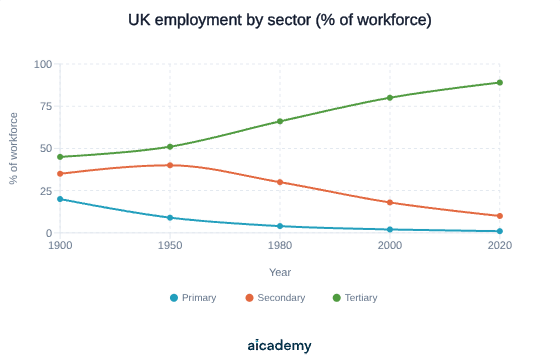
| Primary | Extraction of raw materials: farming, fishing, mining, forestry | Massive decline; from ~20% of workforce in 1900 to <2% today; coal mining effectively ended in the UK |
| Secondary | Manufacturing and industry: steel, textiles, cars, chemicals | Sharp decline from ~40% in 1950 to ~10% today (deindustrialisation) |
| Tertiary | Services: retail, transport, finance, healthcare, education, tourism | Growth to ~80% of UK employment today; the dominant sector |
| Quaternary | Knowledge-based industries: research and development (R&D), IT, biotechnology, financial services | Fastest-growing sector; concentrated in cities and science parks |
The chart below shows the long shift in UK employment: primary and secondary work declining while the tertiary sector grew to dominate.
Why did deindustrialisation happen?
- Globalisation: manufacturing moved to lower-wage countries (China, India, Bangladesh) where production costs are far cheaper
- Mechanisation: automation replaced manual workers in factories, mines, and on farms
- Government policies: Thatcher government policies of the 1980s (NUM strike 1984–85, privatisation of nationalised industries, reduced subsidies to uncompetitive heavy industry) accelerated the decline of coal, steel, and shipbuilding; more recently, industrial policy supports R&D and high-tech sectors through tax credits and innovation grants
- Changing demand: consumers in wealthy countries spend more on services (restaurants, travel, healthcare, digital entertainment) than manufactured goods as proportion of income
Impacts of industry on the physical environment:
- Coal mining left spoil heaps, subsidence, and contaminated land across South Wales, Yorkshire, Durham, and the Scottish coalfields
- Steel and chemical works caused severe river and air pollution in industrial regions; the River Tees and River Mersey were among Europe's most polluted rivers in the 1970s
- Sustainable industrial example — Hinkley Point C (Somerset): the UK's first new nuclear power station in a generation; under construction; will generate low-carbon electricity for approximately 6 million homes for 60 years; sited to minimise land use and carefully managed for visual impact; waste management plans in place — an example of planning for sustainability in major industrial development
Studying this for an exam?
Generate a personalised learning path for this subject. Free to get started.
Key terms
- Deindustrialisation
- The process by which a country's manufacturing sector shrinks as a proportion of the economy, typically as production moves to lower-wage countries and the service sector grows.
- Globalisation
- The growing interconnection of economies that allowed manufacturing to move to lower-wage countries where production costs are far cheaper.
- North-south divide
- A spatial inequality between the more prosperous south of England and the less prosperous north and west of the UK.
- Quaternary sector
- Knowledge-based industries such as research and development, IT, biotechnology and financial services; the fastest-growing sector.
- Science park
- A cluster of high-tech and R&D businesses co-located near universities, allowing collaboration and shared facilities.
- TNC
- A transnational corporation that operates across multiple countries; the UK both hosts foreign TNCs and is home to TNCs investing globally.
- Counter-urbanisation
- The movement of people out of cities into rural and commuter areas, increasing local spending power but also raising house prices.
Frequently asked questions
The four sectors are primary (extracting raw materials like farming, fishing and mining), secondary (manufacturing such as steel and cars), tertiary (services like retail, finance and healthcare), and quaternary (knowledge-based industries like R&D, IT and biotechnology).
Deindustrialisation happened because globalisation moved manufacturing to lower-wage countries, mechanisation replaced workers with automation, government policies in the 1980s accelerated the decline of heavy industry, and demand shifted towards services.
The north-south divide is a spatial inequality where southern England is more prosperous than the north and west, shown in higher GVA per head, lower unemployment and higher life expectancy and house prices in London and the South East.
Generate revision on any topic you study
Type any topic you're studying and Aicademy generates a complete lesson, quiz, and flashcard set, personalised to your level.
Lessons on anything
Structured, level-matched lessons on any topic you study
Practice quizzes
Find out what you actually know before the exam does
Flashcard sets
Lock in key concepts with instant revision cards
Ask Aica
Stuck on something? Get a clear explanation, any time
The Development Gap: Causes and Strategies
Tropical Rainforests: Characteristics and Biodiversity
Related lessons
15 min