Energy Security: Demand, Supply and Sustainable Solutions

Aligned to the AQA 8035 specification
- Level
- Intermediate
- Reading time
- 14 min
- Published
- 10 June 2026
- Updated
- 16 August 2026
On this page
Key takeaways
- Energy security exists when a country can reliably and affordably meet its energy needs from stable sources; it depends on both supply and price, as the 2022 price spike caused fuel poverty even without a supply cut.
- Global energy consumption is unequal and rising, driven by population growth, rising incomes and industrialisation in NEEs, urbanisation, and technology; fossil fuels still supply roughly four-fifths of world energy.
- Energy supply is affected by physical factors like uneven fossil fuel deposits and renewable potential, and human factors like technology, cost and politics such as the 2022 Russia-Ukraine war energy crisis.
- North Sea oil and gas gave the UK self-sufficiency and major tax revenues but is now declining; disadvantages include the 1988 Piper Alpha disaster that killed 167 workers and a £20 billion decommissioning cost.
- Sustainable energy strategies include a diversified energy mix, renewable deployment and carbon capture and storage; Grameen Shakti had installed about 4 million solar home systems in rural Bangladesh by 2022.
Global Energy Supply and Consumption
Energy security exists when a country can reliably and affordably meet its population's energy needs from stable sources without significant supply disruption.
Global energy consumption — deeply unequal:
| Country / region | Per capita energy use | Characteristic |
|---|---|---|
| USA | ~75 GJ/person/year | Very high — car-dependent, large homes, energy-intensive industry |
| UK | ~50 GJ/person/year | High; declining due to efficiency improvements and deindustrialisation |
| China | ~35 GJ/person/year | Rising rapidly; world's largest total energy consumer since 2010 |
| India | ~12 GJ/person/year | Still relatively low per capita; growing fast |
| Sub-Saharan Africa (average) | ~6–8 GJ/person/year | Low; approximately 600 million without electricity access |
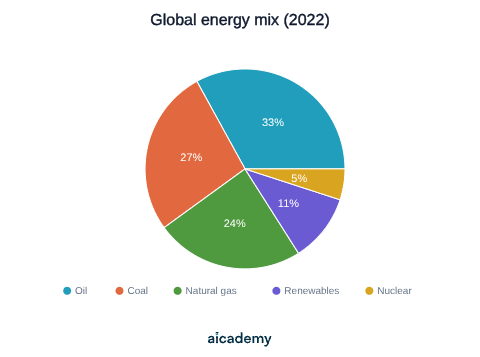
Global energy mix (share of total primary energy supply, 2022):
- Oil: ~33% — dominated by transport; Middle East, Russia, USA are major producers
- Coal: ~27% — dominant in electricity generation, especially China and India
- Natural gas: ~24% — heating, electricity; major producers: USA, Russia, Qatar
- Nuclear: ~5% — low-carbon electricity; France generates ~70% of electricity from nuclear
- Renewables (wind, solar, hydro, bioenergy): ~11% and growing rapidly
The chart below shows how fossil fuels (oil, coal, gas) still supply roughly four-fifths of the world's energy.
Why is energy consumption increasing globally?
- Population growth: more people require more energy for cooking, heating, transport, and manufacturing
- Rising incomes in NEEs: industrialisation in China, India, and other NEEs has driven massive growth in energy-intensive manufacturing; growing middle classes purchase cars, appliances, and air conditioning
- Urbanisation: cities consume more energy per capita than rural areas (transport, lighting, commercial activity); as LICs and NEEs urbanise, energy demand rises
- Technology: proliferation of electronic devices, data centres (which consume approximately 1–2% of global electricity), and electric vehicles (once grid-connected) all increase electricity demand
Studying this for an exam?
Generate a personalised learning path for this subject. Free to get started.
Key terms
- Energy security
- When a country can reliably and affordably meet its population's energy needs from stable sources without significant supply disruption.
- Energy mix
- The combination of different energy sources a country relies on; a diversified mix reduces vulnerability to supply disruption and price volatility.
- Non-renewable energy
- A finite energy source that cannot be naturally replenished, such as coal, oil, natural gas and nuclear.
- Renewable energy
- An energy source that is naturally replenished, such as wind, solar, hydroelectric, wave, tidal, geothermal and bioenergy.
- Sustainable energy
- Energy that meets present needs without compromising future generations' ability to meet theirs.
- Carbon capture and storage (CCS)
- Technology that captures CO2 from exhaust gases before it reaches the atmosphere and injects it underground.
- Energy poverty
- When households cannot afford to heat their homes adequately or lack electricity access.
Frequently asked questions
Energy security exists when a country can reliably and affordably meet its energy needs from stable sources without significant disruption. It requires both supply availability and an affordable price, as the 2022 price spike caused fuel poverty for millions in the UK even though physical supply was not cut.
Renewable means the energy source is naturally replenished, such as wind, solar and water. Sustainable means meeting present needs without compromising future generations. Most renewable energy is sustainable, but not all: bioenergy from forest clearance is renewable yet not sustainable as it depletes carbon stores.
CCS captures CO2 from power station or industrial exhaust gases and injects it underground before it reaches the atmosphere. It is distinct from switching to renewables because it can decarbonise industries like steel and cement where renewables cannot easily substitute.
Generate revision on any topic you study
Type any topic you're studying and Aicademy generates a complete lesson, quiz, and flashcard set, personalised to your level.
Lessons on anything
Structured, level-matched lessons on any topic you study
Practice quizzes
Find out what you actually know before the exam does
Flashcard sets
Lock in key concepts with instant revision cards
Ask Aica
Stuck on something? Get a clear explanation, any time
Ecosystems: Components, Food Webs and Global Biomes
Food Security: Insecurity, Strategies and Sustainability
Related lessons
15 min