Track progress, take quizzes and save notes on this lesson.

Free forever · no card needed

Start free
Intermediate

Group 1: The Alkali Metals

4.1.2.5 Group 1

Aligned to the AQA 8462 specification

Level
Intermediate
Reading time
5 min
Published
2 July 2026
On this page
  1. 1.The Alkali Metals
  2. 2.Reaction With Oxygen
  3. 3.Reaction With Chlorine
  4. 4.Reaction With Water
  5. 5.Reactivity Increases Down the Group
  6. 6.Common Exam Mistakes

Key takeaways

  • The alkali metals in Group 1 all have one electron in their outer shell, which they lose to form 1+ ions, giving the group its shared chemical properties.
  • Reactivity increases down Group 1: lithium is the least reactive of the first three, then sodium, then potassium is the most reactive.
  • Group 1 metals react with water to give a metal hydroxide plus hydrogen gas, for example 2Na + 2H₂O → 2NaOH + H₂; the hydroxide makes the solution alkaline.
  • Group 1 metals react with oxygen to form metal oxides and with chlorine to form white metal chlorides, for example 2Na + Cl₂ → 2NaCl.
  • Reactivity increases down the group because the outer electron is further from the nucleus and more shielded, so it is lost more easily.

The Alkali Metals

Group 1 is the first column of the periodic table and holds the alkali metals: lithium, sodium and potassium, followed by rubidium, caesium and francium. They are soft metals that can be cut with a knife, and freshly cut surfaces are shiny before they quickly tarnish in air.

Every alkali metal atom has exactly one electron in its outer shell. This shared feature is the reason the group members react in the same way. To reach a stable, full outer shell, each atom loses that single outer electron, forming a positive ion with a 1+ charge (for example Na⁺).
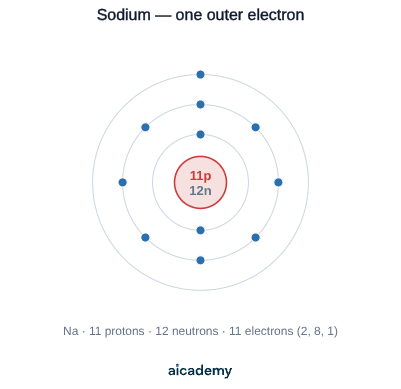
All Group 1 metals have one outer electron, which they lose to form a 1+ ion. Losing the same number of electrons is why they share their chemical reactions.

The group is called the "alkali" metals because their hydroxides dissolve in water to form alkaline solutions.

Reaction With Oxygen

Alkali metals react readily with oxygen in the air, which is why they tarnish so fast and are stored under oil to keep air away.

The reaction forms a metal oxide. Each metal combines with oxygen in the same ratio, giving a general pattern across the group:

The metal oxides formed are white solids. Because each metal forms a 1+ ion and oxygen forms a 2− ion, the formula of the oxide is always of the form M₂O, with two metal atoms to each oxygen atom.

MetalOxide formedFormula
LithiumLithium oxideLi₂O
SodiumSodium oxideNa₂O
PotassiumPotassium oxideK₂O

Reaction With Chlorine

Alkali metals react with chlorine gas, burning vigorously to form a metal chloride, which is a white crystalline salt.

Each metal combines with chlorine in a 1:1 ratio of atoms because the metal forms a 1+ ion and chlorine forms a 1− ion:

Sodium chloride (NaCl) is ordinary table salt. All three chlorides are white ionic solids that dissolve in water. As with the other reactions, the more reactive the metal, the more vigorous the reaction with chlorine.

MetalChloride formedFormula
LithiumLithium chlorideLiCl
SodiumSodium chlorideNaCl
PotassiumPotassium chlorideKCl

Reaction With Water

The reaction with water is the most memorable and the one exams ask about most. An alkali metal reacts with water to produce a metal hydroxide and hydrogen gas.

The metal floats and moves across the surface (it is less dense than water), fizzing as hydrogen is released. The heat produced can ignite the hydrogen. The metal hydroxide dissolves, making the solution alkaline, so universal indicator added to the water turns purple.

The three metals differ sharply in how violently they react:

MetalWhat you see with water
LithiumFizzes steadily, moves slowly on the surface
SodiumMelts into a ball, whizzes about, may ignite with an orange flame
PotassiumReacts violently, ignites immediately with a lilac flame, may spark

Group 1 + water → metal hydroxide + hydrogen. Learn the general pattern; it lets you write the equation for any alkali metal.

How much of this have you taken in?

Quiz yourself on this section, free, no card needed.

Test myself

Reactivity Increases Down the Group

Comparing lithium, sodium and potassium shows a clear trend: reactivity increases down Group 1. Potassium reacts far more violently than sodium, and sodium more vigorously than lithium.

Reacting means losing the single outer electron. The easier that electron is to lose, the more reactive the metal. Going down the group:

  • the outer electron sits in a shell further from the nucleus;
  • there are more inner shells between the nucleus and the outer electron, which shield it from the nuclear charge.

Both effects weaken the attraction between the nucleus and the outer electron, so it is lost more easily. That is why potassium (outer electron in shell 4) loses its electron more readily than sodium (shell 3) or lithium (shell 2).

Reactivity increases down Group 1 because the outer electron is further from the nucleus and more shielded, so the atom loses it more easily.

This trend lets you predict that rubidium and caesium, lower still, react even more violently than potassium.

Common Exam Mistakes

1. Getting the reactivity trend backwards

Reactivity increases down Group 1. Lithium is the least reactive of the first three and potassium the most reactive. This is the opposite of Group 7.

2. Explaining the trend with "atoms get bigger" alone

The mark-scheme explanation is that the outer electron is further from the nucleus and shielded by more inner shells, so it is held less strongly and lost more easily. "Bigger atoms" on its own does not explain why the electron is lost more readily.

3. Forgetting hydrogen in the water reaction

The products of Group 1 + water are a metal hydroxide and hydrogen gas. Missing out the hydrogen, or writing a metal oxide instead of a hydroxide, loses marks.

4. Writing the wrong ion charge

Group 1 metals form 1+ ions by losing one electron. Do not write Na²⁺ or give oxides a formula like NaO; the correct oxide is Na₂O.

5. Saying the solution turns acidic

The metal hydroxide makes the solution alkaline, turning universal indicator purple. It does not turn acidic or red.

6. Unbalanced oxygen equations

The reaction with oxygen needs four metal atoms per O₂ molecule, for example 4Na + O₂ → 2Na₂O. Check the oxygen atoms balance (two on each side) before moving on.

Key terms

Alkali metal
An element in Group 1 with one outer electron; it forms a 1+ ion and its hydroxide dissolves to give an alkaline solution.
Metal hydroxide
A compound of a metal with the OH group, such as sodium hydroxide (NaOH), which dissolves in water to make an alkaline solution.
Shielding
The reduction in attraction between the nucleus and an outer electron caused by the inner shells of electrons between them.

Frequently asked questions

Reactivity increases down Group 1 because each element down the group has its outer electron in a shell further from the nucleus, with more inner shells shielding it. The attraction on the outer electron is weaker, so it is lost more easily and the metal reacts faster.

An alkali metal reacts with water to make a metal hydroxide and hydrogen gas. For sodium: 2Na + 2H₂O → 2NaOH + H₂. The metal hydroxide dissolves to give an alkaline solution, which turns universal indicator purple.

Sodium reacts with chlorine to form sodium chloride, a white solid: 2Na + Cl₂ → 2NaCl. Sodium reacts with oxygen to form sodium oxide: 4Na + O₂ → 2Na₂O. Both products are ionic compounds containing the Na⁺ ion.

Generate revision on any topic you study

Type any topic you're studying and Aicademy generates a complete lesson, quiz, and flashcard set, personalised to your level.

Lessons on anything

Structured, level-matched lessons on any topic you study

Practice quizzes

Find out what you actually know before the exam does

Flashcard sets

Lock in key concepts with instant revision cards

Ask Aica

Stuck on something? Get a clear explanation, any time

Prev

Group 0: The Noble Gases

Next

Group 7: The Halogens

Related lessons

5 min

Lesson

Group 0: The Noble Gases

AQA GCSE Chemistry · AQA 8462

20 days ago

7 min

Lesson

Group 7: The Halogens

AQA GCSE Chemistry · AQA 8462

20 days ago

Top students don’t revise more. They revise what counts.

Start revising free

Free to start. No card needed.