Track progress, take quizzes and save notes on this lesson.

Free forever · no card needed

Start free
Intermediate

Group 7: The Halogens

4.1.2.6 Group 7

Aligned to the AQA 8462 specification

Level
Intermediate
Reading time
7 min
Published
2 July 2026
On this page
  1. 1.The Halogens
  2. 2.Diatomic Molecules
  3. 3.Reactions With Metals and Non-metals
  4. 4.Trends in Physical Properties
  5. 5.Reactivity Decreases Down the Group
  6. 6.Displacement Reactions
  7. 7.Common Exam Mistakes

Key takeaways

  • The halogens in Group 7 all have seven electrons in their outer shell, so they gain one electron to form 1− ions and share similar reactions.
  • The halogens are non-metals that exist as diatomic molecules (pairs of atoms), such as Cl₂, Br₂ and I₂.
  • Going down Group 7, relative molecular mass, melting point and boiling point all increase, while reactivity decreases.
  • A more reactive halogen displaces a less reactive halogen from an aqueous solution of its salt, for example chlorine displaces bromine: Cl₂ + 2KBr → 2KCl + Br₂.
  • Reactivity decreases down Group 7 because the outer shell is further from the nucleus and more shielded, so the atom gains an electron less easily.

The Halogens

Group 7, near the right of the periodic table, contains the halogens: fluorine, chlorine, bromine and iodine (and astatine below them). They are reactive non-metals with strong colours and, in the case of chlorine, a choking smell.

Every halogen atom has seven electrons in its outer shell. Needing just one more electron to complete the shell, each atom tends to gain one electron, forming a negative ion with a 1− charge (for example Cl⁻). This shared electron arrangement is why the whole group reacts in similar ways.
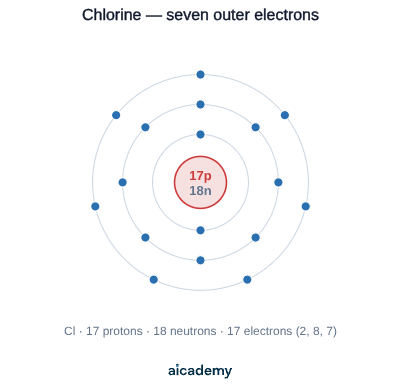
All Group 7 atoms have seven outer electrons and gain one electron to reach a full outer shell, forming a 1− ion (a halide). Gaining the same number of electrons is why the group shares its reactions.

The 1− ions they form are called halides: chloride, bromide, iodide.

Diatomic Molecules

Halogen elements do not exist as single atoms. Each halogen exists as a diatomic molecule: two atoms joined by a covalent bond, sharing a pair of electrons so that both atoms gain a full outer shell.

HalogenMoleculeState at room temperatureColour
FluorineF₂GasPale yellow
ChlorineCl₂GasGreen (yellow-green)
BromineBr₂LiquidOrange-brown
IodineI₂SolidGrey-black (purple vapour)

Writing the element correctly matters in equations: chlorine gas is Cl₂, not Cl. The colours and states are worth learning, since they let you identify a halogen and spot the changes in a displacement reaction.

Reactions With Metals and Non-metals

Halogens react with both metals and other non-metals, and the type of compound formed depends on what they react with.

With metals, a halogen gains an electron from the metal, so an ionic compound (a metal halide) forms. The metal becomes a positive ion and the halogen a negative halide ion:

With non-metals, the halogen shares electrons rather than taking them, so a covalent (molecular) compound forms. Reacting with hydrogen gives a hydrogen halide:

Reacts withType of compoundExample product
A metal (e.g. sodium)Ionic (metal halide)Sodium chloride, NaCl
A non-metal (e.g. hydrogen)Covalent (molecular)Hydrogen chloride, HCl

The metal halides contain 1− halide ions; the covalent compounds are made of molecules.

Trends in Physical Properties

Going down Group 7, the physical properties change in a clear pattern. As you move from fluorine to iodine, the relative molecular mass, melting point and boiling point all increase.

This is why the physical state changes down the group: fluorine and chlorine are gases, bromine is a liquid, and iodine is a solid, all at room temperature. The larger molecules lower down are held together more strongly by the forces between them, so more energy is needed to melt or boil them.

HalogenRelative molecular massMelting / boiling point
Fluorine (F₂)SmallestLowest
Chlorine (Cl₂)
Bromine (Br₂)
Iodine (I₂)LargestHighest

Because the trend is steady, you can predict a missing melting or boiling point: it must lie between the values of the halogens above and below it.

Worth saving these ideas?

Turn what you've read into instant revision cards. Free to get started.

Make flashcards

Reactivity Decreases Down the Group

Unlike the physical properties, reactivity decreases down Group 7. Fluorine is the most reactive halogen and iodine the least reactive of the common ones.

Reacting means gaining an electron into the outer shell. The easier it is to attract that electron in, the more reactive the halogen. Going down the group:

  • the outer shell is further from the nucleus;
  • there are more inner shells shielding the outer shell from the nuclear charge.

Both effects mean the nucleus attracts an incoming electron less strongly, so the atom gains an electron less easily and the halogen is less reactive.

Reactivity decreases down Group 7 because the outer shell is further from the nucleus and more shielded, so an incoming electron is attracted less strongly and gained less easily.

Notice the contrast with Group 1: there, atoms lose electrons and reactivity increases down the group; here, atoms gain electrons and reactivity decreases down the group. The same idea (distance and shielding) explains both.

Displacement Reactions

The reactivity order can be demonstrated directly with a displacement reaction: a more reactive halogen displaces a less reactive halogen from an aqueous solution of its salt.

If chlorine (more reactive) is added to a colourless solution of potassium bromide, the chlorine takes the place of the bromine, releasing bromine into the solution, which turns orange:

The reverse does not happen: bromine cannot displace chlorine from potassium chloride, because bromine is less reactive. This table shows which combinations react:

Halogen addedTo potassium chlorideTo potassium bromideTo potassium iodide
ChlorineNo reactionDisplaces bromine ✓Displaces iodine ✓
BromineNo reactionNo reactionDisplaces iodine ✓
IodineNo reactionNo reactionNo reaction

Worked example. Bromine water (orange) is added to potassium iodide solution. Bromine is more reactive than iodine, so it displaces the iodide: . The solution darkens to a brown colour as iodine is released, confirming the displacement.

A displacement reaction only happens if the halogen added is more reactive than the halide already in solution. A colour change signals that a reaction has occurred.

Common Exam Mistakes

1. Getting the reactivity trend backwards

Reactivity decreases down Group 7. Fluorine and chlorine are more reactive than bromine and iodine. This is the opposite of Group 1.

2. Explaining the trend with size alone

The mark-scheme explanation is that the outer shell is further from the nucleus and shielded by more inner shells, so an incoming electron is attracted less strongly and gained less easily. "Atoms get bigger" alone does not earn the explanation mark.

3. Forgetting halogens are diatomic

Halogen elements are written as molecules of two atoms: Cl₂, Br₂, I₂. Writing Cl instead of Cl₂ leaves equations unbalanced and loses marks.

4. Predicting a displacement in the wrong direction

Only a more reactive halogen displaces a less reactive one. Bromine does not displace chlorine, and iodine displaces neither.

5. Muddling the physical and chemical trends

Melting point, boiling point and relative molecular mass increase down the group, but reactivity decreases. Do not assume every property changes in the same direction.

6. Confusing halogen with halide

The halogen is the element (Cl₂, a diatomic molecule); the halide is the 1− ion or its compound (Cl⁻, chloride). Use the right word for the element and for the ion.

Key terms

Halogen
A non-metal element in Group 7 with seven outer electrons; it gains one electron to form a 1− ion (a halide).
Diatomic molecule
A molecule made of two atoms bonded together, such as Cl₂; the halogens exist as diatomic molecules.
Displacement reaction
A reaction in which a more reactive element takes the place of a less reactive element in one of its compounds.
Halide
A compound of a halogen with a metal, containing the 1− halogen ion, such as sodium chloride or potassium bromide.

Frequently asked questions

Reactivity decreases down Group 7 because each element down the group has its outer shell further from the nucleus, with more inner shells shielding it. The nucleus attracts an incoming electron less strongly, so the atom gains an electron less easily and reacts more slowly.

A displacement reaction is where a more reactive halogen takes the place of a less reactive halogen in a salt solution. For example, chlorine displaces bromine: Cl₂ + 2KBr → 2KCl + Br₂. The solution changes colour as the displaced halogen is released.

Halogen atoms have seven outer electrons and need one more for a full outer shell, so two atoms share a pair of electrons in a covalent bond. This gives molecules of two atoms (diatomic), such as Cl₂, Br₂ and I₂, rather than single atoms.

Generate revision on any topic you study

Type any topic you're studying and Aicademy generates a complete lesson, quiz, and flashcard set, personalised to your level.

Lessons on anything

Structured, level-matched lessons on any topic you study

Practice quizzes

Find out what you actually know before the exam does

Flashcard sets

Lock in key concepts with instant revision cards

Ask Aica

Stuck on something? Get a clear explanation, any time

Prev

Group 1: The Alkali Metals

Next

Ionic Bonding

Related lessons

5 min

5 min

Lesson

Group 0: The Noble Gases

AQA GCSE Chemistry · AQA 8462

20 days ago

7 min

Lesson

Transition Metals

AQA GCSE Chemistry · AQA 8462

20 days ago

Top students don’t revise more. They revise what counts.

Start revising free

Free to start. No card needed.