Track progress, take quizzes and save notes on this lesson.

Free forever · no card needed

Start free
Intermediate

The Development of the Atomic Model

4.1.1.3 The development of the model of the atom

Aligned to the AQA 8462 specification

Level
Intermediate
Reading time
6 min
Published
2 July 2026
On this page
  1. 1.Why Scientific Models Change
  2. 2.The First Idea and the Discovery of the Electron
  3. 3.The Plum Pudding Model
  4. 4.Alpha Particle Scattering and the Nuclear Model
  5. 5.Bohr's Model of Energy Levels
  6. 6.Protons, and Chadwick's Neutrons
  7. 7.Common Exam Mistakes

Key takeaways

  • Before the electron was discovered, atoms were thought to be tiny indivisible spheres that could not be divided.
  • The discovery of the electron led to the plum pudding model: a ball of positive charge with negative electrons embedded in it.
  • The alpha particle scattering experiment showed that mass and positive charge are concentrated in a tiny central nucleus, which replaced the plum pudding model with the nuclear model.
  • Niels Bohr showed that electrons orbit the nucleus at fixed distances called energy levels, and his calculations agreed with experimental observations.
  • Later work showed the nucleus contains positively charged protons, and about 20 years later James Chadwick provided evidence for neutrons.

Why Scientific Models Change

A scientific model is our best current explanation of something we cannot see directly. When new experimental evidence appears that a model cannot explain, scientists change the model or replace it entirely. The story of the atom is the clearest example on the GCSE course.

The model of the atom was not worked out by one person in one moment. It was built up in stages, each stage triggered by a new experiment, over roughly a hundred years.

The atom is far too small to see, so every model is inferred from what atoms do in experiments. A model survives only as long as it fits the evidence.

Understanding why each model changed matters more for the exam than memorising dates. Examiners reward answers that link a specific piece of evidence to the specific change it forced in the model.

The First Idea and the Discovery of the Electron

Before the electron was discovered, atoms were thought to be tiny spheres that could not be divided. This is often called the "solid sphere" idea: the atom was the smallest possible piece of matter, with no internal parts.

That picture had to change once the electron was discovered. The electron is a tiny, negatively charged particle, and its discovery proved the atom is not indivisible after all: it contains smaller parts inside it.

If atoms contain negative electrons but are neutral overall, there must also be positive charge somewhere to cancel it out. Explaining where that positive charge sits was the next problem, and it led directly to the first detailed model of atomic structure. The key logical step is simple: a neutral atom that contains negative electrons must also contain an equal amount of positive charge.

The Plum Pudding Model

The discovery of the electron led to the plum pudding model. In this model the atom is a ball of positive charge with negative electrons embedded in it, like pieces of fruit dotted through a pudding.

The positive charge was spread evenly throughout the whole atom, and the electrons were scattered inside it. There was no nucleus in this model, and there was no empty space: the positive charge filled the entire atom.

FeaturePlum pudding model
Positive chargeSpread evenly through the whole atom
ElectronsEmbedded throughout the positive ball
NucleusNone
Empty spaceNone

The plum pudding model fitted what was known at the time: atoms are neutral and contain negative electrons balanced by positive charge. It stood until an experiment produced results it simply could not explain.

Alpha Particle Scattering and the Nuclear Model

The alpha particle scattering experiment fired positively charged alpha particles at a very thin sheet of gold foil. If the plum pudding model were correct, the positive charge would be spread out thinly, so every alpha particle should pass almost straight through with only tiny deflections.

The actual results were different:

ObservationWhat it showed
Most alpha particles passed straight throughThe atom is mostly empty space
Some were deflected through large anglesThere is a concentrated positive charge to repel them
A very few bounced almost straight backThe mass and charge are packed into a tiny, dense centre

These results could not fit the plum pudding model. They led to the nuclear model: the mass of an atom is concentrated at the centre in a nucleus, and the nucleus is charged. The electrons occupy the space around it. Because the nuclear model explained the scattering results and the plum pudding model could not, the nuclear model replaced it.

Something not quite clicking?

Ask Aica to explain any part of this differently. Free, takes 30 seconds.

Ask Aica

Bohr's Model of Energy Levels

The early nuclear model still had a problem: if electrons simply sat around a positive nucleus, they should spiral inwards. Niels Bohr adapted the nuclear model to fix this.

Bohr proposed that electrons orbit the nucleus at specific distances from it, called energy levels (or shells). Electrons in a given energy level stay at that fixed distance rather than falling in. Crucially, the results calculated from Bohr's model agreed with experimental observations, which is why it was accepted.
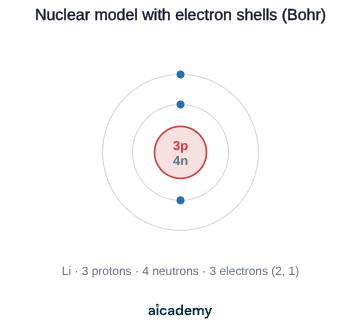
The diagram shows the key features of the model after Bohr: a small central nucleus containing the positive charge and the mass, with electrons arranged in fixed shells around it.

(The detail of the experimental work behind Bohr's model is not required by AQA. You need the idea that electrons orbit at fixed energy levels and that Bohr's calculations matched observation.)

This shell arrangement is the foundation of electronic structure, which explains chemical bonding and the whole shape of the periodic table.

Protons, and Chadwick's Neutrons

Later experiments refined the nucleus itself. Scientists found that the positive charge of the nucleus could be subdivided into a whole number of smaller particles, each carrying the same positive charge. These particles are the protons.

About 20 years later, James Chadwick carried out work that provided the evidence for neutrons in the nucleus. Neutrons have no charge but do have mass, which explained why the mass of an atom is greater than the protons alone could account for.

DiscoveryWhat it added to the model
ProtonsThe nucleus contains whole-number positive particles
Neutrons (Chadwick)The nucleus also contains uncharged particles with mass

(The detail of Chadwick's experimental work is not required by AQA. You need only that his work gave evidence for the neutron, roughly 20 years after protons.)

With protons and neutrons in the nucleus and electrons in energy levels outside it, the model reached the form you use throughout GCSE chemistry.

Common Exam Mistakes

1. Saying the plum pudding model has a nucleus

The plum pudding model has no nucleus. Its positive charge is spread evenly through the whole atom. The nucleus only appears in the nuclear model, after alpha scattering.

2. Not linking the evidence to the change

An answer that just says "alpha particles were fired at gold foil" scores little. You must link each observation to a conclusion: particles passing through means mostly empty space; particles bouncing back means a tiny dense nucleus.

3. Crediting the wrong scientist for the neutron

Protons came first; Chadwick provided the evidence for the neutron about 20 years later. Do not attribute the neutron to the scientist who found the nucleus.

4. Describing experimental detail that is not required

AQA does not require the experimental detail behind the Bohr model or Chadwick's work. Focus on what each stage concluded about the atom, not on apparatus you are not asked for.

5. Thinking the model was correct from the start

Each model was the best fit for the evidence available at the time, then was changed when new evidence appeared. Describe the sequence as a response to new experiments, not as a single correct answer discovered at once.

Key terms

Plum pudding model
A model of the atom as a ball of positive charge with negative electrons embedded in it.
Nuclear model
A model in which almost all the mass and the positive charge are concentrated in a tiny central nucleus, with electrons around the outside.
Alpha particle scattering
An experiment in which positively charged alpha particles were fired at thin gold foil, giving evidence for the nuclear model.
Energy level
A fixed distance from the nucleus at which electrons orbit, as described by Bohr.

Frequently asked questions

Most alpha particles passed straight through the gold foil, but a few were deflected and a very small number bounced back. This showed the atom is mostly empty space with mass and positive charge concentrated in a tiny central nucleus, so the plum pudding model was replaced by the nuclear model.

In the plum pudding model the atom is a ball of positive charge with electrons dotted through it, with no nucleus. In the nuclear model the positive charge and almost all the mass sit in a tiny central nucleus, with electrons around the outside and mostly empty space between.

James Chadwick provided the evidence for neutrons, about 20 years after the nucleus was found to contain protons. His work explained why atoms have more mass than the protons alone could account for.

Generate revision on any topic you study

Type any topic you're studying and Aicademy generates a complete lesson, quiz, and flashcard set, personalised to your level.

Lessons on anything

Structured, level-matched lessons on any topic you study

Practice quizzes

Find out what you actually know before the exam does

Flashcard sets

Lock in key concepts with instant revision cards

Ask Aica

Stuck on something? Get a clear explanation, any time

Prev

Mixtures and Separating Techniques

Next

Atomic Structure, Isotopes and Relative Atomic Mass

Related lessons

Top students don’t revise more. They revise what counts.

Start revising free

Free to start. No card needed.