Viral, Bacterial, Fungal and Protist Diseases

Aligned to the AQA 8461 specification
- Level
- Intermediate
- Reading time
- 11 min
- Published
- 16 June 2026
- Updated
- 16 August 2026
On this page
Key takeaways
- AQA names seven diseases by pathogen type: measles, HIV and tobacco mosaic virus (viruses), salmonella and gonorrhoea (bacteria), rose black spot (fungus) and malaria (protist).
- Antibiotics kill bacteria, so they treat salmonella and gonorrhoea but do nothing for the viral diseases measles, HIV and TMV.
- HIV is the virus; AIDS is the late stage of infection where the immune system is so damaged it can no longer fight other infections or cancers.
- In malaria the protist is the pathogen and the mosquito is only a vector, so control targets the mosquito by stopping breeding and using nets.
- Both TMV (a virus) and rose black spot (a fungus) are plant diseases that reduce photosynthesis and stunt growth, and do not infect humans.
How much of this have you taken in?
Quiz yourself on this section, free, no card needed.
Malaria — A Protist Disease
The pathogens that cause malaria are protists. Malaria causes recurrent episodes of fever and can be fatal.
What makes malaria distinctive is its life cycle, which includes the mosquito. The mosquito is a vector — an organism that carries a pathogen from one host to another without getting the disease itself. The malarial protist is passed to people when an infected mosquito bites them.
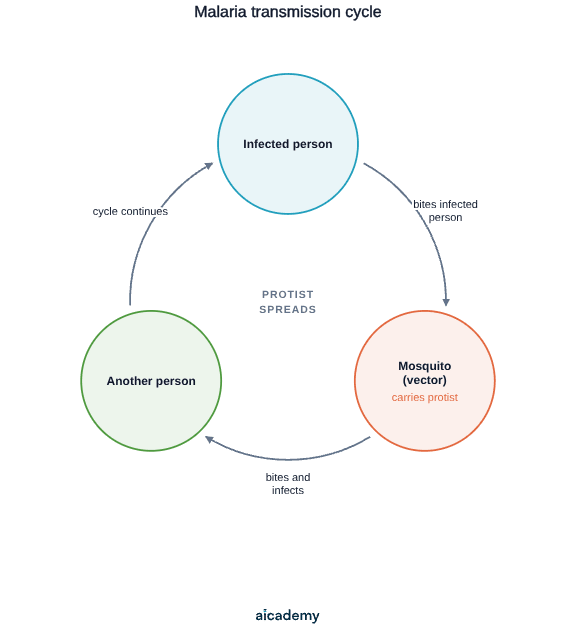
Because the mosquito is essential to the spread, malaria is controlled by attacking the vector rather than only treating sick people:
- Preventing mosquitoes from breeding — for example, removing or draining the standing water where mosquito larvae develop.
- Using mosquito nets — sleeping under a net stops infected mosquitoes biting people at night.
Vector logic: break the mosquito's role and you break the chain of infection. This is why malaria control targets the insect, not just the patient.
Applied walk-through 1 — identify the disease and a control measure. A patient has recurrent episodes of fever and lives in a region with many mosquitoes near standing water.
- The mosquito link and recurrent fever point to malaria.
- Malaria is caused by a protist, spread by a mosquito vector.
- A valid control measure: drain the standing water to stop mosquitoes breeding, and use mosquito nets to avoid bites.
Applied walk-through 2 — match symptoms to pathogen and prevention. A patient reports a thick yellow discharge and pain on urinating, following sexual contact.
- Sexual transmission plus that discharge identify gonorrhoea.
- It is caused by a bacterium, so antibiotics can treat it (though resistant strains exist).
- A valid prevention measure: a barrier method of contraception such as a condom.
Key terms
- Pathogen
- A microorganism that causes a communicable disease.
- Vector
- An organism that carries a pathogen from one host to another without getting the disease itself, such as the mosquito in malaria.
- AIDS
- The late stage of HIV infection, when the immune system is so damaged the body can no longer deal with other infections or cancers.
- Antiretroviral drugs
- Drugs used to control HIV by keeping virus levels low enough to protect the immune cells, without removing the virus from the body.
- Tobacco mosaic virus (TMV)
- A plant virus that gives leaves a mosaic discolouration, lowering photosynthesis and stunting growth.
- Salmonella
- Bacteria, ingested in or on contaminated food, that cause fever, abdominal cramps, vomiting and diarrhoea through the toxins they secrete.
- Gonorrhoea
- A sexually transmitted disease caused by a bacterium, with symptoms of a thick yellow or green discharge and pain on urinating.
- Rose black spot
- A fungal plant disease that causes purple or black spots on rose leaves, which then turn yellow and drop, reducing photosynthesis.
- Malaria
- A disease caused by protists, spread by a mosquito vector, that causes recurrent episodes of fever and can be fatal.
Frequently asked questions
Antibiotics kill bacteria, not viruses, so they have no effect on measles, HIV or TMV. Viral diseases are controlled in other ways, such as vaccinating young children against measles or using antiretroviral drugs to control HIV.
HIV is the virus, while AIDS is the late stage of HIV infection. In AIDS the immune system is so badly damaged that the body can no longer deal with other infections or cancers. Antiretroviral drugs can stop a person ever reaching the AIDS stage.
Malaria is caused by a protist passed to people when an infected mosquito bites them, so the mosquito is a vector. It is controlled by stopping mosquitoes breeding (for example draining standing water) and by using mosquito nets to prevent bites.
Generate revision on any topic you study
Type any topic you're studying and Aicademy generates a complete lesson, quiz, and flashcard set, personalised to your level.
Lessons on anything
Structured, level-matched lessons on any topic you study
Practice quizzes
Find out what you actually know before the exam does
Flashcard sets
Lock in key concepts with instant revision cards
Ask Aica
Stuck on something? Get a clear explanation, any time
Communicable Diseases and Pathogens
Human Defence Systems and the Immune System
Related lessons
10 min
12 min
10 min