Culturing Microorganisms

Aligned to the AQA 8461 specification
- Topic
- Cell biology
- Level
- Intermediate
- Reading time
- 8 min
- Published
- 16 June 2026
- Updated
- 25 August 2026
On this page
Key takeaways
- Bacteria reproduce by binary fission, one cell dividing into two identical daughter cells, and can divide as often as once every 20 minutes in suitable conditions.
- To find a population after a time, divide total time by the mean division time to get the number of divisions, then multiply the starting number by 2 to the power of that number.
- Aseptic technique keeps a culture free of unwanted microorganisms: sterilise media and the inoculating loop, work near a flame, tape the lid without sealing it, and incubate at 25 °C in school labs.
- In Required practical 2, paper discs soaked in antiseptics, antibiotics or plant extracts are placed on a bacterial lawn; a larger clear zone of inhibition means the substance is more effective.
- The zone of inhibition is circular, so its area is found with pi times the radius squared, halving the diameter to get the radius first.
Want more lessons like this one?
Generate lessons on anything you study. Free account, no card needed.
Required Practical 2: Zones of Inhibition
Required practical 2 investigates the effect of antiseptics, antibiotics, or plant extracts on bacterial growth.
The method:
- Spread bacteria evenly over an agar plate to make a "lawn".
- Soak paper discs in different antibiotics or antiseptics (plus one control disc soaked in sterile water).
- Place the discs on the lawn, tape the lid, and incubate at 25 °C.
- After incubation, measure the clear ring around each disc where bacteria could not grow.
The clear ring is the zone of inhibition. A larger zone means the substance is more effective at killing or stopping the bacteria.
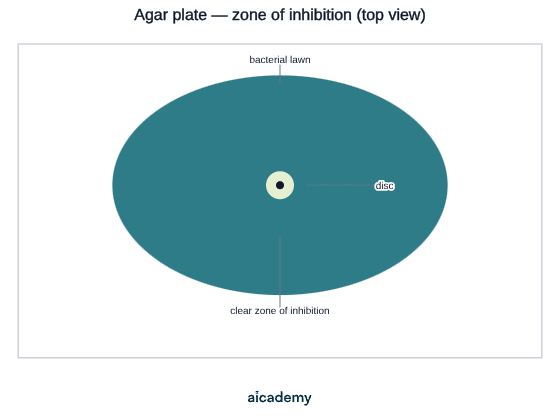
The control disc (sterile water) should show no zone. This confirms that any clear zone is caused by the test substance and not the disc itself.
Key terms
- Binary fission
- Asexual reproduction in which one bacterial cell copies its genetic material and divides into two identical daughter cells.
- Aseptic technique
- The set of precautions that keeps a culture free from unwanted microorganisms during investigation.
- Nutrient broth
- A sterile liquid containing nutrients in which bacteria spread, with growth measured by how cloudy the liquid becomes.
- Agar plate
- A Petri dish set with nutrient agar on which bacteria grow into visible colonies.
- Colony
- A visible mass of identical bacteria on an agar plate, all descended from one original cell by binary fission.
- Zone of inhibition
- The clear ring around a disc on a bacterial lawn where bacteria could not grow; a larger zone means a more effective substance.
- Inoculating loop
- A tool passed through a flame to sterilise it before transferring bacteria, so it does not introduce other microbes.
Frequently asked questions
First find the number of divisions by dividing the total time by the mean division time (using the same units). Then multiply the starting number by 2 to the power of the number of divisions, because the population doubles each division.
Cultures are incubated at 25 °C rather than 37 °C to limit the growth of pathogens that thrive at human body temperature, reducing the risk of culturing microbes that are dangerous to humans.
The zone of inhibition is the clear ring around a disc where bacteria could not grow. A larger zone means the antibiotic or antiseptic on that disc is more effective at killing or stopping the bacteria.
Generate revision on any topic you study
Type any topic you're studying and Aicademy generates a complete lesson, quiz, and flashcard set, personalised to your level.
Lessons on anything
Structured, level-matched lessons on any topic you study
Practice quizzes
Find out what you actually know before the exam does
Flashcard sets
Lock in key concepts with instant revision cards
Ask Aica
Stuck on something? Get a clear explanation, any time
Microscopy and Magnification
Mitosis and the Cell Cycle
Related lessons
9 min
10 min
10 min