Virtual and Parasocial Relationships

Aligned to the AQA 7182 specification
- Topic
- Relationships
- Level
- Intermediate
- Reading time
- 11 min
- Published
- 1 July 2026
- Updated
- 16 August 2026
On this page
Key takeaways
- Reduced cues theory says online communication lacks non-verbal cues, reducing disclosure, while the hyperpersonal model argues online relationships can be more intimate and form faster via selective self-presentation.
- Absence of gating means online relationships are not blocked by superficial 'gates' like physical appearance or shyness, so they form on the basis of self-disclosure, but the same absence of gates enables deception.
- A parasocial relationship is one-sided: a person invests emotional energy in a media figure or celebrity who does not know they exist.
- McCutcheon's Celebrity Attitude Scale identifies three levels: entertainment-social, intense-personal and borderline-pathological.
- The absorption-addiction model links parasocial relationships to deficiencies in a person's life, while the attachment explanation links them to insecure attachment, especially insecure-resistant types.
Something not quite clicking?
Ask Aica to explain any part of this differently. Free, takes 30 seconds.
The Absorption-Addiction Model
The absorption-addiction model (McCutcheon) explains why people form parasocial relationships and why some escalate to intense levels. Its core claim is that these relationships stem from deficiencies in a person's own life — a weak sense of identity, a lack of fulfilment, or difficulty with real relationships. The parasocial relationship is a way of compensating.
The model has two components:
- Absorption — the person becomes preoccupied with the celebrity and identifies strongly with them, seeking to feel closer and to establish a sense of identity and fulfilment through them.
- Addiction — like any addiction, the person needs increasingly strong "doses" of involvement to feel connected. This can escalate into the intense-personal and borderline-pathological levels, including extreme behaviours.
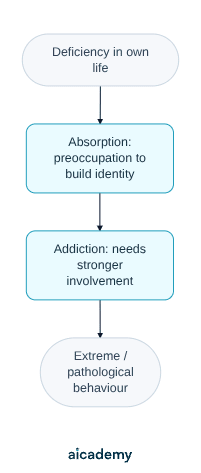
Escalating absorption and addiction are associated with poorer psychological functioning, including higher anxiety and depression, which is why the intense-personal level in particular is linked to lower wellbeing.
Key terms
- Self-disclosure
- The process of revealing personal information about oneself to another person, which builds intimacy in a developing relationship.
- Absence of gating
- The idea that online relationships lack the 'gates' (obstacles such as physical appearance, a stammer or shyness) that can prevent a face-to-face relationship forming.
- Hyperpersonal model
- Walther's theory that online relationships can be more intimate and develop faster than face-to-face ones because people selectively self-present an edited, positive version of themselves.
- Parasocial relationship
- A one-sided relationship in which a person directs emotional energy towards a media figure or celebrity who is unaware the person exists.
- Absorption-addiction model
- McCutcheon's explanation that parasocial relationships arise from deficiencies in a person's life, where absorption in a celebrity can escalate into addictive levels of involvement.
- Celebrity Attitude Scale
- McCutcheon's questionnaire measure that identifies three levels of parasocial relationship: entertainment-social, intense-personal and borderline-pathological.
Frequently asked questions
Reduced cues theory (Sproull and Kiesler) says online communication reduces self-disclosure because it lacks non-verbal cues. The hyperpersonal model (Walther) argues the opposite: online relationships can be more intimate and develop faster because people selectively self-present.
McCutcheon's Celebrity Attitude Scale identifies entertainment-social (casual interest for fun and gossip), intense-personal (deeper, obsessive feelings) and borderline-pathological (uncontrollable fantasies and extreme behaviour).
It says parasocial relationships stem from deficiencies in a person's own life. Absorption (preoccupation with a celebrity to build an identity) can escalate into addiction, where the person needs ever-stronger involvement to feel connected, linked to poorer psychological functioning.
Generate revision on any topic you study
Type any topic you're studying and Aicademy generates a complete lesson, quiz, and flashcard set, personalised to your level.
Lessons on anything
Structured, level-matched lessons on any topic you study
Practice quizzes
Find out what you actually know before the exam does
Flashcard sets
Lock in key concepts with instant revision cards
Ask Aica
Stuck on something? Get a clear explanation, any time
Theories of Romantic Relationships and Breakdown
Sex, Gender and Androgyny
Related lessons
9 min
Factors Affecting Attraction in Romantic Relationships
A-Level Psychology · AQA 7182
4 months ago
11 min
9 min
Explanations of Attachment: Learning Theory and Bowlby
A-Level Psychology · AQA 7182
4 months ago