Theories of Romantic Relationships and Breakdown

Aligned to the AQA 7182 specification
- Topic
- Relationships
- Level
- Intermediate
- Reading time
- 11 min
- Published
- 1 July 2026
- Updated
- 16 August 2026
On this page
Key takeaways
- Social exchange theory says we judge relationships by profit (rewards minus costs), a comparison level (what we expect) and a comparison level for alternatives (whether we could do better elsewhere).
- Equity theory adds that fairness matters, not just profit: partners are dissatisfied when the ratio of inputs to outputs is unequal, whether they over-benefit or under-benefit.
- Rusbult's investment model says commitment depends on satisfaction, comparison with alternatives and investment size; commitment, not satisfaction, explains why people stay in unsatisfying relationships.
- Duck's phase model describes breakdown as four phases, each crossing a threshold: intra-psychic, dyadic, social and grave-dressing.
- Comparison level (CL) is what you expect to receive; comparison level for alternatives (CLalt) is whether another option would give you more.
Worth saving these ideas?
Turn what you've read into instant revision cards. Free to get started.
Duck's Phase Model of Relationship Breakdown
Duck's phase model describes how a relationship falls apart as a sequence of four phases. Each phase begins only once a threshold (a point of realisation) is crossed, so the model is about the process of breaking up, not a single event.
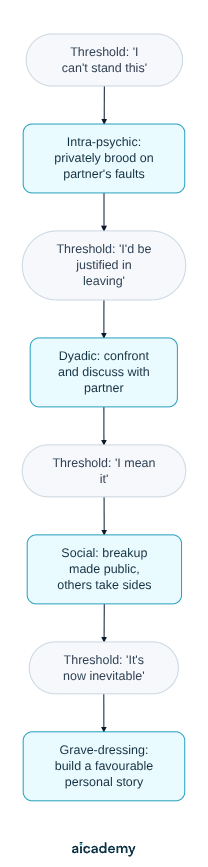
In the intra-psychic phase one partner privately broods on their dissatisfaction and the partner's faults, saying nothing. In the dyadic phase they confront the partner and discuss the problems, which may either resolve or deepen the conflict. In the social phase the breakup is made public: friends and family take sides, offer support and can push the couple apart or try to patch things up. In the grave-dressing phase the relationship is finalised and each partner constructs a favourable personal story about it ("I was a good partner; it just wasn't right"), protecting their reputation for future relationships. Rollie and Duck later added a fifth resurrection phase, in which ex-partners apply what they have learned to future relationships.
(Extra context — Rollie and Duck's fifth "resurrection" phase is a later revision. AQA's specification names the original four phases, so learn intra-psychic, dyadic, social and grave-dressing as the core model.)
Key terms
- Social exchange theory
- A theory that romantic relationships work like an economic exchange, in which partners try to maximise rewards and minimise costs to gain the greatest profit.
- Comparison level
- The standard of rewards a person expects from a relationship, based on past relationships and social norms; a relationship is judged worthwhile if it exceeds this level.
- Comparison level for alternatives
- A judgement of whether a person could gain a better outcome from an alternative partner or from being alone rather than staying in the current relationship.
- Equity theory
- A theory that partners are most satisfied when they perceive the ratio of their inputs to outputs as fair and roughly equal, rather than simply maximising profit.
- Investment model
- Rusbult's model in which commitment to a relationship depends on satisfaction, comparison with alternatives and the size of the investment already made.
- Duck's phase model
- A model of relationship breakdown as a sequence of four phases (intra-psychic, dyadic, social and grave-dressing), each beginning once a threshold of dissatisfaction is crossed.
Frequently asked questions
Social exchange theory says we try to maximise profit (rewards minus costs). Equity theory goes further: partners want fairness, so an equal ratio of inputs to outputs, not simply the biggest profit. Both over-benefitting and under-benefitting cause dissatisfaction.
Intra-psychic (privately brooding on the partner's faults), dyadic (confronting the partner), social (making the breakup public so friends and family get involved) and grave-dressing (finalising it and building a favourable personal story about the relationship).
Rusbult's investment model argues that commitment, not satisfaction, keeps people in relationships. High investment and a lack of attractive alternatives can produce strong commitment even when satisfaction is low, which helps explain why people stay in abusive relationships.
Generate revision on any topic you study
Type any topic you're studying and Aicademy generates a complete lesson, quiz, and flashcard set, personalised to your level.
Lessons on anything
Structured, level-matched lessons on any topic you study
Practice quizzes
Find out what you actually know before the exam does
Flashcard sets
Lock in key concepts with instant revision cards
Ask Aica
Stuck on something? Get a clear explanation, any time
Factors Affecting Attraction in Romantic Relationships
Virtual and Parasocial Relationships
Related lessons
9 min
Factors Affecting Attraction in Romantic Relationships
A-Level Psychology · AQA 7182
4 months ago
11 min