Factors Affecting Attraction in Romantic Relationships

Aligned to the AQA 7182 specification
- Topic
- Relationships
- Level
- Intermediate
- Reading time
- 9 min
- Published
- 1 July 2026
- Updated
- 16 August 2026
On this page
Key takeaways
- Self-disclosure is revealing personal information to a partner; social penetration theory (Altman & Taylor) says relationships develop through gradual, reciprocal disclosure that grows in breadth and depth.
- The halo effect (Dion et al.) means we assume physically attractive people also have other positive traits, summed up as 'what is beautiful is good'.
- The matching hypothesis (Walster et al.) says people tend to choose partners of a similar level of physical attractiveness to their own, balancing desire against the fear of rejection.
- Filter theory (Kerckhoff & Davis) narrows a field of availables to a field of desirables using three filters: social demography, similarity in attitudes, then complementarity.
- Similarity in attitudes matters most early in a relationship, while complementarity matters most in longer-term relationships.
How much of this have you taken in?
Quiz yourself on this section, free, no card needed.
Filter Theory
Filter theory (Kerckhoff & Davis, 1962) explains how we move from an enormous number of possible partners to the small number we actually consider. We start with a field of availables — everyone we could theoretically date — and narrow it to a field of desirables by passing candidates through a series of filters. The filters matter at different stages, in this order:
- Social demography — factors such as proximity, social class, education and religion. This filter operates first, narrowing the field to people we are realistically likely to meet and who share our background, so we tend to find them more familiar and similar.
- Similarity in attitudes and values — most important in the early stages of a relationship. Sharing core attitudes encourages deeper communication and self-disclosure; when partners have little in common, the relationship often stalls.
- Complementarity — the ability to meet each other's needs, so that the traits one partner lacks are supplied by the other ("opposites that fit"). This matters most in longer-term relationships, where feeling that together you form a whole strengthens commitment.
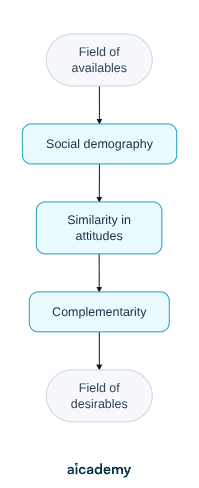
Remember the order by when each filter bites: demography decides who you meet, similarity of attitudes matters early, and complementarity matters later.
Key terms
- Self-disclosure
- Revealing personal, intimate information about yourself to a partner, which helps build trust and intimacy when it is reciprocated.
- Matching hypothesis
- The idea that people tend to form relationships with partners of a similar level of physical attractiveness to their own.
- Halo effect
- A cognitive bias in which we assume that physically attractive people also possess other positive characteristics, such as kindness or competence.
- Filter theory
- Kerckhoff and Davis's theory that we narrow a large field of available partners down to a field of desirables through a series of filters.
- Social demography
- Factors such as proximity, social class, education and religion that narrow the field of available partners to people we are likely to meet and find similar.
- Complementarity
- The extent to which two partners meet each other's needs, so that what one lacks the other provides; most important in longer-term relationships.
Frequently asked questions
The matching hypothesis (Walster et al., 1966) states that people tend to choose romantic partners whose physical attractiveness is similar to their own. It reflects a balance between wanting the most attractive partner and fearing rejection by someone seen as out of their league.
The order is social demography first, then similarity in attitudes and values, then complementarity. Social demography narrows who you meet, similarity matters most in the early stages, and complementarity matters most in longer-term relationships.
No. Self-disclosure specifically means revealing personal, intimate information about yourself. What matters is reciprocity and a gradual increase in breadth and depth of disclosure, not the sheer amount of conversation.
Generate revision on any topic you study
Type any topic you're studying and Aicademy generates a complete lesson, quiz, and flashcard set, personalised to your level.
Lessons on anything
Structured, level-matched lessons on any topic you study
Practice quizzes
Find out what you actually know before the exam does
Flashcard sets
Lock in key concepts with instant revision cards
Ask Aica
Stuck on something? Get a clear explanation, any time
Idiographic, Nomothetic Approaches and Ethical Implications
Theories of Romantic Relationships and Breakdown
Related lessons
11 min
11 min