Track progress, take quizzes and save notes on this lesson.

Free forever · no card needed

Start free
Intermediate

Piaget's Theory of Cognitive Development

4.3.4 Cognition and development

Aligned to the AQA 7182 specification

Level
Intermediate
Reading time
11 min
Published
1 July 2026
On this page
  1. 1.How Children Build Knowledge: Schemas
  2. 2.Assimilation and Accommodation
  3. 3.Equilibration: The Motivation to Learn
  4. 4.The Four Stages of Development
  5. 5.The Sensorimotor Stage and Object Permanence
  6. 6.The Pre-operational Stage: Three Key Limitations
  7. 7.Evaluation
  8. 8.Common Exam Mistakes

Key takeaways

  • Piaget saw children as active learners who build schemas — mental representations of the world — and learn by adjusting them through assimilation and accommodation.
  • Assimilation fits new information into an existing schema; accommodation changes or creates a schema when the information does not fit.
  • Equilibration is the drive to escape disequilibrium (the discomfort of information that will not fit) by accommodating, and it is what motivates learning.
  • The four stages are invariant in sequence: sensorimotor (0–2), pre-operational (2–7), concrete operational (7–11) and formal operational (11+).
  • Key stage markers are object permanence (sensorimotor), the mastery of conservation, egocentrism and class inclusion (pre-operational to concrete operational), and abstract reasoning (formal operational).

How Children Build Knowledge: Schemas

For Piaget, a child is not a passive recipient of information poured in by adults. The child is an active learner who constructs their own understanding of the world by interacting with it. The basic unit of that understanding is the schema.

A schema is a mental representation of the world — a package of knowledge about an object, action or concept, built up from experience. A baby has a "grasping" schema; an older child has a "dog" schema that bundles together fur, four legs and barking.

Schemas do two jobs at once:

  • They let the child interpret new experiences by matching them to what is already known.
  • They grow and change as the child meets things that do not fit.

A schema is a mental framework of knowledge. Cognitive development, for Piaget, is the process of building ever more sophisticated schemas.

Because the child builds these structures through their own activity, Piaget's is a constructivist theory: knowledge is constructed by the learner, not simply transmitted to them. The two processes that drive that construction are assimilation and accommodation.

Assimilation and Accommodation

New information is dealt with in one of two ways, and telling them apart is one of the most heavily tested distinctions in this topic.

Assimilation means incorporating new information into an existing schema. The schema itself does not change — the new experience simply slots into what the child already understands. A child with a "dog" schema who sees an unfamiliar breed and correctly calls it a dog has assimilated it.

Accommodation means changing an existing schema, or creating a new one, because the new information does not fit. The schema is restructured to cope. A child who calls a horse a "dog", is corrected, and then forms a separate "horse" schema has accommodated.

ProcessWhat happens to the schemaExample
AssimilationNo change — new item slots inSeeing a poodle and calling it a dog
AccommodationSchema changed or a new one madeLearning a cat is not a dog and forming a cat schema

Assimilation leaves the schema unchanged; accommodation changes it. If the schema had to be altered, it was accommodation.

Assimilation keeps the child's world stable; accommodation is where genuine learning and change happen.

Equilibration: The Motivation to Learn

Assimilation and accommodation explain how schemas change, but not why a child bothers to change them. That is the job of equilibration.

When a child meets new information that fits neatly into an existing schema, they are in a comfortable, balanced state of equilibrium. But when they meet something that cannot be assimilated — a fact that clashes with what they already believe — they experience disequilibrium, an unpleasant state of mental imbalance.

The child is motivated to escape this discomfort. Equilibration is the drive to move out of disequilibrium and back to equilibrium, and the only way to do that is to accommodate: to change the schema so the new information now fits.
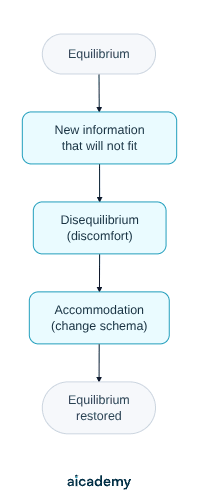
Disequilibrium is the engine of learning. Because it is unpleasant, the child is pushed to accommodate, and in doing so their schemas become more advanced.

This is why Piaget saw learning as something the child is intrinsically driven to do, rather than something that has to be forced on them.

The Four Stages of Development

Piaget argued that children pass through four stages of intellectual development. The stages are invariant in sequence — every child goes through them in the same fixed order — even though the ages attached to them are approximate rather than rigid.

StageApprox. ageWhat the child can doKey limitation or milestone
Sensorimotor0–2 yearsLearns through senses and physical actionsDevelops object permanence at around 8 months
Pre-operational2–7 yearsUses symbols and languageEgocentric; lacks conservation and class inclusion
Concrete operational7–11 yearsReasons logically about concrete objectsMasters conservation and class inclusion; struggles with abstract ideas
Formal operational11+ yearsReasons about abstract and hypothetical problemsAdult-like logical thought

The order of the stages never changes, but a child may reach a stage a little earlier or later than the stated age. Treat the ages as guides, not as fixed cut-offs.

The next two slides look closely at the two most heavily examined stages: the sensorimotor stage and, especially, the pre-operational stage.

How much of this have you taken in?

Quiz yourself on this section, free, no card needed.

Test myself

The Sensorimotor Stage and Object Permanence

In the sensorimotor stage (0–2 years), the infant understands the world only through their senses and their own physical actions — looking, grasping, sucking, moving. There is little internal thought; knowledge is tied directly to what the baby is doing right now.

The key achievement of this stage is object permanence: the understanding that objects continue to exist even when they cannot be seen, heard or touched. Piaget put its development at around 8 months.

Piaget tested this by showing a baby an interesting toy and then covering it with a blanket while the child watched:

  • Before about 8 months the infant loses interest the moment the toy is hidden, as if it had ceased to exist — out of sight is out of mind.
  • From about 8 months the infant will actively search for the hidden toy, showing they know it is still there.

Object permanence is the understanding that things still exist when out of view. Its arrival marks the point at which the infant can hold a mental representation of an absent object.

Without object permanence, the child cannot form stable schemas of objects that are not currently in front of them, so it is a crucial building block for everything that follows.

The Pre-operational Stage: Three Key Limitations

The pre-operational stage (2–7 years) is defined by what the child cannot yet do. The child can now use symbols and language, but their thinking is limited in three ways the exam expects you to describe with the correct study for each.

1. Egocentrism — the inability to see a situation from another person's point of view. Piaget and Inhelder demonstrated this with the three mountains task: a child sits at a model of three mountains and is asked what a doll seated on the opposite side can see. Pre-operational children typically choose the view they see, not the doll's — they cannot decentre from their own viewpoint.

2. Lack of conservation — the failure to understand that a quantity stays the same despite a change in its appearance. In the classic conservation of liquid task, water is poured from a short, wide glass into a tall, thin one. The pre-operational child says the tall glass has "more", fooled by the change in height. Conservation of number and volume can be tested the same way.

3. Lack of class inclusion — the failure to grasp that a subordinate class is contained within a superordinate one. Shown a set of wooden beads, most brown and a few white, and asked "are there more brown beads or more wooden beads?", the child answers "more brown beads" — they cannot hold the whole class ("wooden") and the sub-class ("brown") in mind at once.

LimitationPiaget's testTypical pre-operational error
EgocentrismThree mountains taskChooses their own view, not the doll's
Lack of conservationConservation of liquidSays the taller glass holds more
Lack of class inclusionWooden beads taskSays more brown beads than wooden beads

These limitations are overcome in the concrete operational stage (7–11 years), where the child masters conservation and class inclusion and reasons logically about concrete objects — though abstract, hypothetical reasoning does not arrive until the formal operational stage (11+ years).

Evaluation

A huge influence on education. Piaget's theory reshaped teaching. The idea that children construct knowledge through active discovery underpins child-centred, discovery learning, and his notion of readiness — that a child can only learn certain concepts once they have reached the relevant stage — influenced how curricula are sequenced. This real-world impact is a major strength.

Research may have underestimated children. Later studies suggest children can do things earlier than Piaget claimed. Hughes' policeman doll study found that when the task was made more meaningful, children as young as 3.5 could hide a doll from two policemen, showing they overcame egocentrism far earlier than the three mountains task implied. McGarrigle and Donaldson's "naughty teddy" study found children showed conservation earlier when a naughty teddy accidentally rearranged the counters, suggesting the deliberate change in the original task confused them. Baillargeon's violation-of-expectation research indicates object permanence appears well before 8 months. This undermines the ages, and sometimes the whole idea of discrete stages.

Methodological problems with the tasks. In the conservation task the child is asked the same question twice — once before and once after the change. Young children may reasonably assume that a repeated question means their first answer was wrong, and so change it. If so, Piaget's tasks underestimate children's true ability, meaning his method may have manufactured the very failures it reported.

Underplayed social and cultural factors. Piaget saw the child as a "lone scientist" discovering the world largely on their own. Vygotsky argued the opposite: cognitive development is fundamentally social, driven by interaction with more knowledgeable others and shaped by culture and language. Piaget's relative neglect of these factors is widely seen as a significant weakness of the theory.

A strong AO3 answer does more than name a study — it states what the study found and explains why that finding challenges or supports Piaget's specific claim.

Common Exam Mistakes

1. Mixing up assimilation and accommodation

Assimilation slots new information into an existing schema with no change to it; accommodation changes a schema or creates a new one. If the schema had to be altered, it is accommodation. Getting these the wrong way round is the single most common error on this topic.

2. Getting the four stages or their features out of order

The order is fixed: sensorimotor → pre-operational → concrete operational → formal operational. Object permanence belongs to the sensorimotor stage; abstract reasoning to the formal operational stage. Do not attach a milestone to the wrong stage.

3. Confusing conservation with class inclusion

Conservation is about quantity staying the same when appearance changes (water poured into a taller glass). Class inclusion is about a sub-class fitting inside a larger class (brown beads within wooden beads). They are tested with different tasks and are not interchangeable.

4. Treating the stage ages as rigid cut-offs

The sequence of stages is invariant, but the ages are approximate. Writing that a child must be pre-operational at exactly a given age misrepresents the theory. Say "around" the stated age.

5. Describing a study without linking it to Piaget's claim

Naming Hughes or McGarrigle and Donaldson earns little on its own. You must state the finding and explain what it shows — for example, that conservation appears earlier than Piaget claimed, so his task may have underestimated children.

Key terms

Schema
A mental representation of the world built from experience, used to organise and interpret new information.
Assimilation
Incorporating new information into an existing schema without changing that schema.
Accommodation
Changing an existing schema, or creating a new one, when new information does not fit what is already known.
Equilibration
The drive to escape the discomfort of disequilibrium and restore mental balance by accommodating new information.
Object permanence
The understanding that objects continue to exist even when they cannot be seen, developing at around eight months.
Conservation
The understanding that a quantity such as number, liquid or volume stays the same despite a change in its appearance.
Egocentrism
The inability to see a situation from another person's point of view, characteristic of the pre-operational stage.
Class inclusion
The understanding that a subordinate class is contained within a superordinate class, for example that brown beads are part of the larger set of wooden beads.

Frequently asked questions

Assimilation is fitting new information into an existing schema without changing it. Accommodation is changing an existing schema or creating a new one because the new information does not fit. A child calling every animal 'dog' is assimilating; learning that a cat is different is accommodating.

Sensorimotor (0–2 years), pre-operational (2–7 years), concrete operational (7–11 years) and formal operational (11+ years). Piaget argued the order is fixed and universal, though the ages are approximate.

Conservation is understanding that a quantity stays the same even when its appearance changes, such as pouring water into a taller, thinner glass. Pre-operational children lack it; children master it in the concrete operational stage.

Generate revision on any topic you study

Type any topic you're studying and Aicademy generates a complete lesson, quiz, and flashcard set, personalised to your level.

Lessons on anything

Structured, level-matched lessons on any topic you study

Practice quizzes

Find out what you actually know before the exam does

Flashcard sets

Lock in key concepts with instant revision cards

Ask Aica

Stuck on something? Get a clear explanation, any time

Prev

Social Learning Theory of Gender and Gender Incongruence

Next

Vygotsky and Baillargeon on Cognitive Development

Related lessons

Top students don’t revise more. They revise what counts.

Start revising free

Free to start. No card needed.