Track progress, take quizzes and save notes on this lesson.

Free forever · no card needed

Start free
Advanced

The Physiology of Stress and Stress-Related Illness

4.3.7 Stress

Aligned to the AQA 7182 specification

Topic
Stress
Level
Advanced
Reading time
9 min
Published
1 July 2026
On this page
  1. 1.What Stress Does to the Body
  2. 2.General Adaptation Syndrome (Selye)
  3. 3.Acute Stress: The Sympathomedullary Pathway
  4. 4.Chronic Stress: The HPA System
  5. 5.The Role of Stress in Illness
  6. 6.Evaluation (AO3)
  7. 7.Common Exam Mistakes

Key takeaways

  • General adaptation syndrome (Selye) describes the body's non-specific response to prolonged stress in three stages: alarm, resistance and exhaustion.
  • The sympathomedullary pathway handles acute stress fast: hypothalamus to sympathetic nervous system to adrenal medulla, releasing adrenaline and noradrenaline.
  • The hypothalamic-pituitary-adrenal system handles chronic stress slowly: hypothalamus releases CRH, pituitary releases ACTH, adrenal cortex releases cortisol.
  • Chronically high cortisol suppresses the immune system (immunosuppression), leaving the body more vulnerable to infection, as shown by Kiecolt-Glaser's research.
  • Chronic stress raises the risk of cardiovascular disorders such as hypertension and coronary heart disease, both directly and indirectly through unhealthy coping.

What Stress Does to the Body

Stress is the body's physiological response to a demand or threat that is perceived to exceed a person's ability to cope. When you meet a stressor, your body does not sit still: a chain of nervous and hormonal signals prepares you to act.

The physiology of stress splits into two questions, and AQA assesses both:

  • How does the body respond over time? This is described by Hans Selye's general adaptation syndrome (GAS).
  • Which biological pathways carry the response? There are two: a fast one for short bursts (the sympathomedullary pathway) and a slow one for ongoing pressure (the hypothalamic-pituitary-adrenal system).
FeatureAcute (short-term) stressChronic (ongoing) stress
PathwaySympathomedullary (SAM)Hypothalamic-pituitary-adrenal (HPA)
SpeedFast, secondsSlower, sustained
Key hormoneAdrenaline, noradrenalineCortisol
GlandAdrenal medullaAdrenal cortex

Stress is not simply "feeling worried". For this topic it is a measurable cascade of hormones and nervous activity — get the biology right and the marks follow.

General Adaptation Syndrome (Selye)

Hans Selye noticed that animals exposed to very different stressors (cold, injury, toxins) showed the same underlying bodily changes. He concluded that the body has a general, non-specific response to any prolonged stressor, which he called the general adaptation syndrome. It unfolds in three stages.

StageWhat happens in the body
1. AlarmA stressor triggers sympathetic arousal (fight-or-flight); adrenaline is released.
2. ResistanceThe body adapts and appears to cope, but is draining resources; cortisol stays elevated.
3. ExhaustionResources are depleted, the stress response can no longer be maintained, and stress-related illnesses appear.

The word non-specific is the important one: the same three-stage pattern appears no matter what the stressor is. During resistance a person may look and feel fine, which is deceptive, because their reserves are quietly being used up.

"Non-specific" means the physiological response is broadly the same regardless of the type of stressor. This is precisely the claim later researchers challenged (see the Evaluation slide).

Acute Stress: The Sympathomedullary Pathway

For a sudden threat you need an instant response, and the sympathomedullary pathway (SAM) delivers it. It runs through the nervous system, so it is fast-acting.

The sequence is: the hypothalamus activates the sympathetic branch of the autonomic nervous system (ANS), which stimulates the adrenal medulla (the inner part of the adrenal gland). The adrenal medulla releases adrenaline and noradrenaline into the bloodstream, producing rapid fight-or-flight changes.
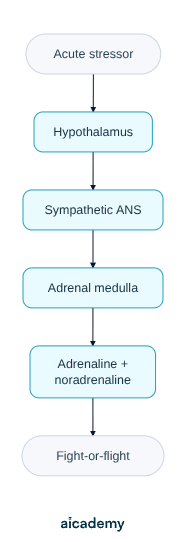
These hormones raise heart rate, redirect blood to the muscles, dilate the pupils and release stored glucose. Because the signal travels along nerves, the whole response fires within seconds. Once the threat passes, the parasympathetic branch of the ANS returns the body to rest.

Adrenaline (adrenal medulla) is the signature of the fast acute pathway. If a question stresses speed and fight-or-flight, this is the pathway to describe.

Chronic Stress: The HPA System

When a stressor persists for hours, days or weeks, a slower hormonal system takes over: the hypothalamic-pituitary-adrenal (HPA) system. It relies on hormones travelling through the blood rather than fast nerve impulses, so it is slower but sustained.

The sequence runs through three structures, each releasing a hormone that triggers the next:
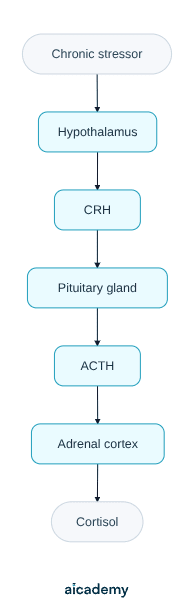
The hypothalamus releases CRH (corticotropin-releasing hormone), which tells the pituitary gland to release ACTH (adrenocorticotropic hormone). ACTH travels to the adrenal cortex (the outer part of the adrenal gland), which releases cortisol. Cortisol mobilises energy by raising blood glucose, keeping the body fuelled for a prolonged demand. But when cortisol stays high for a long time, it begins to cause harm, and that is where illness comes in.

Cortisol (adrenal cortex) is the signature of the slow, chronic HPA system. The name gives you the order: Hypothalamus, Pituitary, Adrenal.

Want more lessons like this one?

Generate lessons on anything you study. Free account, no card needed.

Start generating

The Role of Stress in Illness

The reason stress physiology matters clinically is that chronic activation of these systems damages health. AQA requires two named consequences: immunosuppression and cardiovascular disorders.

Immunosuppression. Chronically high cortisol reduces the activity of the immune system, a process called immunosuppression. With fewer active immune cells the body is more vulnerable to infection and heals more slowly.

  • Kiecolt-Glaser et al. (1984) measured medical students' immune function before and during exams. Natural killer (NK) cell activity was lower during the exam period, when stress was highest.
  • Kiecolt-Glaser et al. (1995) found that stressed participants (carers of relatives with dementia) took longer to heal from a small standardised wound than matched controls.

Cardiovascular disorders. Chronic stress repeatedly raises heart rate and blood pressure. Over time this damages blood vessels and increases the risk of hypertension (high blood pressure) and coronary heart disease (CHD). The link can be:

RouteHow stress harms the heart
DirectPhysiological wear: raised blood pressure damages vessel walls over time.
IndirectUnhealthy coping: stressed people may smoke more, drink more or eat poorly.

Note the direction of the cortisol effect. In the short term stress can prime the body, but chronic cortisol suppresses immunity. Writing that stress "boosts the immune system" loses marks.

Evaluation (AO3)

A strong answer weighs the physiological account rather than just describing it. Develop three or four points fully.

GAS is pioneering but based on animals. Selye's research used rats, so generalising to human psychological stress is uncertain, because humans appraise stressors cognitively in a way rats do not. His claim that the response is non-specific has also been challenged: Mason (1975) found that different stressors produced different patterns of hormone release, suggesting the response is more specific than Selye proposed.

The stress-illness link has strong supporting evidence, but limitations. Kiecolt-Glaser's controlled studies give solid support for immunosuppression. However, much of the wider evidence is correlational, so other factors (diet, exercise, genetics) may explain the illness rather than stress itself. There are also individual differences: the same stressor affects people's health very differently, which a purely physiological model struggles to explain.

Immunosuppression is not the whole story. Brief, acute stress can actually enhance immune function, preparing the body to deal with injury. The relationship is therefore more complex than "stress equals suppression" and depends on whether the stress is short-lived or chronic.

The physiological account is useful but reductionist: it downplays the psychological appraisal that decides whether an event is experienced as stressful in the first place. Two people meeting the same event may mount very different stress responses.

Common Exam Mistakes

1. Confusing the SAM pathway with the HPA system

The sympathomedullary pathway is fast, uses the sympathetic nervous system, and releases adrenaline from the adrenal medulla. The HPA system is slow, works through CRH and ACTH, and releases cortisol from the adrenal cortex. Swapping medulla and cortex, or adrenaline and cortisol, is the most common error here.

2. Getting the three GAS stages out of order

The order is always alarm → resistance → exhaustion. Illness appears in the exhaustion stage, once resources are depleted, not during alarm or resistance.

3. Saying cortisol boosts immunity

Chronically high cortisol suppresses the immune system. It is short-term acute stress that may briefly enhance immune function; sustained cortisol does the opposite.

4. Treating the stress-illness correlation as proven cause

Much of the evidence linking stress to illness is correlational. Say that stress is associated with raised illness risk, and note that lifestyle and other factors may contribute, rather than claiming stress definitively causes the illness.

5. Naming the wrong hormone chain in the HPA system

The order is hypothalamus → CRH → pituitary → ACTH → adrenal cortex → cortisol. Students often muddle CRH and ACTH or attach cortisol to the pituitary. Use the name as a memory aid: Hypothalamus, Pituitary, Adrenal.

Key terms

General adaptation syndrome
Selye's model of the body's general, non-specific response to any prolonged stressor, passing through alarm, resistance and exhaustion stages.
Sympathomedullary pathway
The acute stress response in which the hypothalamus activates the sympathetic nervous system and adrenal medulla to release adrenaline and noradrenaline.
Hypothalamic-pituitary-adrenal system
The chronic stress response in which the hypothalamus, pituitary gland and adrenal cortex act in sequence to release cortisol.
Cortisol
A stress hormone released by the adrenal cortex that mobilises energy by raising blood glucose but suppresses the immune system when chronically elevated.
Immunosuppression
The reduction in immune system activity caused by chronically high cortisol, leaving the body more vulnerable to infection.

Frequently asked questions

The sympathomedullary (SAM) pathway responds to acute stress: it is fast and releases adrenaline and noradrenaline from the adrenal medulla. The HPA system responds to chronic stress: it is slow and releases cortisol from the adrenal cortex.

Alarm (sympathetic fight-or-flight arousal and adrenaline release), resistance (the body adapts and appears to cope while draining resources), and exhaustion (resources are depleted and stress-related illness appears).

Chronic stress keeps cortisol high, which suppresses the immune system and leaves the body open to infection. It also raises heart rate and blood pressure, damaging blood vessels and increasing the risk of hypertension and coronary heart disease.

Generate revision on any topic you study

Type any topic you're studying and Aicademy generates a complete lesson, quiz, and flashcard set, personalised to your level.

Lessons on anything

Structured, level-matched lessons on any topic you study

Practice quizzes

Find out what you actually know before the exam does

Flashcard sets

Lock in key concepts with instant revision cards

Ask Aica

Stuck on something? Get a clear explanation, any time

Prev

Explanations for Obesity

Next

Sources of Stress and Measuring Stress

Related lessons

Top students don’t revise more. They revise what counts.

Start revising free

Free to start. No card needed.