Track progress, take quizzes and save notes on this lesson.

Free forever · no card needed

Start free
Intermediate

The Endocrine System and Fight or Flight

4.2.2 Biopsychology

Aligned to the AQA 7182 specification

Level
Intermediate
Reading time
9 min
Published
1 July 2026
On this page
  1. 1.What the Endocrine System Is
  2. 2.The Main Glands and Their Hormones
  3. 3.The Fight or Flight Response
  4. 4.The Role of Adrenaline
  5. 5.Evaluation
  6. 6.Common Exam Mistakes

Key takeaways

  • The endocrine system is a network of glands that secrete hormones directly into the bloodstream; compared with the nervous system its effects are slower to start but more widespread and longer-lasting.
  • The pituitary is the master gland, directed by the hypothalamus, and controls the release of hormones from other glands throughout the body.
  • In fight or flight the hypothalamus activates the sympathetic branch of the autonomic nervous system, which stimulates the adrenal medulla to release adrenaline into the bloodstream.
  • Adrenaline triggers rapid changes such as increased heart rate and breathing, dilated pupils, released glucose and inhibited digestion, preparing the body to fight or flee.
  • Once the threat passes, the parasympathetic branch returns the body to its resting state, sometimes called the rest and digest response.

What the Endocrine System Is

The endocrine system is a network of glands that secrete chemical messengers called hormones directly into the bloodstream. From there, hormones travel to target organs and cells, where they bind and alter the cell's activity, ultimately affecting behaviour.

A gland is an organ that produces and releases hormones. A hormone is the chemical messenger it releases. Because hormones move through the blood rather than along a fixed wire, they reach many parts of the body at once.

It helps to compare the endocrine system with the nervous system, since AQA often sets the two side by side:

FeatureNervous systemEndocrine system
Signal typeElectrical impulses along neuronsChemical hormones in the bloodstream
Speed of actionVery fast (milliseconds)Slower (seconds to minutes)
Spread of effectTargeted to specific cellsWidespread across the body
DurationShort-livedLonger-lasting

The endocrine system is slower to act than the nervous system, but its effects are more widespread and longer-lasting. This trade-off is a common exam comparison.

The two systems are not separate. They work together, and the pituitary gland links them by responding to signals from the brain.

The Main Glands and Their Hormones

You do not need every gland in the body, but you should recognise the major ones and, above all, the pituitary and adrenal glands, which drive the fight or flight response.

GlandKey hormone(s)Main effect
PituitaryControls release from other glandsThe "master gland" — directs the endocrine system
Adrenal medullaAdrenaline, noradrenalineTriggers fight or flight bodily changes
Adrenal cortexCortisolRegulates the longer-term stress response, metabolism
ThyroidThyroxineRegulates metabolism
OvariesOestrogenFemale reproductive development
TestesTestosteroneMale reproductive development
PancreasInsulinRegulates blood glucose

The pituitary gland is often called the master gland because it controls the release of hormones from many other glands. It does not act alone: it is directed by the hypothalamus, a region of the brain that links the nervous and endocrine systems.

The adrenal glands sit on top of the kidneys and have two parts. The adrenal medulla (the inner part) secretes adrenaline and noradrenaline. The adrenal cortex (the outer part) secretes cortisol.

Focus your revision on the pituitary (master gland, directed by the hypothalamus) and the adrenal medulla (source of adrenaline). These two are central to the fight or flight response that follows.

The Fight or Flight Response

When an acute stressor is perceived — a sudden threat such as a car swerving towards you — the body launches a rapid, coordinated reaction called the fight or flight response. It prepares you either to confront the danger or to escape it.

The route this response takes is the sympathomedullary pathway (often abbreviated to the SAM pathway, for sympathetic–adrenal–medullary). It runs in a fixed order:

  1. The hypothalamus identifies the threat.
  2. It activates the sympathetic branch of the autonomic nervous system.
  3. This stimulates the adrenal medulla to release adrenaline (and noradrenaline) into the bloodstream.
  4. Adrenaline triggers physiological changes across the body that prepare it to fight or flee.
  5. Once the threat passes, the parasympathetic branch returns the body to its resting state.
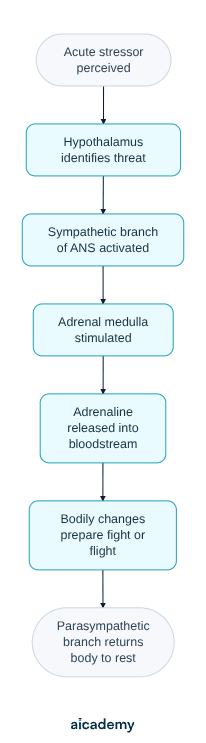
The key sequence to memorise is: stressor → hypothalamus → sympathetic branch → adrenal medulla → adrenaline → bodily changes. Adrenaline is released by the adrenal medulla, not the pituitary.

The Role of Adrenaline

Adrenaline is the key hormone of the fight or flight response. Released from the adrenal medulla into the bloodstream, it acts almost instantly to produce the physical changes that ready the body for sudden physical effort.

Each change has a survival purpose:

Bodily changeWhy it helps you fight or flee
Increased heart ratePumps oxygenated blood to muscles faster
Increased breathing rateTakes in more oxygen for respiration
Dilated pupilsLets in more light to improve vision of the threat
Release of stored glucoseSupplies fuel for a rapid burst of energy
Blood redirected to the musclesPrioritises the muscles needed for action
Inhibited digestionDiverts energy away from non-urgent processes
SweatingCools the body during exertion

Because adrenaline travels in the blood, these effects appear together within seconds. This is why the response feels so physical: a pounding heart, quick shallow breaths and a dry mouth as digestion shuts down.

When the danger has passed, the parasympathetic branch takes over and reverses these changes — slowing the heart, restarting digestion and returning the body to normal. This is often called the rest and digest response.

How much of this have you taken in?

Quiz yourself on this section, free, no card needed.

Test myself

Evaluation

Fight or flight is well supported, but AQA rewards a critical view. Weigh up its strengths and limitations.

Adaptive and evolutionary value. Fight or flight is widely seen as an adaptive survival mechanism. Ancestors who could respond to danger with a fast burst of energy were more likely to survive and reproduce, so the response is thought to have been naturally selected. This gives the model strong evolutionary plausibility.

A possible beta bias — the response may be androcentric. Much of the early research was conducted on males, and the fight or flight model was then generalised to everyone. Taylor et al. (2000) argued this ignores a distinct female response. They proposed a tend and befriend pattern, in which women under stress protect their offspring (tend) and form alliances with other women (befriend), possibly linked to the hormone oxytocin. If correct, the traditional model does not fully describe how women respond.

Fight or flight is not the only reaction — the freeze response. Gray (1988) argued that the first response to a threat is often not to fight or flee but to freeze: a state of hypervigilance in which the animal stops, stays alert and assesses the danger before acting. This suggests the model is incomplete because it leaves out an initial, and common, reaction to threat.

Negative consequences in modern life. The response evolved to handle acute, physical threats that were quickly resolved. Modern stressors — deadlines, money, relationships — are often chronic, repeatedly activating the same system. Prolonged activation is linked to health problems such as raised blood pressure and cardiovascular disease, so a once-adaptive response can become harmful.

A strong evaluation does not just list these points. Explain why each one strengthens or weakens the model, then reach a supported conclusion.

Common Exam Mistakes

1. Confusing the endocrine system with the nervous system

The endocrine system uses hormones carried in the blood, so it is slower but widespread and long-lasting. The nervous system uses electrical impulses along neurons, so it is fast, targeted and short-lived. Mixing up which system is fast and chemical loses easy comparison marks.

2. Saying adrenaline is released by the pituitary

Adrenaline comes from the adrenal medulla, not the pituitary. The pituitary is the master gland that controls other glands, but it is not the source of adrenaline in fight or flight.

3. Forgetting the parasympathetic return to rest

The response does not stop at the release of adrenaline. Once the threat passes, the parasympathetic branch returns the body to its resting state. Leaving this out gives an incomplete answer to a "describe the fight or flight response" question.

4. Treating fight or flight as universal

Fight or flight has been challenged. Taylor et al. (2000) proposed a tend and befriend response in women, and Gray (1988) argued the first reaction to threat is often to freeze. Presenting the model as the single, universal response to all stressors misses the evaluation the exam wants.

5. Describing the SAM pathway in the wrong order

The order is fixed: stressor → hypothalamus → sympathetic branch → adrenal medulla → adrenaline → bodily changes. Jumping straight from the hypothalamus to adrenaline, or omitting the sympathetic branch, breaks the causal chain examiners look for.

Key terms

Endocrine system
A network of glands that secrete chemical messengers called hormones directly into the bloodstream to affect target organs and behaviour.
Gland
An organ in the body that synthesises and secretes hormones into the bloodstream.
Hormone
A chemical messenger secreted by a gland that travels in the bloodstream to target cells and influences their activity.
Adrenaline
A hormone released by the adrenal medulla that produces the rapid bodily changes of the fight or flight response.
Fight or flight response
The body's rapid physiological reaction to an acute stressor, preparing it to either confront the threat or flee from it.
Sympathomedullary pathway
The route of the acute stress response, from the hypothalamus through the sympathetic nervous system to the adrenal medulla, which releases adrenaline.

Frequently asked questions

The nervous system sends fast electrical impulses along neurons for rapid, targeted, short-lived responses. The endocrine system releases hormones into the bloodstream, so it acts more slowly but its effects are widespread and longer-lasting.

Adrenaline is the hormone released by the adrenal medulla during fight or flight. It acts almost instantly to increase heart rate and breathing, redirect blood to the muscles, release stored glucose and dilate the pupils, preparing the body to fight or flee.

It is the route of the acute fight or flight response: the hypothalamus triggers the sympathetic branch of the autonomic nervous system, which stimulates the adrenal medulla to release adrenaline and noradrenaline into the bloodstream.

Generate revision on any topic you study

Type any topic you're studying and Aicademy generates a complete lesson, quiz, and flashcard set, personalised to your level.

Lessons on anything

Structured, level-matched lessons on any topic you study

Practice quizzes

Find out what you actually know before the exam does

Flashcard sets

Lock in key concepts with instant revision cards

Ask Aica

Stuck on something? Get a clear explanation, any time

Prev

Neurons and Synaptic Transmission

Next

Ways of Studying the Brain

Related lessons

11 min

Lesson

The Biological Approach

A-Level Psychology · AQA 7182

20 days ago

Top students don’t revise more. They revise what counts.

Start revising free

Free to start. No card needed.