Track progress, take quizzes and save notes on this lesson.

Free forever · no card needed

Start free
Intermediate

Neurons and Synaptic Transmission

4.2.2 Biopsychology

Aligned to the AQA 7182 specification

Level
Intermediate
Reading time
8 min
Published
1 July 2026
On this page
  1. 1.The Building Blocks: Neurons
  2. 2.The Three Types of Neuron
  3. 3.Electrical Transmission Within a Neuron
  4. 4.Synaptic Transmission: Crossing the Gap
  5. 5.Excitation and Inhibition
  6. 6.Common Exam Mistakes

Key takeaways

  • There are three types of neuron: sensory neurons carry impulses from receptors to the CNS, relay neurons connect neurons within the CNS, and motor neurons carry impulses from the CNS to effectors.
  • Within a single neuron the signal is electrical: at rest the inside is negatively charged (resting potential), and a stimulus briefly reverses this to fire an action potential down the axon.
  • Between neurons the signal is chemical: an action potential triggers vesicles to release neurotransmitters, which diffuse across the synaptic cleft and bind to receptors on the postsynaptic neuron.
  • Excitatory neurotransmitters (e.g. dopamine) make the postsynaptic neuron more likely to fire; inhibitory neurotransmitters (e.g. serotonin, GABA) make it less likely to fire.
  • Summation is the process by which the net effect of all excitatory and inhibitory signals is added up to decide whether the postsynaptic neuron actually fires.

The Building Blocks: Neurons

The nervous system communicates using neurons — specialised cells that transmit signals electrically along their length and chemically to other neurons. The human nervous system contains roughly 86 billion of them, and understanding their structure is the foundation for everything in this topic.

Although neurons vary in shape, they share the same basic parts:

  • Cell body — contains the nucleus and the genetic material of the cell.
  • Dendrites — branch-like extensions that receive signals from other neurons and carry them towards the cell body.
  • Axon — the long fibre that carries the electrical impulse away from the cell body.
  • Myelin sheath — a fatty layer that insulates the axon and speeds up transmission.
  • Nodes of Ranvier — gaps in the myelin sheath that force the impulse to jump along the axon, speeding it up further.
  • Terminal buttons — the end of the axon, where the signal is passed on to the next neuron.

A neuron works in two ways at once: the signal travels electrically along the axon within a single neuron, but passes chemically between one neuron and the next.

The Three Types of Neuron

The specification names three types of neuron, each with a distinct job and a distinct structure. The differences in the length of their dendrites and axons reflect the distances the signal has to travel.

NeuronDirection of impulseLocationDendritesAxons
SensoryFrom sensory receptors to the CNSCell body in the PNSLongShort
RelayBetween neurons (connects sensory to motor)Within the CNSShortShort
MotorFrom the CNS to effectors (muscles/glands)Cell body in the CNSShortLong

Sensory neurons carry impulses from the sensory receptors (in the eyes, skin, ears and so on) of the peripheral nervous system (PNS) towards the central nervous system (CNS). They have long dendrites and short axons.

Relay neurons connect sensory neurons to motor neurons, or to other relay neurons. They lie entirely within the CNS and have short dendrites and short axons.

Motor neurons carry impulses from the CNS to effectors — the muscles and glands that produce a response. They have short dendrites and long axons that reach out to the effector.

A quick memory aid: sensory neurons sense the world and carry the message in; motor neurons put the body in motion by carrying the message out; relay neurons sit in the middle and pass it along.

Electrical Transmission Within a Neuron

Before a neuron can pass a message to its neighbour, the signal has to travel along its own length. This happens electrically, and it depends on the charge inside the neuron changing.

When a neuron is not firing, it is at its resting potential: the inside of the cell is negatively charged relative to the outside. The neuron is switched on but idle, ready to respond.

When the neuron is activated by a stimulus of sufficient strength, the charge inside the cell briefly reverses and becomes positive. This momentary reversal is called an action potential — the electrical impulse itself.

The action potential then travels as a wave down the length of the axon, from the cell body towards the terminal buttons at the end. The myelin sheath and nodes of Ranvier speed this journey up.

Key sequence within one neuron: resting potential (inside negative) → stimulusaction potential (charge reverses) → impulse travels down the axon to the terminal buttons.

Once the action potential reaches the terminal buttons, it has run out of neuron to travel along. To reach the next cell, the signal must cross a gap — and here it stops being electrical.

Synaptic Transmission: Crossing the Gap

Neurons do not physically touch. Where the terminal button of one neuron meets the next there is a tiny gap called the synapse, and the space itself is the synaptic cleft. The electrical impulse cannot cross this gap on its own, so the signal is passed across chemically.

The process happens in a fixed order:

  1. The action potential arrives at the presynaptic terminal (the terminal button of the first neuron).
  2. This triggers synaptic vesicles — tiny sacs — to release neurotransmitters into the synaptic cleft.
  3. The neurotransmitter diffuses across the gap.
  4. It binds to specialised receptors on the membrane of the postsynaptic neuron.
  5. This is converted back into a new electrical impulse (or influences whether one is fired).
  6. The neurotransmitter is then cleared away, either by reuptake into the presynaptic neuron or by being broken down.
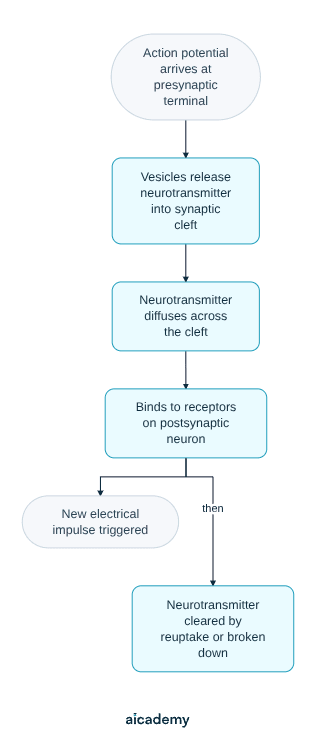
Because vesicles that release neurotransmitters are only on the presynaptic side and receptors are only on the postsynaptic side, synaptic transmission runs in one direction only — from the presynaptic to the postsynaptic neuron.

Studying this for an exam?

Generate a personalised learning path for this subject. Free to get started.

Create a learning path

Excitation and Inhibition

When a neurotransmitter binds to the postsynaptic receptors, it changes the charge of the postsynaptic neuron. Whether this makes the next neuron more or less likely to fire depends on the type of neurotransmitter.

EffectWhat it does to the postsynaptic neuronResultExamples
ExcitatoryMakes it more positively chargedMore likely to fireAdrenaline, dopamine
InhibitoryMakes it more negatively chargedLess likely to fireSerotonin, GABA

Excitatory neurotransmitters create an excitatory postsynaptic potential (EPSP): they increase the positive charge of the postsynaptic neuron, pushing it closer to firing an action potential of its own.

Inhibitory neurotransmitters create an inhibitory postsynaptic potential (IPSP): they increase the negative charge, pushing the neuron away from firing.

Most neurotransmitters are not simply one or the other in every situation, so a single postsynaptic neuron is receiving many signals at once — some excitatory, some inhibitory.

Whether the postsynaptic neuron actually fires depends on summation: the net sum of all the excitatory and inhibitory influences it receives. If the excitatory signals outweigh the inhibitory ones and the combined effect passes the threshold, an action potential is triggered; if not, the neuron stays at rest.

This adding-up is what allows the nervous system to make fine decisions rather than firing every time it receives any signal at all.

Common Exam Mistakes

1. Saying the electrical impulse "jumps" the synapse

The signal does not cross the synapse electrically. The impulse is electrical within a neuron, but at the synapse it stops; a chemical neurotransmitter is released, diffuses across the cleft, and binds to receptors to start a new impulse. Describing it as an electrical signal leaping the gap loses marks.

2. Mixing up the direction of sensory, relay and motor neurons

Sensory neurons carry impulses towards the CNS; motor neurons carry them away from the CNS to effectors; relay neurons connect them within the CNS. A reliable check: sensory carries in, motor carries out to put the body in motion.

3. Forgetting that synaptic transmission is one-directional

Neurotransmitters are released only from the presynaptic neuron and receptors sit only on the postsynaptic neuron, so signals travel one way across the synapse. Do not describe neurotransmitters crossing back the other way.

4. Treating all neurotransmitters as excitatory

Not every neurotransmitter makes a neuron fire. Inhibitory neurotransmitters such as serotonin and GABA make the postsynaptic neuron less likely to fire. A full answer names both excitation and inhibition and explains that the outcome depends on summation.

5. Confusing the synapse structure

The synapse is the whole junction; the synaptic cleft is the gap itself. The presynaptic neuron sends the signal and the postsynaptic neuron receives it. Vesicles and neurotransmitters are on the presynaptic side; receptors are on the postsynaptic side.

Key terms

Sensory neuron
A neuron that carries nerve impulses from sensory receptors in the peripheral nervous system towards the central nervous system.
Relay neuron
A neuron that lies within the central nervous system and connects sensory neurons to motor neurons.
Motor neuron
A neuron that carries nerve impulses from the central nervous system to effectors such as muscles and glands.
Synapse
The junction between two neurons, consisting of the presynaptic terminal, the synaptic cleft (gap) and the postsynaptic membrane, across which signals pass chemically.
Neurotransmitter
A chemical released from synaptic vesicles that diffuses across the synaptic cleft and binds to receptors on the postsynaptic neuron to transmit the signal.
Excitation
The process by which a neurotransmitter makes the postsynaptic neuron more positively charged and more likely to fire an action potential.
Inhibition
The process by which a neurotransmitter makes the postsynaptic neuron more negatively charged and less likely to fire an action potential.

Frequently asked questions

Sensory neurons carry impulses from sensory receptors to the CNS, relay neurons connect sensory and motor neurons within the CNS, and motor neurons carry impulses from the CNS to effectors such as muscles and glands.

The signal crosses chemically. An action potential triggers vesicles to release neurotransmitters into the synaptic cleft; these diffuse across the gap and bind to receptors on the postsynaptic neuron, where they are converted back into a new electrical impulse.

Excitatory neurotransmitters make the postsynaptic neuron more positively charged and more likely to fire, while inhibitory neurotransmitters make it more negatively charged and less likely to fire. Whether it fires depends on the net sum of the two.

Generate revision on any topic you study

Type any topic you're studying and Aicademy generates a complete lesson, quiz, and flashcard set, personalised to your level.

Lessons on anything

Structured, level-matched lessons on any topic you study

Practice quizzes

Find out what you actually know before the exam does

Flashcard sets

Lock in key concepts with instant revision cards

Ask Aica

Stuck on something? Get a clear explanation, any time

Prev

Divisions of the Nervous System

Next

The Endocrine System and Fight or Flight

Related lessons

10 min

Top students don’t revise more. They revise what counts.

Start revising free

Free to start. No card needed.