Divisions of the Nervous System

Aligned to the AQA 7182 specification
- Topic
- Biopsychology
- Level
- Intermediate
- Reading time
- 9 min
- Published
- 1 July 2026
- Updated
- 16 August 2026
On this page
Key takeaways
- The nervous system has two main divisions: the central nervous system (brain and spinal cord) and the peripheral nervous system (all the nerves outside it).
- The peripheral nervous system splits into the somatic nervous system, which controls voluntary movement, and the autonomic nervous system, which controls involuntary vital functions.
- The autonomic nervous system divides into the sympathetic branch, which arouses the body for fight or flight, and the parasympathetic branch, which calms it for rest and digest.
- The spinal cord is part of the central nervous system, not the peripheral nervous system, and it controls reflex actions as well as relaying messages to and from the brain.
- The somatic system carries sensory information to the CNS and motor commands to skeletal muscles; the autonomic system runs the internal organs without conscious control.
Studying this for an exam?
Generate a personalised learning path for this subject. Free to get started.
The Full Hierarchy
Because this topic is all about structure, the clearest way to hold it in memory is as a single branching tree. Every division you have met slots into one place, from the whole nervous system at the top down to the two branches of the ANS at the bottom.
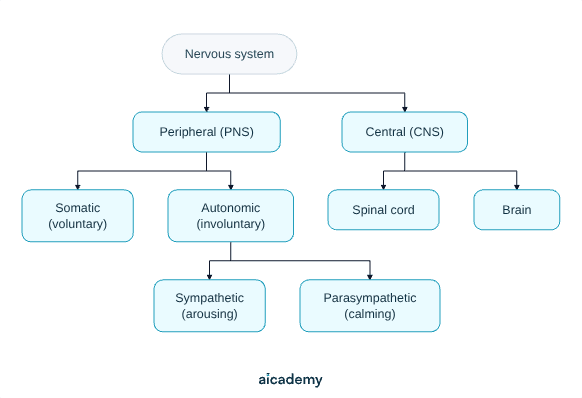
Read it top to bottom: the nervous system splits into CNS and PNS; the CNS is brain plus spinal cord; the PNS splits into somatic and autonomic; and the autonomic splits into sympathetic and parasympathetic. If you can reproduce this tree, you can answer almost any structural question on this part of the spec.
Key terms
- Central nervous system
- The brain and the spinal cord; the centre of conscious awareness and the structure that processes information and coordinates the body's responses.
- Peripheral nervous system
- All the nerves outside the central nervous system, which transmit messages to and from the CNS via the somatic and autonomic systems.
- Somatic nervous system
- The division of the peripheral nervous system that controls voluntary movement, carrying sensory information to the CNS and motor commands to skeletal muscles.
- Autonomic nervous system
- The division of the peripheral nervous system that controls involuntary, vital functions such as heart rate, breathing and digestion.
- Sympathetic nervous system
- The branch of the autonomic nervous system that arouses the body and prepares it for action (fight or flight).
- Parasympathetic nervous system
- The branch of the autonomic nervous system that calms the body, conserves energy and returns it to a resting state (rest and digest).
Frequently asked questions
The two main divisions are the central nervous system (CNS), made up of the brain and spinal cord, and the peripheral nervous system (PNS), which is all the nerves outside the CNS. The PNS then splits into the somatic and autonomic systems.
The somatic nervous system controls voluntary movement, carrying sensory information to the CNS and motor commands to skeletal muscles. The autonomic nervous system controls involuntary functions such as heart rate, breathing and digestion, without conscious control.
The sympathetic branch arouses the body for action (fight or flight), raising heart rate and dilating pupils. The parasympathetic branch calms the body (rest and digest), slowing heart rate and stimulating digestion. They are antagonistic, working in opposition.
Generate revision on any topic you study
Type any topic you're studying and Aicademy generates a complete lesson, quiz, and flashcard set, personalised to your level.
Lessons on anything
Structured, level-matched lessons on any topic you study
Practice quizzes
Find out what you actually know before the exam does
Flashcard sets
Lock in key concepts with instant revision cards
Ask Aica
Stuck on something? Get a clear explanation, any time
Humanistic Psychology and Comparison of Approaches
Neurons and Synaptic Transmission
Related lessons
8 min
9 min
10 min
11 min