Track progress, take quizzes and save notes on this lesson.

Free forever · no card needed

Start free
Intermediate

Free Will and Determinism

4.3.1 Issues and debates in Psychology

Aligned to the AQA 7182 specification

Level
Intermediate
Reading time
9 min
Published
1 July 2026
On this page
  1. 1.What Free Will Means
  2. 2.What Determinism Means
  3. 3.The Three Types of Determinism
  4. 4.The Scientific Emphasis on Causal Explanations
  5. 5.Evaluation: Free Will and Determinism
  6. 6.Common Exam Mistakes

Key takeaways

  • Free will is the idea that humans are self-determining and can make their own choices; the humanistic approach argues for free will.
  • Determinism is the view that behaviour is caused by internal or external factors beyond our control, so behaviour is predictable rather than chosen.
  • Hard determinism says free will is an illusion and all behaviour is caused; soft determinism (James) says behaviour is constrained but people still make conscious choices, so the two positions are compatible.
  • The three types of determinism are biological (genes, hormones, neurotransmitters), environmental (conditioning and reinforcement, Skinner) and psychic (unconscious conflicts and early experience, Freud).
  • Libet et al. found the brain's readiness potential appeared before participants were consciously aware of deciding to move, which challenges the idea of conscious free will.

What Free Will Means

Free will is the idea that humans are able to make their own choices and are self-determining. On this view, our behaviour is not controlled by internal biology or external circumstances: we are the authors of what we do, and we could have acted otherwise.

This does not mean free will ignores biology and environment altogether. It means that, even with those influences present, a person can reject or override them and choose a course of action for themselves.

The humanistic approach is the clearest advocate of free will in psychology. Humanistic psychologists such as Rogers and Maslow argue that people are active agents who shape their own development. Healthy growth, in this view, depends on taking personal responsibility for your choices rather than seeing yourself as the product of forces you cannot control.

Free will: the idea that we are able to make our own choices and are self-determining, not controlled by internal or external forces. The humanistic approach argues for free will.

Because free will is a synoptic issue (Paper 3, Section A), you are expected to illustrate it using topics from across the specification, not to discuss it in the abstract.

What Determinism Means

Determinism is the opposing view: that behaviour is caused or determined by internal or external factors that are beyond the individual's control. If behaviour is caused, then in principle it is predictable, and the sense that we freely chose it is a description of the experience rather than the cause of the action.

Determinism comes in two strengths, and telling them apart is where most marks are won or lost.

PositionCore claimIs free will possible?Fits which approach
Hard determinismAll behaviour has a cause; free will is an illusionNo — free will does not existBehaviourist, biological
Soft determinismBehaviour is constrained by causes but conscious choice remainsYes, within limitsCognitive

Hard determinism (also called incompatibilism) holds that every action is the inevitable result of prior causes. Free will is an illusion: it feels as if we choose, but the choice was already fixed by biology, environment or the unconscious.

Soft determinism, argued by the psychologist and philosopher William James, holds that behaviour is constrained by internal and external forces but people can still exercise conscious choice within those constraints. Free will and determinism are therefore compatible — this is why soft determinism is described as a compatibilist position, and the cognitive approach fits it well.

Soft determinism is not the same as free will. It still accepts that behaviour has causes; it simply allows room for conscious choice inside those causes.

The Three Types of Determinism

Determinism also comes in three flavours, sorted by where the cause is located. Each maps onto an approach you have already studied, so learning the pairing gives you ready-made synoptic examples.

TypeBehaviour is caused byKey figure / approachCourse example
Biological determinismGenes, brain structure, hormones, neurotransmittersBiological approachThe MAOA "warrior gene" linked to aggression; low serotonin linked to OCD
Environmental determinismConditioning and features of the environment (reinforcement history)Skinner, behaviourist approachA phobia acquired through classical conditioning and maintained by avoidance
Psychic determinismUnconscious conflicts and early childhood experiencesFreud, psychodynamic approachAdult behaviour driven by fixation at an unresolved psychosexual stage

Biological determinism explains behaviour through factors inside the body: inherited genes, the structure and activity of the brain, hormone levels and neurotransmitters. For example, the influence of dopamine and serotonin on mood is a biologically determinist claim.

Environmental determinism locates the cause outside the person, in their history of conditioning. Skinner described free will as "an illusion" and argued that all behaviour is the product of a lifetime of reinforcement: we do what we have been rewarded for doing.

Psychic determinism places the cause in the unconscious mind. Freud argued that there are no accidents in behaviour, not even slips of the tongue; adult actions are driven by unconscious conflicts and early experiences we cannot access or control.

The Scientific Emphasis on Causal Explanations

Determinism is tightly linked to the aims of science. A basic assumption of science is that every event has a cause that can, in principle, be identified. Psychology has largely modelled itself on the natural sciences, which is one reason determinism has been so influential in the subject.

The tool that delivers causal explanations is the controlled laboratory experiment. By manipulating an independent variable (IV) while holding everything else constant, a researcher can measure its effect on a dependent variable (DV) and establish cause and effect.
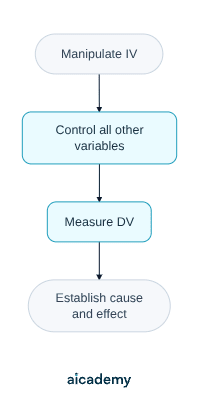
If behaviour has predictable causes, it can be studied this way, predicted and even controlled — for example, using drug treatments that target the neurotransmitters thought to cause a disorder. Free will, by contrast, is far harder to fit into this model, because a genuinely free choice has no prior cause to isolate.

Determinism suits the scientific method: it assumes behaviour is caused, and causes can be isolated, measured and predicted in controlled conditions.

Worth saving these ideas?

Turn what you've read into instant revision cards. Free to get started.

Make flashcards

Evaluation: Free Will and Determinism

Examiners reward developed AO3 points that weigh both sides. Below are four you can use, each anchored to research from across the course.

Free will has face validity and practical value. The idea that we choose our actions matches everyday experience, which gives it intuitive strength. It may also benefit mental health: people with an internal locus of control (a belief that they determine their own outcomes) tend to be more resilient and, in social influence research, better able to resist pressure to conform or obey. Believing you have choice appears to be good for you, which counts in free will's favour.

Free will is hard to test scientifically, and neuroscience challenges it. Because a free choice has no measurable cause, free will resists empirical study. Libet et al. (1983) asked participants to flick their wrist whenever they chose while their brain activity was recorded. The readiness potential — the brain activity preparing the movement — appeared around half a second before participants reported being consciously aware of deciding to move. This suggests the decision may be determined at a neural level before we experience choosing it.

Libet's findings are debated. Some argue the conscious mind can still "veto" an action after the readiness potential begins, so the study does not fully disprove free will — but it does challenge the idea that conscious choice starts the action.

Determinism is consistent with science, but hard determinism has troubling implications. Its causal stance allows prediction and control, as seen in drug treatments for disorders like OCD and depression. However, hard determinism clashes with the principle of moral and legal responsibility: if a person's behaviour is entirely determined, it becomes difficult to argue they should be held accountable for it. Courts, which assume people choose their actions, do not accept "my brain made me do it" as a defence.

Soft determinism may be the most reasonable position. An interactionist stance that accepts behaviour has causes while allowing conscious choice within those constraints avoids the extremes. It fits how most psychologists actually work: they look for causes of behaviour without denying that people deliberate and decide.

Common Exam Mistakes

1. Confusing the three types of determinism

Biological, environmental and psychic determinism differ only in where the cause sits: inside the body (genes, hormones, neurotransmitters), in the environment (conditioning and reinforcement), or in the unconscious mind (early experience). Mixing them up, or giving Skinner's reinforcement as an example of biological determinism, loses easy marks. Learn one clear example for each.

2. Treating soft determinism as the same as free will

Soft determinism still says behaviour is caused; it only adds that conscious choice operates within those causes. It is a form of determinism, not a version of free will. Describing it as "free will with a different name" misrepresents the position.

3. Not linking approaches to positions

Each approach takes a stance, and naming the link earns synoptic credit:

ApproachPosition on the debate
HumanisticFree will
BehaviouristEnvironmental determinism
BiologicalBiological determinism
PsychodynamicPsychic determinism
CognitiveSoft determinism

Forgetting these pairings makes an answer vague and general when the question rewards specific illustration.

4. Not using the Libet evidence

Evaluation questions want research, not just opinion. Libet et al.'s readiness potential is the standard evidence that decisions may be determined before we are consciously aware of them. An answer that argues about free will without any evidence stays at a lower level than one that cites Libet.

5. Treating determinism as a synonym for biology

Determinism is a broad debate, not a synonym for the biological approach. Environmental and psychic determinism are just as determinist as biological determinism. Reducing the whole debate to genes and brains ignores two-thirds of the specification content.

Key terms

Free will
The idea that humans are able to make their own choices and are self-determining, rather than being controlled by internal or external forces.
Determinism
The view that an individual's behaviour is caused or determined by internal or external factors that are beyond their control.
Hard determinism
The view that all behaviour has a cause and free will is an illusion, so every action is entirely determined by internal or external forces.
Soft determinism
The view, associated with William James, that behaviour is constrained by causes but people can still exercise some conscious choice, making free will and determinism compatible.
Biological determinism
The view that behaviour is caused by biological factors such as genes, brain structure, hormones and neurotransmitters.
Environmental determinism
The view that behaviour is caused by conditioning and features of the environment, such as an individual's history of reinforcement.
Psychic determinism
The view that behaviour is caused by unconscious conflicts and early childhood experiences that we cannot control.

Frequently asked questions

Hard determinism says all behaviour is caused and free will is an illusion, so choice does not exist. Soft determinism, associated with William James, says behaviour is constrained by causes but people can still exercise conscious choice within those limits, so free will and determinism are compatible.

Biological determinism explains behaviour through genes, brain structure, hormones and neurotransmitters. Environmental determinism explains it through conditioning and reinforcement (Skinner). Psychic determinism explains it through unconscious conflicts and early childhood experiences (Freud).

Science assumes every event has a cause, and controlled lab experiments isolate causes by manipulating an independent variable to measure its effect on a dependent variable. Because determinism fits this causal, predictable model, it aligns with psychology's scientific aims.

Generate revision on any topic you study

Type any topic you're studying and Aicademy generates a complete lesson, quiz, and flashcard set, personalised to your level.

Lessons on anything

Structured, level-matched lessons on any topic you study

Practice quizzes

Find out what you actually know before the exam does

Flashcard sets

Lock in key concepts with instant revision cards

Ask Aica

Stuck on something? Get a clear explanation, any time

Prev

Gender and Culture Bias

Next

The Nature-Nurture Debate

Related lessons

Top students don’t revise more. They revise what counts.

Start revising free

Free to start. No card needed.